The communal violence at Sambhal on November 24, 2024, was the result of a “calculated criminal conspiracy” that was targeted at obstructing a court-ordered survey of the disputed Jama Masjid-Hari Har Mandir site, and not a spontaneous reaction, according to a report of the judicial inquiry commission set up by the Uttar Pradesh government to investigate the issue that was tabled in the state assembly on Wednesday.
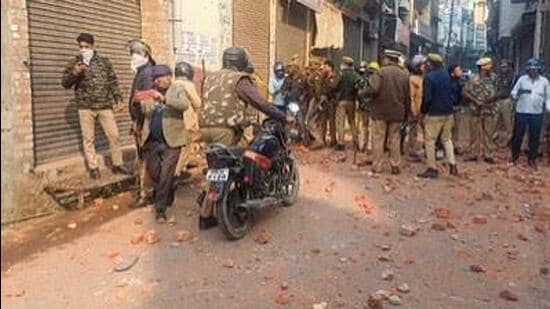
Four people died in the violence.
The dispute over the religious nature of the site itself is in a state of suspension with an interim order of the Supreme Court staying proceedings in a lower court till it (the Supreme Court) considers broader issues related to the Places of Worship Act of 1991.
Following the violence, the state set up a three-member commission, headed by Justice Devendra Kumar Arora, a former Allahabad high court judge, with retired IAS officer Amit Mohan Prasad and retired IPS officer Arvind Kumar Jain as members to determine whether the violence was sudden or pre-planned, examine the preparedness of the administration and police, and recommend measures to prevent similar incidents.
Tracing the background of the incident, the report said the civil judge at Chandausi on November 19, 2024 ordered a survey of the disputed religious structure after Hindu litigants claimed the Jama Masjid was built over the ancient Hari Har Temple. Acting on the order, the advocate commissioner sought adequate police deployment to ensure peaceful execution of the survey.
The commission, however, drew a clear distinction between the survey and the violence, stating that the judicial order merely triggered the sequence of events while the violence was the culmination of prior planning and mobilisation. On November 24, 2024, violence erupted during a second round of the survey.
{{/usCountry}}The commission, however, drew a clear distinction between the survey and the violence, stating that the judicial order merely triggered the sequence of events while the violence was the culmination of prior planning and mobilisation. On November 24, 2024, violence erupted during a second round of the survey.
{{/usCountry}}According to the report, a large crowd gathered around the mosque as the survey commenced. Protesters raised slogans against the exercise and repeatedly attempted to enter the mosque despite police explaining that the survey was being conducted under court orders.
The crowd allegedly ignored repeated persuasion, resorted to large-scale stone-pelting, opened fire on security personnel and set police and private vehicles ablaze, the report added.
The organised mobilisation, coordinated attempts to stop the survey, attacks on police using firearms and subsequent arson bore all the hallmarks of a planned conspiracy aimed at challenging the authority of the courts and the state administration, the commission’s report said.
The panel also examined whether the district administration and police had made adequate preparations. It reconstructed the deployment of personnel, weapons issued and ammunition used, recording that police initially adopted calibrated crowd-control measures, including warning shots from service pistols and pump-action guns, tear-gas shells, anti-riot equipment, rubber bullets and pepper bombs before bringing the situation under control. It also scrutinised the chain of command and operational decisions taken during the violence.
The report documented that four civilians were killed and several others injured, including several police personnel. It listed those killed, the locations where their bodies were recovered and linked each death to the corresponding criminal case, besides cataloguing injured persons and related FIRs.
Describing the exercise as one of the most exhaustive inquiries into the incident, the commission said it examined statements of police officers, civil administrators, litigants, advocates representing both sides in the title dispute, members of the Jama Masjid Intezamia Committee, eyewitnesses and journalists.
It also relied on FIRs, medical records, post-mortem reports, forensic science laboratory findings, ballistic evidence and other material. The final report comprised two main volumes and six additional volumes containing affidavits, witness statements and supporting evidence.
Concluding that the Sambhal violence was not merely a breakdown of public order but a deliberate attempt to prevent the implementation of a judicial order, the panel said the disturbances were the product of careful planning rather than a spontaneous outbreak of communal unrest.
Zia-ur-Rehman Barq, the Samajwadi Party MP from Sambhal, rejected the judicial inquiry commission’s report. He dismissed the findings as “wrong,” and accused the government of using the report to polarise the public ahead of elections. Assembly elections are due in the state early next year.
“We will take legal opinion and will probably challenge it in the high court,” he said.
Rajesh Chaudhary, BJP MLA and state general secretary, said the commission’s report on the Sambhal violence was “fact-based” and accused the Samajwadi Party of trying to evade its findings because its local leaders were involved. He alleged that SP leaders had illegally grabbed land in Sambhal. “We challenge the SP to debate the findings of the commission’s report with us,” he said.
Responding to the report, Uttar Pradesh Congress chief Ajay Rai said if it was a conspiracy, then it was also the failure of the intelligence agencies and the state government. “If there was a conspiracy, what was the state’s intelligence doing? They failed and so did the government,” he said.
SP MP Zia-ur-Rehman Barq, others named
The three-member judicial inquiry commission has named Samajwadi Party MP Zia-ur-Rehman Barq and several others for their alleged role in provoking and orchestrating the unrest. The 857-page report, tabled in the Uttar Pradesh legislature on Wednesday, identifies Barq, Sohail Iqbal—son of the Sambhal MLA—Jama Masjid Intazamia Committee president Zafar Ali, advocates Qasim Jamal and Mashhood Ali Farooqui, vice-president Lahdan Khan and other committee members as key individuals allegedly involved in inciting the violence.
The report alleges that misleading videos were circulated to create the impression that the mosque was under threat. The commission also concluded that the four deaths reported during the incident resulted from firing by the mob and not police firing, citing forensic evidence and scene reconstruction.