Chief minister Yogi Adityanath on Saturday said it was wrong to assume that youth were moving away from books. The success of book festivals in Lucknow and Gorakhpur was evidence that youngsters wanted to read when books were made accessible to them, he added.
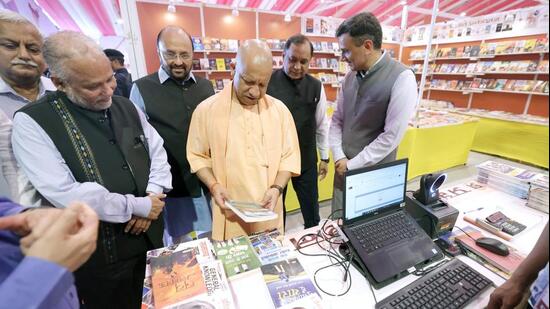
Inaugurating the nine-day Gomti Book Festival at Lucknow University, the chief minister said the response to the festivals had dispelled the notion that young people spent their time only on social media.
“We simply hadn’t made the effort to bring books to them. They do want to read, but we must establish a system to deliver books to them,” he said.
Adityanath said the book festival was inspired by Prime Minister Narendra Modi’s vision of connecting India’s ancient knowledge tradition with modern knowledge. Recalling the first edition of the Lucknow book festival, he said, “When Yuvraj Malik, director, National Book Trust, first brought the proposal of a book festival in Lucknow, I wondered what the results would be. But after the first edition saw a positive response, I asked him to organise one in Gorakhpur as well. Gorakhpur saw an even bigger turnout and more books were purchased than in Lucknow.”
Invoking the Vedic mantra ‘A no bhadrah kratavo yantu vishvatah’ (let noble thoughts come from every side), the chief minister said knowledge could not be acquired only through the syllabus taught in schools and colleges. “No person becomes great overnight. Greatness comes after enduring multiple failures without giving up,” he said.
{{/usCountry}}Invoking the Vedic mantra ‘A no bhadrah kratavo yantu vishvatah’ (let noble thoughts come from every side), the chief minister said knowledge could not be acquired only through the syllabus taught in schools and colleges. “No person becomes great overnight. Greatness comes after enduring multiple failures without giving up,” he said.
{{/usCountry}}Highlighting Uttar Pradesh’s literary heritage, Adityanath said Lucknow had been an ancient centre of literature, while Naimisharanya, around 70 km from Lucknow, was where 88,000 sages had carried forward the Vedic tradition through the Puranas. He said Shuktirtha in Muzaffarnagar was where the Shrimad Bhagavat was first narrated around 5,000 years ago.
Adityanath said the state had faced adverse consequences when knowledge remained confined to narrow boundaries and was subsequently labelled a “bimaru” state. “A decade ago, youth here faced an identity crisis and hesitated to disclose their identity outside. In the last 10 years, dedicated efforts changed it and the digital era bridged the gap between cities and villages,” he said.
He said the state had set up libraries in all 57,600 gram secretariats, stocked with NBT books and equipped with access to digital libraries, which were now being used by village youth. He added that under Operation Kayakalp, basic education schools had been provided modern buildings, digital libraries and smart classrooms.
Urging students to build personal book banks, Yogi said, “Make it a habit to purchase books that foster creative thought apart from textbooks. This book bank will be a lifelong inspiration.”
LU vice-chancellor Prof JP Saini, NBT chairman Prof Milind Marathe, NBT director Yuvraj Malik, ministers Sandeep Singh, Yogendra Upadhyay and Gulab Devi, and CM advisor Awanish Awasthi were present at the programme.