MUMBAI: On a usual weeknight at IF.BE in Ballard Estate, the gallery space felt more like a charged courtroom than a cultural venue. Architects, students, lawyers and curious citizens packed themselves between drawings and renderings, which formed the exhibition of competition entries for the new High Court complex planned in Bandra Kurla Complex (BKC). The winning scheme by architect Hafeez Contractor shared space with proposals by Abha Narain Lambah Associates, Somaya Sampat, PKDA Architects and Sanjay Puri Architects—an unusually transparent display for a public building in India.
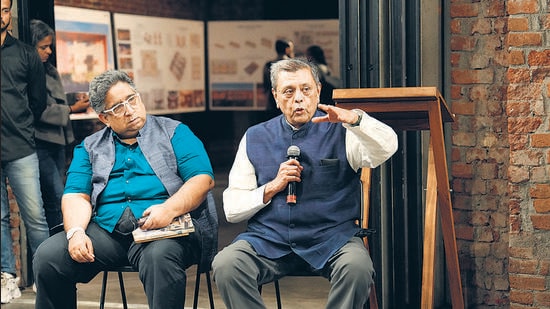
Mustansir Dalvi, architect and professor of architecture at Sir JJ College of Architecture, opened the evening by reminding the room just how rare this was. The last time he remembered a major civic competition being put up for public viewing was in the 1980s, with the Indira Gandhi National Centre for the Arts in New Delhi. Since then, most decisions about large public buildings have been taken behind closed doors. Here, at least for one evening, the public could see the alternatives—and hear a forthright dismantling of the chosen one.
Alongside, Justice (retired) Gautam Patel made it clear he would not dwell on who won or lost the competition. His real concern lay elsewhere: in the brief, the process, and in what the winning design says about how the justice system sees the citizen.
The PWD document that guided the competition, he shared, ran 23 pages long but was not a brief. It listed square footage requirements, bungalows for the chief justice, the number of courtrooms and loggias—without any articulation of context, history, or philosophy. “We want a new High Court building. These are the dimensions,” was the spirit of it. He bristled at the language of the court—often used approvingly—as a “temple of justice. A temple implies a god, a priest in elaborate robes, and a worshipper who approaches in submission. These should be halls of justice,” he insisted, spaces where eye contact, audibility and clear sight lines create a calmer, less hostile atmosphere. He spoke of courtrooms abroad, such as in Oslo, where judges sit at the lowest point of an amphitheatre, with litigants rising above them; and of how the height of a podium in a courtroom can completely alter the power dynamic between judges and litigants.
{{/usCountry}}The PWD document that guided the competition, he shared, ran 23 pages long but was not a brief. It listed square footage requirements, bungalows for the chief justice, the number of courtrooms and loggias—without any articulation of context, history, or philosophy. “We want a new High Court building. These are the dimensions,” was the spirit of it. He bristled at the language of the court—often used approvingly—as a “temple of justice. A temple implies a god, a priest in elaborate robes, and a worshipper who approaches in submission. These should be halls of justice,” he insisted, spaces where eye contact, audibility and clear sight lines create a calmer, less hostile atmosphere. He spoke of courtrooms abroad, such as in Oslo, where judges sit at the lowest point of an amphitheatre, with litigants rising above them; and of how the height of a podium in a courtroom can completely alter the power dynamic between judges and litigants.
{{/usCountry}}The current proposal, in his opinion, is “a monument, but not an efficient building, not climate-resilient, and not designed for its purpose.” It is, he said bluntly, “a design we should devoutly pray never comes into being.” There was, he bemoaned, “no mention, no imagination” for what will happen to the current, much-loved Gothic-style High Court at Fort, even though the plea for a new building rests on the argument of inadequate space, much of which is currently swallowed by stacks of paper and documents occupying entire rooms. “Courtrooms and corridors are clogged with files, many of which could be digitised or moved to off-site storage in places like Dombivli. Force the court to go paperless,” he said. “You free up some of the most expensive real estate in the city.”
If Patel’s critique focused on function, Dalvi’s went straight for the building’s language. The BKC site, he reminded the room, is not a heritage precinct. “It is surrounded by government housing and contemporary office blocks; the Bandra-Kurla skyline is made up of glass-and-steel global architecture. No one—certainly not the PWD—had asked for a building that self-consciously referenced the past.”
Colonial echoes in a contemporary city
Yet the winning design—a vast, triumphal complex crowned with multiple domes, fronted by a towering colonnaded portico, and approached by an enormous ceremonial staircase—leans heavily into an imperial pageantry. Renderings show endless ranks of Corinthian columns, balustraded terraces, axial gardens, and an outsized central dome rising above a rigidly symmetrical façade. For Dalvi, he immediately recalled Government House in Kolkata (now Raj Bhavan), which was modelled on Kedleston Hall in Derbyshire—the East India Company’s first grand architectural assertion of power in India. He read out a passage from historian Thomas Metcalf describing how that building was explicitly conceived to project imperial splendour, to rule India “from a palace, not from a counting house. Of all the buildings to emulate,” Dalvi asked, “is this really the one we needed to invoke in 2025?”
As a counter-example, he held up the High Court in Chandigarh, designed by Le Corbusier in the 1950s with a massive parasol roof, an umbrella of justice, to provide a grand entrance while sheltering all activity. Access is via broad ramps, not intimidating staircases, and the Chief Justice’s chamber sits at the same level as other courts. “It is monumental without being imperial, modern without being alien, and born of a post-Independence ethos that eagerly sought future-facing design rather than revivalist nostalgia.”
A fair competition with a flawed brief
When the discussion opened to the floor, the room’s mood shifted from critique to a kind of collective post-mortem. Many architects questioned why such a significant public building had been decided through a closed, invitation-only competition rather than an open or international one. Others, such as architect Brinda Somaya, whose proposals feature in the exhibit, pointed out the lack of a clear, useful brief, noting that Council of Architecture guidelines for competitions—including the requirement of a professional advisor to help frame that brief—had simply not been followed.
Among the architects on the panel, Abha Narain Lambah offered a dissenting but grounding counterpoint. She emphasised that while many may disagree with the aesthetic outcome, the competition process felt unusually fair. Her team presented before a packed room of nearly thirty judges, with several more joining on video calls from across the country, and at no point, she said, did the process carry the whiff of political pressure or preordained winners. What it did carry, repeatedly, was a single word: monumentality. In briefing after briefing, judges stressed their desire for a monumental building for the future. Lambah’s team chose not to pursue that direction, proposing instead a pared-down contemporary response that acknowledged the Victorian Gothic legacy of the existing High Court and attempted to create internal courtyards rather than grand external gestures. “But if a client keeps asking for a blue T-shirt,” she said wryly, “and you insist on offering them a yellow one—well, the person who gives them the blue T-shirt will get the job.”
Stay updated with all the Breaking News and Latest News from Mumbai. Click here for comprehensive coverage of top Cities including Bengaluru, Delhi, Hyderabad, and more across India along with Stay informed on the latest happenings in World News.
Stay updated with all the Breaking News and Latest News from Mumbai. Click here for comprehensive coverage of top Cities including Bengaluru, Delhi, Hyderabad, and more across India along with Stay informed on the latest happenings in World News.