The trailer of ‘Prahaar: The Untold Story of Ujjwal Nikam’ was launched by chief minister Devendra Fadnavis at Chhatrapati Shivaji Maharaj Terminus (CSMT) on Tuesday, bringing the film about the veteran prosecutor to one of the sites at the heart of the 26/11 Mumbai terror attacks.
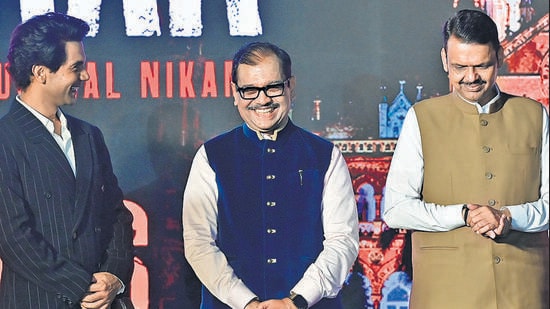
CSMT was among the locations targeted by the gunmen on November 26, 2008, while the prosecution of Ajmal Kasab, the lone attacker captured alive, became the defining case of Nikam’s career. The film, directed by Avinash Arun and starring Rajkummar Rao as Nikam, and also featuring Jaideep Ahlawat, Wamiqa Gabbi and Ashish Vidyarthi in pivotal roles, releases on October 16.
Fadnavis said the film would bring before the public the legal battle that followed the attacks and credited Nikam with using the Kasab trial to expose the conspiracy and role of Pakistan as alleged by the prosecution.
“We could have killed Kasab if we wanted; we could have shot him. But our police and our justice system thoughtfully showed the world that India is a nation that delivers justice through the law,” Fadnavis said.
He said the significance of the prosecution went beyond securing Kasab’s death sentence. “The final justice was that the world accepted Pakistan was a terrorist nation; the world accepted that this was state involvement,” Fadnavis said, adding that the 10 attackers were not “just some random terrorists” but had been “fully trained and financed” and sent by Pakistan.
{{/usCountry}}He said the significance of the prosecution went beyond securing Kasab’s death sentence. “The final justice was that the world accepted Pakistan was a terrorist nation; the world accepted that this was state involvement,” Fadnavis said, adding that the 10 attackers were not “just some random terrorists” but had been “fully trained and financed” and sent by Pakistan.
{{/usCountry}}His remarks were directed at highlighting what he described as the broader significance of the evidence placed before the court. The prosecution’s case, which the courts accepted in Kasab’s conviction, traced the attack to Lashkar-e-Taiba handlers in Pakistan. Pakistan has denied state involvement in the attacks.
Fadnavis said Nikam had “steered this entire case, removing each layer one by one” and established “that this was an incident carried out by Pakistan; what the conspiracy behind it was and who all were behind it”. He also linked the prosecution to justice for the police and security personnel killed during the attacks, naming Maharashtra ATS chief Hemant Karkare, additional commissioner Ashok Kamte, encounter specialist Vijay Salaskar, NSG commando Major Sandeep Unnikrishnan and assistant sub-inspector Tukaram Omble among those who died.
Nikam, who prosecuted Kasab before the special court, recalled how the accused repeatedly changed his version during the proceedings. He said Kasab first claimed to be a minor, later gave different accounts of how he had reached Mumbai, alleged that he was being poisoned and eventually sought to make a confessional statement, only to deny responsibility in it.
“Through Kasab, we established the link to Pakistan,” Nikam said, describing how the evidence against Kasab helped the prosecution establish the larger conspiracy.
Nikam also recalled the painstaking process of presenting evidence in a case in which witnesses had themselves survived a massacre. “It was difficult to record every testimony. To persuade the family of a little girl to allow her to testify was difficult. But we did everything,” he said.
He singled out police constable Arun Jadhav, who was in the police vehicle involved in the encounter in which Karkare, Kamte and Salaskar were killed, describing his testimony as “very important” to the trial.
He pointed out that Kasab was sentenced to death within about a year of the trial beginning, after which the Bombay High Court (HC) and the Supreme Court (SC) considered his appeals.
Kasab was convicted and sentenced to death by the special court in May 2010. The HC confirmed the sentence in February 2011 and the SC upheld it in August 2012. He was executed at Yerwada Central Jail on November 21, 2012.
The 26/11 attacks, which lasted from November 26 to November 29, left 166 people dead and 238 injured. The terrorists attacked CSMT, the Taj Mahal Palace, Oberoi-Trident, Nariman House, Leopold Café and Cama Hospital, among other locations. Kasab was captured alive at Girgaum Chowpatty after an encounter in which Omble was killed.
Nearly 18 years after the attacks, Nikam continues to prosecute the 26/11 case, and is now leading the effort to try the absconding accused.
For Rajkummar Rao, portraying Nikam meant trying to disappear into the real prosecutor rather than simply playing him. “I have tried that people see Ujjwal Nikam rather than seeing Rajkummar Rao,” he said at the launch.
Nikam said Rao had closely studied his courtroom manner, adding that the actor had delivered the dialogue in much the same manner in which he himself argued cases. Director Avinash Arun, he said, had watched two or three of his court proceedings, while Rao had studied videos of his courtroom appearances.
Stay updated with all the Breaking News and Latest News from Mumbai. Click here for comprehensive coverage of top Cities including Bengaluru, Delhi, Hyderabad, and more across India along with Stay informed on the latest happenings in World News.
Stay updated with all the Breaking News and Latest News from Mumbai. Click here for comprehensive coverage of top Cities including Bengaluru, Delhi, Hyderabad, and more across India along with Stay informed on the latest happenings in World News.