Mumbai: By 9 am on Wednesday, a narrow lane leading to a modest community hall in Saki Naka began to resemble a classroom. Hundreds of students flocked to the hall throughout the day to practise spoken Marathi before taking a language proficiency test.
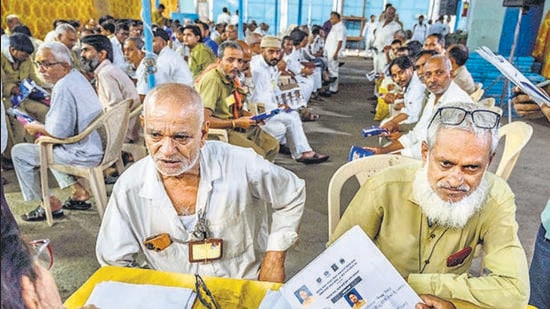
The students were not children. Dressed in white and khaki uniforms, they were auto-rickshaw and taxi drivers, some septuagenarians, rushing to meet the Maharashtra government’s August 15 deadline to obtain a Marathi proficiency certificate.
According to the state’s new policy, drivers of commercial and public service vehicles, including auto-rickshaws, taxis, and app-based cab operators, should be able to understand, speak and communicate in basic Marathi.
Since the policy was announced in April, transport unions, regional transport offices (RTOs) and political parties across Mumbai have been rushing to organise free Marathi coaching sessions and tests for drivers. One such session was the one organised in Saki Naka on Wednesday by a transport union.
‘Kuthe jaycha ahe?’
Seated on cream-coloured plastic chairs arranged in a row at the makeshift examination centre, hundreds of drivers rehearsed around 15 common phrases for passenger interactions from a two-page booklet translated from Hindi into Marathi.
Others sipped cutting chai as they quizzed each other with simple Marathi phrases that drivers are expected to know: “Meter chalu kara” (Please switch on the meter), “Kuthe jaycha aahe?” (Where do you want to go?), and “Rickshaw khali aahe ka?” (Is the auto available?)
{{/usCountry}}Others sipped cutting chai as they quizzed each other with simple Marathi phrases that drivers are expected to know: “Meter chalu kara” (Please switch on the meter), “Kuthe jaycha aahe?” (Where do you want to go?), and “Rickshaw khali aahe ka?” (Is the auto available?)
{{/usCountry}}Other phrases in the booklet include asking whether the passenger wants to hire the vehicle, estimating travel time and confirming the fare. Most answers are limited to a sentence or even a single word, with variations depending on the passenger’s age or gender.
The tests, which took only two to four minutes, were organised in batches of 60 drivers from 10.30 am to 6.30 pm. Such tests will be conducted every day at the centre till the August 15 deadline.
“We are doing our best to get as many drivers for the test. After five to seven days, we will hold another large assembly where drivers who have cleared the test will be issued certificates,” said Manohar Pawar, a transport union leader who arranged the session at Saki Naka.
Back to school
For Ramashankar Mishra, 68, passing the test is another milestone in a life spent behind the wheel. Originally from Jaunpur in Uttar Pradesh, Mishra moved to Mumbai in 1985 and drove heavy vehicles for decades before switching to a kaali-peeli taxi after the Covid-19 pandemic.
“I was asked a few questions in Marathi. I understand the language and have always tried to speak it whenever possible,” he said, after stepping down from the podium of the examination hall. “I have been waiting here for nearly two hours, but that’s alright. The test is mandatory after all.”
Mishra, whose son is an engineer and daughter is pursuing a degree in pharmacy, said learning Marathi remains part of adapting to a city that has been home for more than four decades. “Ironically, passengers themselves rarely speak Marathi. Most conversations happen in Hindi,” he added, with a smile.
Not everyone left the hall relieved. Ramchandra Yadav, 72, sat quietly outside the centre, clutching the question sheet after being asked to revise and return another day. “The examiner asked me to speak about Mumbai and my work as an auto driver. I could explain everything in Hindi, but when they asked the questions in Marathi, I couldn’t answer properly,” he said.
Yadav has lived in Mumbai since the early 1990s, driving heavy vehicles before switching to an auto-rickshaw. His life changed dramatically after he lost his wife in the devastating July 26, 2005 floods.
“I’ve been reading this booklet for the last four or five days. Never in all these years were we required to know Marathi. Even passengers usually speak Hindi. But if this is the rule, we have to learn,” he added.
Mustakim Ansari, who has spent nearly 30 years driving in Mumbai after migrating from Jharkhand, said, “I can have a proper conversation in Marathi as my wife hails from Maharashtra. But I want to appear for the test so that even if the driver is caught, I can show that the auto rickshaw owner is well versed with the local language.”
Assessing communication
While auto and taxi unions had raised concerns about the policy when it was introduced, as a large number of drivers in Mumbai are migrants from other states, the volunteer examiners said the intention was to assess whether they can communicate in Marathi rather than test their grammatical accuracy.
“We are primarily examining whether they understand Marathi and can converse with passengers,” said Dr Samidha Gore, a family physician who is volunteering at the centre.
Another volunteer examiner, Dr Prashant Jadhav, a homoeopathy practitioner from Thane, said the response has been overwhelming. “We ask six to eight questions and then continue speaking in Marathi. Even if someone answers only 30% to 40% correctly, we guide them and help them improve. The objective is communication,” said Jadhav, adding that the Saki Naka centre has tested more than 350 candidates since the morning.
“Many have lived in Mumbai for decades but never had the opportunity or necessity to formally learn Marathi. We correct them during the test itself. This is our way of contributing to society,” he said.
Outside the centre, the queue continued to grow through the afternoon as fresh batches of drivers arrived from different parts of the city. Some revised from laminated notes, while others practised pronunciation in small groups. A few nervously joked about forgetting words the moment they entered the examination hall.
Sampath Chauhan, 61, from Azamgarh, smiled as he said he never expected to take a test at this age. “I am a matric (Class 10) pass. All I did these years was drive. In fact, I even speak in broken Marathi,” he said.
Over the next few days, for these drivers, learning Marathi is more important than learning how to navigate Mumbai’s chockablock traffic.
Stay updated with all the Breaking News and Latest News from Mumbai. Click here for comprehensive coverage of top Cities including Bengaluru, Delhi, Hyderabad, and more across India along with Stay informed on the latest happenings in World News.
Stay updated with all the Breaking News and Latest News from Mumbai. Click here for comprehensive coverage of top Cities including Bengaluru, Delhi, Hyderabad, and more across India along with Stay informed on the latest happenings in World News.