Powai Lake will finally stop receiving direct sewage from today, with the Brihanmumbai Municipal Corporation (BMC) completing work to intercept and divert all 20 identified sewage streams flowing into the lake. The move comes after years of complaints from residents and environmentalists and mounting concern over pollution that has fuelled the spread of water hyacinth in the lake.
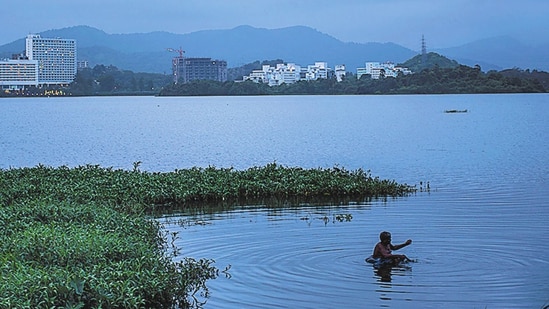
The BMC said 18 sewage outfalls along Adi Shankaracharya Marg (JVLR) have been connected to the existing sewer network leading to the Bhandup Sewage Treatment Plant (STP). Two streams at Peru Gate, on the northern edge of the lake, have been diverted to the Filterpada STP. The project involved laying 3,056 metres of new sewer lines. It began in August 2025 and was completed in 13 months.
Also Read: How will you tackle Powai Lake pollution, MoEF asks BMC
The intervention follows a long-running campaign by residents and environmental groups, who have argued that removing water hyacinth and periodically cleaning the lake would not solve the problem unless the sewage entering it was stopped.
A committee appointed by the NGT had found in 2022 that around 10.9 million litres of untreated sewage was entering Powai Lake every day through 15 culverts. The NGT subsequently directed the BMC to stop the discharge. The issue later triggered renewed citizen mobilisation through campaigns such as #SavePowaiLake. Residents and environmental groups continued to document sewage outfalls, water-hyacinth growth and other pollution sources.
{{/usCountry}}A committee appointed by the NGT had found in 2022 that around 10.9 million litres of untreated sewage was entering Powai Lake every day through 15 culverts. The NGT subsequently directed the BMC to stop the discharge. The issue later triggered renewed citizen mobilisation through campaigns such as #SavePowaiLake. Residents and environmental groups continued to document sewage outfalls, water-hyacinth growth and other pollution sources.
{{/usCountry}}Also Read: Pollution level at Mumbai’s Powai lake 8 times above safe limit, says environment ministry
In 2024, residents also objected to the use of JCB machinery to remove water hyacinth, prompting the Bombay Natural History Society to inspect the lake over concerns that mechanical operations could affect aquatic birds and their nests. The BMC temporarily stopped the work.
The sewage problem was again highlighted in 2025, when BMC assessments put the untreated sewage entering the lake at around 18 MLD. Officials have linked the high organic and nutrient content of the sewage to the rapid growth of water hyacinth. The BMC is simultaneously building an 8-MLD automated STP at the site of a defunct sewage pumping station in Powai. Though the deadline is December 2028, the civic body is aiming to commission the plant by May 2027. The plant will treat 8 MLD locally, with the remaining sewage continuing to be sent to Bhandup STP.
Also Read: BMC clears NEERI study to assess Kanjurmarg landfill emissions
Stopping sewage, however, is only the beginning of the lake’s clean-up, officials said. Additional municipal commissioner Abhijit Bangar said organic matter already present in the lake would remain and that the BMC plans to introduce biological interventions after evaluating suitable technologies over the next one to two months.
Meanwhile, water-hyacinth removal continues. The civic body said 20,340 metric tonnes, or 85% of the estimated 24,000 tonnes of hyacinth, had been removed by September 29 using two harvesters. Bangar said the weed was reproducing faster than it could be mechanically removed because of the high organic content in the lake.
Stay updated with all the Breaking News and Latest News from Mumbai. Click here for comprehensive coverage of top Cities including Bengaluru, Delhi, Hyderabad, and more across India along with Stay informed on the latest happenings in World News.
Stay updated with all the Breaking News and Latest News from Mumbai. Click here for comprehensive coverage of top Cities including Bengaluru, Delhi, Hyderabad, and more across India along with Stay informed on the latest happenings in World News.