
 E-Paper



Campaign for Maharashtra assembly election ends with Rahul Gandhi's swipe against BJP
Maharashtra's election campaign concluded, with Rahul Gandhi targeting the ruling alliance over the Dharavi project, while the BJP emphasizes welfare schemes

 Prefer HTon Google


MUMBAI: The high-voltage campaign for the Maharashtra assembly election ended on Monday, pitting the two major political alliances against each other in a bitter battle for the 288 seats up for grabs in the state. Blitzing the electorate with welfare schemes and monetary handouts, slogans that raised heat and dust, and a dramatic flourish from Congress leader Rahul Gandhi on the final day capped two weeks of campaigning.
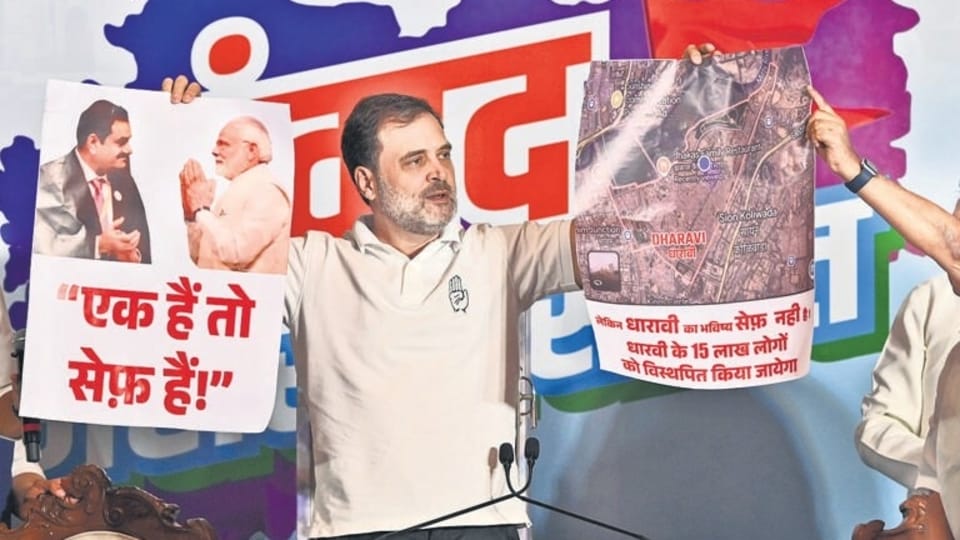
Former Congress president and leader of the opposition in the Lok Sabha, Rahul Gandhi, on Monday took a swipe at the ruling Mahayuti alliance while addressing the media in Mumbai. He alleged that the Dharavi redevelopment project was meant to benefit industrialist Gautam Adani and a ploy to “grab the land and wealth of Mumbai, wealth of residents of Dharavi”.
Turning the BJP’s ‘Ek Hai Toh Safe Hai’ slogan against the ruling Mahayuti alliance who had coined it, Gandhi said it referred to Adani and his political patrons. He also claimed that massive investment projects worth ₹7 lakh crore and with an employment potential of 5 lakh, had been diverted from Maharashtra to other states.
Refuting Gandhi’s charges on Dharavi was chief minister Eknath Shinde. “Plots have been handed over to the Dharavi Rehabilitation Project Private Limited (a joint venture between the state government and the Adani Group), not Adani. Unlike the MVA’s plan to provide homes to only 60,000 eligible residents, we will deliver 2 lakh homes, which include the ineligible ones. This world-class project ensures homes for all Dharavi residents. If this benefits the people of Dharavi, why does it hurt the opposition,” he said.
BJP national general secretary Vinod Tawde challenged Gandhi to a “face-to-face debate” on the alleged diverting of investment projects. “It has been clarified time and again that none of the projects have gone out during our government. In fact, during the UPA governments, the Mundra project was given to Adani in 1990, six SEZs to the company in 2006-08, Food Corporation (of India) project in 2005 to the Adani-led company were given by the Congress-led government.”
Battling it out in the November 20 election in Maharashtra are the two main coalitions – the ruling Bharatiya Janata Party-led Mahayuti alliance and its partners, the Eknath Shinde-led Shiv Sena and Ajit Pawar-led Nationalist Congress Party (NCP); and the opposition Maha Vikas Aghadi (MVA), which includes the Uddhav Thackeray-led Shiv Sena (UBT), the Congress, and the Sharad Pawar-led NCP (SP). A total of 4,136 candidates are in the fray.
Significantly, the election will determine whether the Mahayuti can reverse the massive losses it suffered during the recent Lok Sabha elections. In the Lok Sabha polls, the MVA won 30 of the 48 seats in the state and the Mahayuti just 17.
Learning from the BJP’s experiment in Haryana, the Mahayuti government took more than 100 decisions aimed at various castes and communities in the run-up to the polls. It is also betting big on its Ladki Bahin Yojna, under which it deposits ₹1,500 in the bank accounts of economically vulnerable women, every month.
Among the two main coalitions, the BJP is contesting 149 seats, while the Congress is contesting 102. The BJP’s alliance partner, the Eknath Shinde-led Shiv Sena is contesting 81 seats, while the Ajit Pawar-led NCP has fielded 54 candidates. In the MVA, the Uddhav Thackeray-led Sena (UBT) is contesting 95 seats, while the Sharad Pawar led NCP (SP) has fielded 86 candidates.
There are at least half a dozen small parties that could influence election outcome in several constituencies. Among them are the Raj Thackeray-led Maharashtra Navnirman Sena, Prakash Ambedkar-led Vanchit Bahujan Aghadi, Hitendra Thakur-led Bahujan Vikas Aghadi, Peasants and Workers Party, and Samajwadi Party. There are more than 80 rebel candidates contesting as Independents, from both coalitions. Overall, there are 2,086 Independent candidates in the fray.
As far as issues are concerned, distress among farmers over prices for their produce, the carpet-bombing of sops and welfare schemes, and the split in the Shiv Sena in 2022 and NCP a year later dominated the campaign. It is not clear how much the Maratha reservation agitation will impact the election results as Maratha leader Manoj Jarange-Patil chose not to field candidates.
In the last few days of the campaign, the BJP introduced the Hindutva angle, apparently to counter the effect of Maratha polarisation and resentment among some castes. Prime Minister Narendra Modi used the ‘Ek Hai Toh Safe Hain’ slogan, aimed at uniting all castes under the Hindutva banner. State BJP leaders also extensively used the ‘Batenge to Katenge’ slogan.
The MVA had hoped to capitalise on its success in the Lok Sabha election but failed to build any momentum. The opposition coalition, however, targeted the ruling alliance for allegedly splitting the Shiv Sena and NCP, rising inflation, unemployment, distress among farmers and the alleged diverting of investment projects meant for Maharashtra’s, to Gujarat.
Significantly, industrialist Gautam Adani’s name kept cropping up during the campaign. It began with deputy chief minister Ajit Pawar mentioning that a meeting had been held at Adani’s Delhi residence after the 2019 elections. It was apparently attended by Union home minister Amit Shah, Sharad Pawar, Devendra Fadnavis and Ajit Pawar to discuss the possibility of a BJP-NCP government in Maharashtra. While Fadnavis denied that the meeting had taken place at Adani’s residence or in his presence, Sharad Pawar confirmed what Ajit Pawar had said but added that Adani was not involved in the discussions.
The controversy over the Adani Group’s Dharavi redevelopment project was turned into a major election issue by the opposition. Votes will be counted on November 23.


