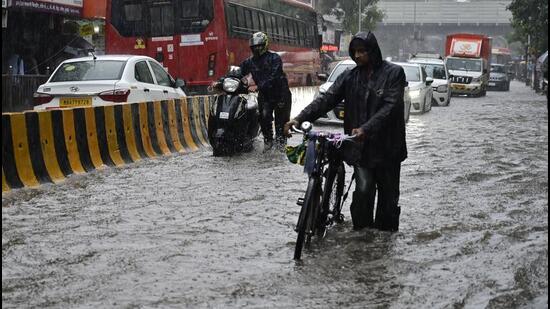
MUMBAI: The season’s first downpour in Mumbai on Monday exposed 59 locations in the island city that experienced waterlogging for the first time ever. These areas, previously unaffected since the devastating Mumbai floods of July 26, 2005, have emerged as red flags, leaving worried citizens demanding answers.
A breakdown shows that A Ward (Fort-Colaba) received flooding complaints from 22 new locations, while B Ward (Dongri) saw 21. C Ward (Marine Lines) reported nine new flood-prone spots, D Ward (Malabar Hill) four, and E Ward (Byculla) three.
Residents and commercial establishments in these traditionally dry areas are dismayed, even as the civic administration is struggling to explain the emergence of these new flood-prone spots. Some of the areas are: Second and Fourth Pasta Lanes in Colaba, Metro Cinema, Crawford Market, Captain Pethe Marg in Cuffe Parade, Nehru Nagar, Ambedkar Nagar, Mantralaya, Churchgate station and DN Road.
A flood-prone spot, according to the civic authorities, is a low-lying area prone to prolonged waterlogging during moderate to heavy rainfall.
According to the Brihanmumbai Municipal Corporation’s (BMC), Nariman Point recorded the highest rainfall (252 mm) between 10pm on May 25 and 11am on May 26. This was followed by the BMC headquarters (216 mm), and the Colaba pumping station (207 mm). The 24-hour rainfall recorded until 8am on Tuesday showed the island city receiving 106 mm on average, while the western suburbs recorded 72 mm and eastern suburbs 63 mm.
The high tide, between 9am and 10am on Monday exacerbated the waterlogging. Still, it wasn’t reason enough for the unprecedented waterlogging. Caught completely off-guard this year, the BMC sought to blame the situation on the lack of sufficient dewatering pumps across the island city. The administration said these pumps, typically installed in flood-prone areas, had been reduced from 482 to 417 this year, as many were underutilised. Moreover, in some places, they were not fully operational.
{{/usCountry}}The high tide, between 9am and 10am on Monday exacerbated the waterlogging. Still, it wasn’t reason enough for the unprecedented waterlogging. Caught completely off-guard this year, the BMC sought to blame the situation on the lack of sufficient dewatering pumps across the island city. The administration said these pumps, typically installed in flood-prone areas, had been reduced from 482 to 417 this year, as many were underutilised. Moreover, in some places, they were not fully operational.
{{/usCountry}}How does that explain waterlogging in areas that are not flood-prone?
A civic official from A Ward claimed the “reverse water flow from the sea into the drains” contributed to the unexpected waterlogging, referring to the high tide, which peaked between 9am and 10am on Monday. Asked why the high tide, which has coincided with heavy rains in previous years, had not led to flooding in these areas earlier, the official shifted the blame to clogged storm water drains.
“Accumulated garbage obstructed the flow of rainwater, especially in areas near Oval and Azad maidans like Mantralaya and the BMC headquarters, where floating debris blocked water ingress points. Except for Jagannath Bhosale Marg and P D’Mello Road, the newly waterlogged areas saw the situation ease once the high tide subsided,” claimed the civic official. “We’ve begun cleaning drain inlets at 57 sites and are installing recycling machines to clear litter from drains.”
The BMC typically cleans the city’s storm water drains from June 1. They claim the unseasonal rain caught them off-guard. At locations like Azad Maidan, leaves, sand and trash blocked covered water inlets.
Meanwhile, municipal commissioner Bhushan Gagrani issued fresh instructions on Wednesday to remove loose curb stones, paver blocks, construction debris, and other waste material from roads and construction sites. Between May 29 and June 15, all BMC ward offices will conduct intensive clean-up operations, including roads, alleys and key drainage inlets.
Stay updated with all the Breaking News and Latest News from Mumbai. Click here for comprehensive coverage of top Cities including Bengaluru, Delhi, Hyderabad, and more across India along with Stay informed on the latest happenings in World News.
Stay updated with all the Breaking News and Latest News from Mumbai. Click here for comprehensive coverage of top Cities including Bengaluru, Delhi, Hyderabad, and more across India along with Stay informed on the latest happenings in World News.