
 E-Paper



Hindi now compulsory third language from Class 1 in Maharashtra schools
Maharashtra mandates Hindi as a third language for Classes 1-5 from 2025-26, implementing NEP 2020's phased rollout, affecting language curriculum in schools.

 Prefer HTon Google


MUMBAI: The Maharashtra government has announced that Hindi will be made a compulsory third language subject for students from Classes 1 to 5, starting from the academic year 2025–26. The move is part of the phased implementation of the National Education Policy (NEP) 2020 at the school level, according to a government resolution (GR) issued by the school education department on Wednesday.
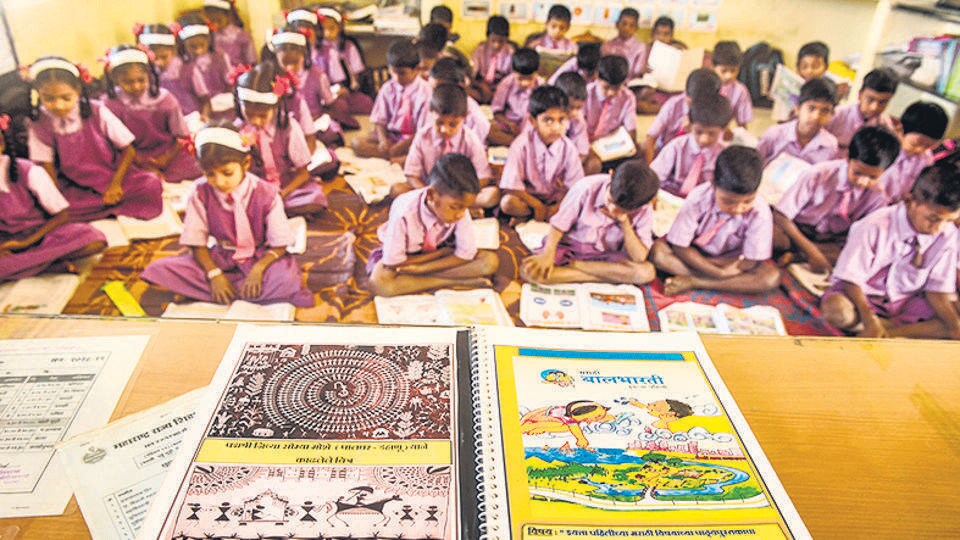
Currently, the three-language formula applies only to secondary education. With this change, it will now begin at the primary level, bringing significant adjustments to the language curriculum particularly in Marathi-medium and English-medium schools.
Under the State Curriculum Framework, students in Marathi- and English-medium schools will now be required to learn Hindi from Class 1 onwards. In schools with other mediums of instruction, Marathi and English will become compulsory subjects while the language of instruction will be the third language. “This marks a crucial shift in early education,” said an education department official. “The intention is to build multilingual competency early on.”
As per the GR, the NEP will be rolled out in four phases, beginning with Class 1 in 2025–26. The new structure replaces the existing 10+2+3 model with a 5+3+3+4 model, dividing schooling into four stages: Foundation (ages 3 to 8), Preparatory (Classes 3 to 5), Pre-Secondary (Classes 6 to 8), and Secondary (Classes 9 to 12).
The State Council of Educational Research and Training (SCERT) and Balbharati will be responsible for developing the updated curriculum, textbooks, supplementary materials, and a ‘Setu Syllabus’ to help ease the transition. NCERT textbooks will also be adapted as needed.
To support the overhaul, teacher training programs, revised school timetables, and updated examination policies will be put in place. Evaluations will now follow a more holistic model, using a ‘Holistic Progress Card’ system aimed at reducing academic stress while promoting logical and experiential learning.
The decision to make Hindi compulsory has sparked a debate among educators and experts. Vasant Kalpande, former director of school education, criticised the move. “Making Hindi mandatory is unfair,” he said. “Students should have the option of choosing among Indian languages like Tamil, Kannada or Telugu.”
Bhausaheb Chaskar, a teacher and convener of the Active Teachers Forum, raised concerns about the practicality of teaching three languages at such an early stage. “Children already struggle to read and write Marathi by the end of their first year,” he said. “Adding English and now Hindi will overwhelm them, especially in schools with just two teachers. It’s not just about adding content—it’s about the kids’ capacity.”
Chaskar also warned that the increased load could compromise the teaching of core subjects like mathematics. “More than half our primary schools operate with only two teachers. Where’s the room for more language classes?” he asked.
Chaskar further argued that Maharashtra, which has granted classical status to the Marathi language, should shed any lingering linguistic inferiority complex. “Education is a subject that is on the concurrent list, and the state has the right to make changes to central diktats,” he said. “It should exercise its authority wisely.”


Stay updated with all the Breaking News and Latest News from Mumbai. Click here for comprehensive coverage of top Cities including Bengaluru, Delhi, Hyderabad, and more across India along with Stay informed on the latest happenings in World News.


