E-Paper



Maharashtra polls: Redevelopment could swing votes, fortunes in Dharavi
A survey to identify residents eligible for rehabilitation within Dharavi is underway and anxiety over its outcome is likely to affect voting patterns

 Prefer HTon Google


Mumbai: Elections in the Dharavi assembly constituency, which houses one of the largest slum clusters in Asia, usually revolve around issues like inadequate housing, public toilets and sanitation, monsoon-induced waterlogging, traffic congestion and poor urban planning. But for the assembly poll scheduled on November 20, these issues have been overshadowed by the Adani group-led Dharavi redevelopment project.
Residents who are found eligible for rehabilitation within Dharavi are likely to benefit significantly from the project, while those who are found ineligible will have to move to an alternative location. A survey to identify eligible residents is currently underway and anxiety over its outcome is likely to affect voting patterns. Candidates in the fray are also tapping into this anxiety, ensuring the redevelopment project stays at the centre of their campaigns.
Congress bastion
Dharavi’s electorate of 261,869 voters comprises a mosaic of communities from across the country, including around 60,000 Buddhists and Charmakars, 45,000 north Indians, 30,000 south Indians, and 35,000 Muslims.
The constituency has been a Congress bastion for over four decades. The legacy began with the deceased Congress leader Eknath Gaikwad, who served as the MLA from 1985 till 1995, when he lost to Shiv Sena’s Baburao Mane. He returned as MLA in 1999 while his daughter, Varsha Gaikwad, was elected as the MLA in the subsequent election in 2004. Varsha won in the 2009, 2014 and 2019 assembly polls as well, cementing the family’s dominance in the area.
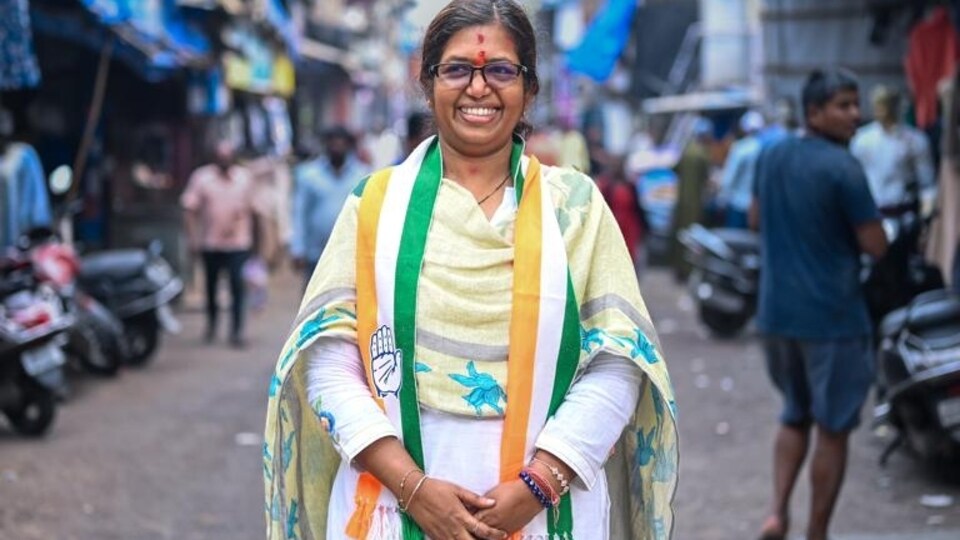
With Varsha Gaikwad being elected as the MP of Mumbai North Central during the Lok Sabha polls held earlier this year, the Congress has fielded her younger sister and ayurvedic doctor Jyoti Gaikwad as its candidate for the upcoming poll. But dissatisfaction with the Congress’s continued reliance on a single family for representation has grown substantially and accusations of dynasty politics have put the party on the defensive, making this election particularly challenging.
In her maiden election, Jyoti Gaikwad is contesting against Rajesh Khandare from the Eknath Shinde-led Shiv Sena, the ruling Mahayuti alliance’s candidate; Manohar Raibage from the Bahujan Samaj Party (BSP); and Adv Sandeep Katke, vice-president of the Aam Aadmi Party’s Mumbai unit, who is in the fray as an independent candidate.
Shrill campaign
The redevelopment project has occupied the centrestage in poll campaigning, with Rajesh Khandare and Jyoti Gaikwad functioning as its ardent votary and ruthless critic, respectively.
Khandare stresses on how the incumbent Mahayuti government has implemented a redevelopment project that has been in the works for nearly four decades.
“Dharavi redevelopment is not a new concept. It was introduced by Eknath Gaikwad in 1985 under the Pradhan Mantri Awas Yojana but it did not take off,” said Khandare. In 2000, residents were promised 180 square feet homes under a new scheme, which they opposed vehemently, whereas in 2004, 269 square feet homes were promised to residents.
“Despite all this, no progress was made...Now, when the dream is finally becoming a reality, why is the opposition resisting it,” he said, accusing the opposition of blocking Dharavi’s development.
His prime opponent Dr Jyoti Gaikwad disagrees. “In any redevelopment project, residents must be taken into confidence, and plans should align with their needs. We cannot disconnect society and businesses in the name of redevelopment,” she said, advocating a sector-wise development model. Her seven-point manifesto promises to scrap the current redevelopment plan and promote “Made in Dharavi” products, among other initiatives.
Despite the criticism, Dr Gaikwad is confident of her victory. “Although I’ve not been actively involved in politics, Dharavi has always been part of my life. During COVID, I worked on vaccination drives and other initiatives here, which the residents remember,” she said.
Divided electorate
Like the two main candidates, Dharavi’s electorate is also split over the redevelopment project, with those likely to deemed eligible backing the ruling alliance.
“Since my childhood, I’ve heard promises of getting homes in buildings. My grandfather died last year waiting for a home. Now, with this scheme, we feel like our dreams are finally becoming a reality,” said a third-generation resident who was told by surveyors that he was eligible for the redevelopment scheme. “We’re not concerned with the politics surrounding the scheme – we just want development in our area.”
In contrast, another resident who was told he was ineligible for rehabilitation said the scheme must be revised to ensure long-term residents are not thrown out.
“We’ve lived here for 25 years, but now they’re telling us that we can’t get a free home because our tenement is higher than the 14-feet height eligibility criteria. Worse, we’re expected to pay for a new house that will be in some far-off place,” the resident said. There are many others like him, he said, who are opposing the redevelopment plan in its current form for being unfair to those “who have called Dharavi home for decades”.