MUMBAI: Sai Paranjpye, 88, occupies a singular space in Indian film history. Neither aligned with mainstream Hindi cinema’s spectacle nor entirely enclosed within the austere idiom of parallel cinema, her films created a third territory - one where humour, loneliness, aspiration and moral ambiguity unfolded in recognisably lived spaces.
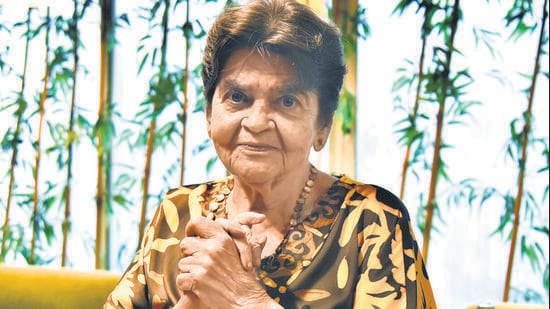
In this meditation on cinema, memory and a city that survives most powerfully in the voices of ordinary people, the filmmaker reflects on Bombay not as a metropolis of landmarks, but as a fragile emotional ecosystem of chawls, gaalas, workers’ dormitories and shared lives.
I never consciously thought that I must stand between two movements. These labels are usually created afterwards by critics and historians. When I was making films, I was simply trying to be truthful to the people I had observed.
What the city gave me was not a style; it gave me permission to notice the ordinary. In the Bombay of my filmmaking years, you couldn’t escape human proximity. You heard quarrels through thin walls, laughter from the next balcony, pressure cookers whistling in chorus, radios competing with one another, children doing homework on staircases, exhausted office-goers discussing politics while waiting for a bus. That constant overlap of lives fascinated me far more than dramatic plots.
Commercial Hindi cinema often looked at Bombay from a distance - through Marine Drive, Nariman Point, luxury hotels, nightclubs, the dream of success. I was interested in what happened after the dream ended for the day. Who returned home carrying disappointment? Who borrowed sugar from a neighbour? Who wrote a money order to a village? Who slept in a room shared with strangers?
{{/usCountry}}Commercial Hindi cinema often looked at Bombay from a distance - through Marine Drive, Nariman Point, luxury hotels, nightclubs, the dream of success. I was interested in what happened after the dream ended for the day. Who returned home carrying disappointment? Who borrowed sugar from a neighbour? Who wrote a money order to a village? Who slept in a room shared with strangers?
{{/usCountry}}Cinema, for me, begins there.
Very much so. Though Pune shaped my sensibility and Delhi shaped my professional confidence it was Bombay that shaped my understanding of human coexistence – which changed my whole creative process for good.
My radio career was entirely in Pune. Radio teaches you something invaluable: how to hear people. You cannot rely on glamour or visual distraction; you must understand pauses, hesitations, rhythms of speech.
Then came Delhi and television. I was among the first group of producers when television began in India. We were inventing things as we went along. There was an atmosphere of excitement and experimentation.
By the time I came to Bombay to make films, I was already carrying those experiences within me. Yet people call me a “Bombay filmmaker.” It makes me smile. I might belong to three cities simultaneously. But it was Bombay that confronted me most directly with the question: How do millions of people live together without collapsing under the weight of each other’s presence?
That question runs through almost all my films.
Definitely not the sea! For many, Bombay is the Arabian Sea, Marine Drive at sunset, the Queen’s Necklace. Those images are beautiful, of course, but they are not the images that wound me with memory.
The first image that comes to me is a post-dusk Girangaon - the old mill district - which has almost vanished now. I distinctly remember Parel, Chinchpokli, Curry Road, Delisle Road and the BDD chawl neighbourhoods shaped by the textile mills and the lives that revolved around them.
Narrow lanes. The smell of wet cotton, machine oil, kerosene and sweat. Workers returning from different shifts. Tea being poured into small glasses. Someone washing clothes at a common tap. Someone else sitting on a wooden bench reading an old newspaper under a weak yellow bulb.
There was hardship everywhere, but there was also an extraordinary density of life. Modern Bombay often feels efficient, vertical and anonymous. Girangaon felt horizontal and intimate. People could not avoid one another, and therefore they developed different forms of solidarity. These often took on very complicated hues but through all that the solidarity was palpable.
I think cities lose something profound when they lose that enforced intimacy.
I knew even while I was writing it for 17 long years that it was affecting me more deeply than any film I had made before.
‘Sparsh’ was emotionally intense. ‘Chashme Buddoor’ gave me great joy. ‘Katha’ allowed me to explore irony and affection. But ‘Disha’ entered a part of my heart that I had not examined earlier.
We were shooting in an actual gaala - a workers’ dormitory. Imagine a single room holding 30-40 men, each possessing only a narrow strip of space for his chatai. These were migrants from villages, men who had plucked themselves from their roots, left behind parents, wives, children, fields, festivals, entire emotional worlds.
What astonished me was that the room never felt emotionally empty. It was crowded not only with bodies, but with longing.
One man would be writing a letter home with immense concentration. Another would be staring silently at nothing. A third would be joking loudly with his companions. Someone would be making tea for everyone. There was a constant negotiation between individual loneliness and collective survival.
It’s a story that keeps coming to me again and again, especially in the context of what it meant to me emotionally and what it told me about the city. As threads of that weft and warp were pulled apart, I can only remember the moment with painful clarity.
I was looking at those rows of chatais and trying to understand how a human being could reduce his existence to such a tiny rectangle of floor. I asked a worker, rather naïvely, “This is all the space you have?”
He replied quite matter-of-factly, “Yes, but only for eight hours. Then the next shift worker comes.”
I was already distressed, so I said, “That must be very difficult.”
He smiled - not bitterly, just with weary humour - and said: “Sone ki jagah hai, karwat badalne ki nahi (There is enough space to sleep, but not enough space to turn over).”
At that instant, the entire tragedy of migrant labour became physical for me.
I used the line in ‘Disha’ unchanged. Later people praised my “powerful dialogue writing”, and I felt almost guilty accepting the compliment.
Absolutely. Subhashini (daughter of Captain Lakshmi Sahgal and Colonel Prem Sahgal who were a part of Subhash Chandra Bose’s Indian National Army) came to my house, saw two rolled-up chatais in a corner and asked whether I needed both. She wanted to give one to someone in a gaala. When she mentioned gaala, I genuinely did not know what the word meant.
She was incredulous: “You’re a Maharashtrian writer and director and you don’t know how the other half of Bombay lives?”
Her reaction embarrassed me, but it was productive. We often imagine that because we speak a city’s language, we know the city. We don’t.
When she took me to that first gaala, I stood frozen at the entrance. Inside, life was unfolding with incredible intensity: stoves hissing, clothes hanging from ropes, letters being written, cards being played, men sleeping amid noise because exhaustion had defeated discomfort.
Subhashini simply stepped over sleeping bodies and called out, “Come inside!”
That invitation was symbolic. She was asking me not merely to enter a room, but to enter a reality I had previously ignored.
Geography is hardly the same thing as emotional truth. ‘Katha’ was not shot in Bombay at all. It was shot in Pune. We cheated!
We first searched for a chawl in Bombay that had the right atmosphere. But those we found were either too dilapidated or unsuitable for filming. Some of the places were just too noisy and the din would make it impossible to shoot. In another we encountered a politically connected goon who wanted a huge amount in protection money to allow us to shoot. So we cheated and recreated that Bombay chawl world in Pune.
But the emotional architecture of the film is unmistakably Bombay.
What defines the chawl world is not the building itself; it is the absence of privacy. Everybody knows who has received a salary, who is in love, who is pretending to be more successful than he really is, who has relatives visiting from the village, who has quarrelled with whom.
In ‘Katha’, the balconies function almost like a Greek chorus. The community observes, comments, judges, sympathises and interferes. That is profoundly Bombay.
I have always felt that the film’s humour comes from recognition rather than invention. Audiences laugh because they have known a Rajaram Purushottam Joshi (Naseeruddin Shah) - decent, hesitant, overlooked - and they have known a charming manipulator like Bashu (Farooque Shaikh) who seems to float through life on confidence alone.
Those characters could exist anywhere in India, but the compressed social ecosystem that forces their interaction is very Bombay.
I was probably doing it instinctively before I even understood it intellectually.
Architecture determines how people encounter one another. A sprawling bungalow allows withdrawal; a chawl corridor does not. A gaala abolishes solitude almost completely. A middle-class apartment creates a different rhythm of interaction. In my films, spaces are never neutral backgrounds. They are active participants in the drama.
In ‘Katha’ the staircase is a place of accidental meetings, embarrassment, flirtation, gossip. In ‘Disha’, the gaala constantly reminds the viewer that migration is not an abstract economic process; it is a condition of shared breathing, exhaustion and waiting.
Yes, though it is a complicated grief.
I do not romanticise the mills. The working conditions were harsh; people suffered enormously. No one should have had to live in those cramped gaalas and chawls.
But redevelopment has often erased not only buildings, but memory. When I pass through those areas in central Mumbai now, I sometimes feel disoriented. The old landmarks have vanished. Towers stand where communities once existed. Economically, perhaps, change was inevitable. Emotionally, however, I mourn the loss of a certain human scale.
What disappears from history first is usually the texture of ordinary life. We remember industrialists, politicians, strikes, court judgments. We forget the man making tea for his roommates at four in the morning before the next mill shift. Cinema can preserve some of that texture. That is one reason I remain grateful for ‘Disha’.
The Bombay I carry is not a skyline; it is a soundscape. It is the clatter of steel tumblers in a crowded room. The hiss of a kerosene stove. Marathi, Hindi, Gujarati, Telugu and Bhojpuri sentences colliding in the same corridor. Someone laughing after a 12-hour shift. Someone reading a letter from home aloud to friends because he is not fully literate. Someone saying, “Karwat badal nahi sakte,” and then smiling as if even that deprivation could be turned into a joke.
That remembered Bombay is tired, overcrowded and imperfect, but it is also extraordinarily tender.
I sometimes think tenderness is the most neglected quality in discussions about cities. We talk about infrastructure, growth, real estate, transport, governance. But what made the old Bombay bearable for millions of people was not efficiency. It was the small, daily tenderness of people who had very little space and yet somehow made space for one another.
It must come from the kaleidoscope of experiences that have framed my worldview from early childhood. My father Youra Sleptzoff was a Russian watercolour artist with an army background. My mother Shakuntala Paranjpye was born to the knighted mathematician Sir R P Paranjpye and went on to be cinema’s leading lady through the 1930s and ’40s.
She was talking of family planning, birth control and reproductive rights long before many even understood the linkage. I was also influenced by filmmaker uncle Achyut Ranade whose house was close to ours and raised and schooled across India, and between 1944-1947 in Canberra, Australia, where my grandfather was posted as the High Commissioner. By the time I passed out of the National School of Drama in 1963, it would have been a wonder if my perspective and take on everything was not intersectional.
As someone who writes scripts and builds films from scratch as a filmmaker, I think I’m more or less done. After I found no takers for the two scripts I have ready, I decided to step back.
(In Conversation Sai Paranjpye and Sonali Kulkarni: A Dialogue on Craft at The Cube, NMACC on August 9, 2026 at 6.30 pm)
Stay updated with all the Breaking News and Latest News from Mumbai. Click here for comprehensive coverage of top Cities including Bengaluru, Delhi, Hyderabad, and more across India along with Stay informed on the latest happenings in World News.
Stay updated with all the Breaking News and Latest News from Mumbai. Click here for comprehensive coverage of top Cities including Bengaluru, Delhi, Hyderabad, and more across India along with Stay informed on the latest happenings in World News.