Outlining a development roadmap that prioritises infrastructure expansion, hydropower generation, entrepreneurship and welfare initiatives while maintaining fiscal discipline, Arunachal Pradesh deputy chief minister Chowna Mein on Tuesday presented the state budget for 2026–27.
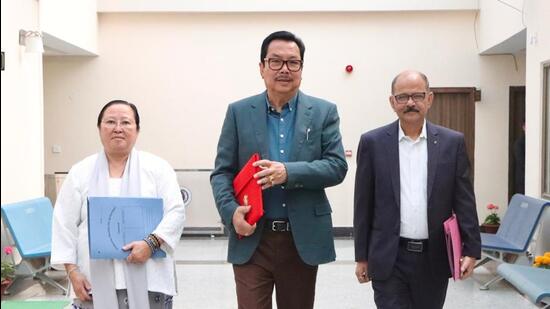
Presenting his 12th consecutive budget in the state assembly, Mein, who also holds the finance portfolio, said the government remains committed to building a “Viksit Arunachal” through sustained economic growth, stronger governance and inclusive development.
Highlighting the state’s economic progress, he said Arunachal Pradesh’s gross state domestic product (GSDP) has grown by nearly 135% over the past decade, while the overall state budget expanded by more than 226% during the same period. Per capita income has more than doubled and the state’s own resources have increased by over 460%, reflecting a strong economic trajectory.
For the financial year 2026–27, the state’s total receipts are projected at ₹36,607 crore, including revenue receipts of ₹30,733 crore and capital receipts of ₹5,873 crore. The fiscal deficit has been estimated at ₹701 crore, or 1.7% of the GSDP, remaining within the limits prescribed under the fiscal responsibility framework.
Also Read: Arunachal to digitise ILP system, tighten migrant worker oversight: CM Khandu
{{/usCountry}}Also Read: Arunachal to digitise ILP system, tighten migrant worker oversight: CM Khandu
{{/usCountry}}Mein said the budget is structured around six focus areas: strengthening foundational infrastructure, people-centric development, sustaining economic growth, entrepreneurship and employment, resource mobilisation and fiscal stability, and governance reforms.
The government plans major investments in road connectivity, township roads and bridges under various state programmes, with nearly 87 township and headquarters connectivity roads targeted for completion in 2026–27.
Construction of the Naharlagun–Hollongi airport road is currently underway.
The government has also proposed the development of an Aerocity near Donyi Polo Airport, with an allocation of ₹90 crore to position the Itanagar region as a hub for tourism, trade and connectivity. Authorities will also explore monorail and ropeway systems for the Itanagar–Naharlagun twin capital region to address traffic congestion and improve urban mobility.
Emphasising Arunachal Pradesh’s vast hydropower potential of around 58,000 MW, Mein said the state aims to commission 19 GW of hydropower capacity between 2025 and 2035, with investments estimated at around ₹1.9 lakh crore.
Major projects such as the Subansiri Lower Hydroelectric Project, where two 250-MW units have already been commissioned, are progressing, with full commissioning expected by December 2026. The Dibang Multipurpose Project is expected to be completed by 2032.
The state is projected to receive monetised free power worth ₹4,520 crore between 2025 and 2035, and about ₹4,100 crore annually thereafter, along with local area development funds and dividends from hydropower projects.
To strengthen the power sector, the government is implementing transmission and distribution upgrades, smart metering and improved grid connectivity.
Around 4,000 solar home lighting systems have already been installed in remote habitations, while 11,601 additional systems will be provided in border and uncovered villages through a new off-grid electrification initiative.
The government also announced the Arunachal Pradesh Substance Abuse Prevention Mission to address rising drug abuse among youth through prevention, enforcement, treatment and rehabilitation measures.
Under Mission Shikshit Arunachal 2029, the government is investing heavily in school infrastructure. A ₹500-crore Golden Jubilee School Programme aims to upgrade selected government schools into model institutions.
The government also plans to introduce local language textbooks from Class I to VIII, establish Animation, Visual Effects, Gaming and Comics (AVGC) labs in educational institutions and set up a Centre for Japanese Language Studies at Arunachal Pradesh University.
In agriculture and allied sectors, the government will promote oil palm cultivation, high-value crops such as kiwi, avocado and passion fruit, and expand support for dairy, fisheries and honey production.
To boost tourism, the state plans to develop Buddhist pilgrimage circuits, establish a World War-II heritage museum along the Stilwell Road, and promote adventure and eco-tourism.
To generate employment, the government announced the ARUN MSME Mission, which will support 500 micro and small enterprises every year, while expanding support for start-ups and entrepreneurship programmes.