Gurugram: Residents living in societies built along the Dwarka Expressway, on Sunday, protested against the Municipal Corporation of Gurugram’s (MCG) decision to start dumping and processing fresh waste from the Dwarka Expressway at a site in the middle of residential sector 103.
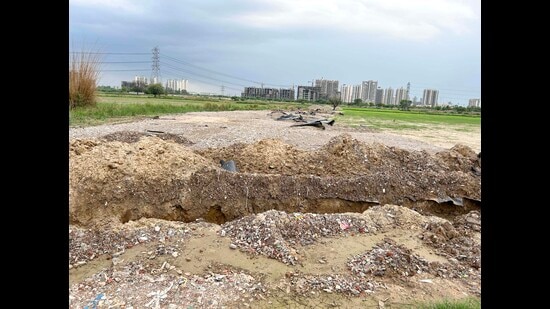
They argued that this move reflects a lack of vision by the Haryana government authorities towards waste management and will directly impact the health of residents in numerous societies and nearby villages.
All RWAs of the Dwarka Expressway protested against this unplanned move by the Haryana government. Farmers, residents, home buyers, investors, village Panchayats took part in the protest.
The protest, organized under the banner of the Dwarka Expressway Gurugram Development Association (DXP-GDA), saw over one thousand participants, including children, women, senior citizens and working professionals voicing their opposition to the proposed dumping site. The DXP-GDA represents the interests of all societies and villages along the Dwarka Expressway and New Gurugram, and they said that the protests would grow if the decision was not withdrawn.
The protesters raised several key concerns, including the repeated attempts to undermine the sectors along Dwarka Expressway and New Gurugram, marking this as the third such effort in recent years.
{{/usCountry}}The protesters raised several key concerns, including the repeated attempts to undermine the sectors along Dwarka Expressway and New Gurugram, marking this as the third such effort in recent years.
{{/usCountry}}Sunil Sareen, a resident of Sector 102 said that all residential societies and gated complexes in the area are mandated to maintain zero discharge facilities to independently manage their waste and contribute to a cleaner environment. “The proposed facility poses significant health and environmental risks, including increased pollution, foul odours and potential groundwater contamination due to the high-water table, which is approximately 5 feet in the area. There will be an adverse impact on future developments, such as the nearly complete 750-bed Maa Sheetla Mata Medical Hospital and Research Centre and the Chaudhary Charan Singh Agricultural University, which would be negatively affected by the waste processing facility,” he said.
Navdeep Singh, a resident of Sector 104, Dwarka Expressway, said that MCG’s negligence in implementing proper waste management practices is not only illegal but also a threat to our safety and health.
Moreover, the protesters argued that the MCG’s decision contradicts the Central government’s investment of ₹9,500 crore to develop a world-class Dwarka Expressway, a project led by Prime Minister Narendra Modi to make the area comparable to Singapore. Despite this significant investment, the proposed waste dumping site threatens to degrade the area and undermine its development.
In response to the protest, the DXP-GDA handed over a letter to the Deputy Commissioner and MCG Commissioner, with a copy to the chief minister of Haryana, expressing their grave concerns and demanding the halting of the proposed dumping site. Over 3,000 people also raised their concerns through an online signature campaign initiated by the DXP-GDA. Children participating in the protest highlighted the potential pollution and its adverse effects on their health and the environment.
MCG joint commissioner Naresh Kumar said that they had already finalized the spot and the decision can only be reversed by higher authorities. “Due to this protest, we are unable to start the new project. We cannot ask other districts to process the waste of Gurugram. The city’s waste will be processed in the city itself. If residents have an issue, then they should segregate and ensure they are bulk waste generators (BWG). According to the Solid Waste Management Rules, 2016, the BWGs should have a composting plant to compost their wet waste and dry waste should be recycled,” he said.