Nagaland Forest Department (NFD) on Monday announced the re-wilding of ten captive-bred juveniles of Asian Giant Tortoise (manouria emys phayrei) into Nagaland’s protected forest Ntangki National Park in Peren district.
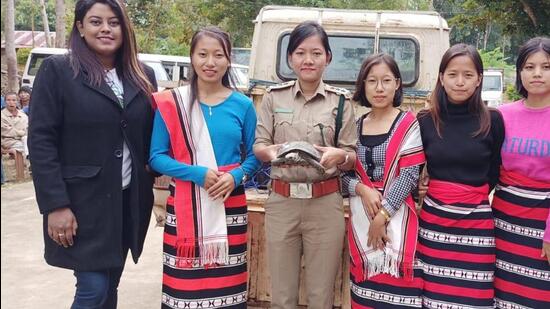
The process was done in collaboration with the Turtle Survival Alliance (TSA) and Wildlife Conservation Society India (WCSI).
“This first monitored rewilding of the critically endangered tortoise in India comes after over five years of conservation breeding efforts at Nagaland Zoological Park, Dimapur,” a statement from TSA said.
It mentioned that in December last year, ten captive-bred individuals were released in the Matamuhuri valley, Chattogram Hill Tracts of Bangladesh by the TSA and Creative Conservation Alliance.
“Nagaland Forest Department with the help of stakeholders and partner organisations is committed in long-term program to restore an ecologically viable population of Asian Giant Tortoise in the state,” said Vedpal Singh, Chief Wildlife Warden Nagaland.
Also Read:Odisha’s Nandankanan zoo plans re-wilding of captive tigers
“This pilot release is a major leap towards repopulating the species,” he added.
{{/usCountry}}“This pilot release is a major leap towards repopulating the species,” he added.
{{/usCountry}}“Having developed successful conservation breeding programs across species’ native ranges in India and Bangladesh, with regional partners, the release of these ten tortoises is a large step into the population replenishment phase”, Dr Shailendra Singh, principle investigator of joint Asian Giant Tortoise Recovery Project said.
“Today, Nagaland Zoological Park has the highest number of Asian Giant Tortoise population in India holding over 110 successful hatchlings and juveniles with 13 founder adults”, states Dr C Zupeni Tsanglao, director NZP.
Tracing the recent species donations at northeast Indian zoos, historic habitats and indirect evidence on-field, such re-wilding events shall be conducted in multiple phases at the most probable habitats achieving eventual reintroduction of the captive reared individuals, the TSA statement said.
“Currently in the first phase, animals will be soft-released or moved to a large natural enclosure with native habitat for acclimation throughout the winters and allowed to disperse into the forests at the onset of monsoon followed by active tracking by a joint project team”, said T Aochuba, director Ntangki National Park.
Soft release is described as gradual return of captive raised individuals to the wild.
“These ten juveniles were born in 2018, the first batch of the conservation breeding program initiated with NZP, and have an average weight of 2.4kg. The cohort underwent a thorough health examination by a panel of wildlife veterinarians, prior to their release”, informed Sushmita Kar, Asian Giant Tortoise project researcher.
This long-term Asian Giant Tortoise Population Recovery Program also engages with target local communities in the priority areas through awareness program, and community involvement, for sensitization against the hunting of released animals, and protection of important habitats, thus strengthening the participatory conservation initiatives and fostering sense of environmental stewardship in the identified sites inhabited by ethnic tribes who have age long tradition of protecting their local habitats as Indigenous Community Conserved Areas (ICCA).