A tiger was captured by camera traps in the last week of June in Surla village in north Goa, along the Karnataka border in the Mhadei sanctuary, for the first time after four tigers were poisoned in the area in January 2020.
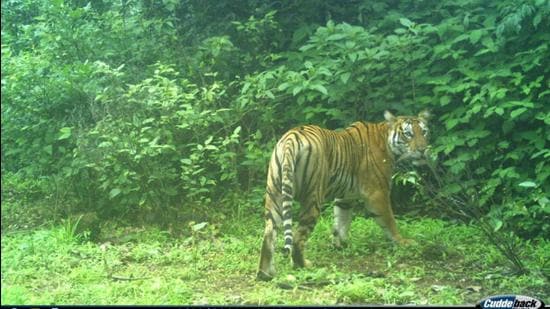
The tiger was captured by the department on June 23 and June 30, but evidence of its presence was visible earlier --a cow belonging to a villager was killed in the third week of June; it distinctly appeared to be the work of a tiger and not any other wild cat, said authorities.
“An adult tigress was spotted atop the Surla plateau along the border with Karnataka. It must’ve moved in from Karnataka as part of routine foraging. The presence of tigers is well established in the area,” chief wildlife warden Santosh Kumar told HT.
Also Read | Angry villagers attack forest guards after tiger killed two in Pilibhit Tiger Reserve
The Mhadei wildlife sanctuary was estimated to have five tigers in 2014, but subsequent counts placed the figure at three in 2018, the time of the last census. The sanctuary made news for the wrong reasons in January 2020, when an adult tigress and three male young adults were found poisoned to death. Forest officers arrested three male members of a tribal family and two more persons in connection with the suspected poisoning. All five were released on bail in a few days.
{{/usCountry}}The Mhadei wildlife sanctuary was estimated to have five tigers in 2014, but subsequent counts placed the figure at three in 2018, the time of the last census. The sanctuary made news for the wrong reasons in January 2020, when an adult tigress and three male young adults were found poisoned to death. Forest officers arrested three male members of a tribal family and two more persons in connection with the suspected poisoning. All five were released on bail in a few days.
{{/usCountry}}The present spotting, while in the same wildlife sanctuary, is some distance away from where the four were killed in 2020.
The National Tiger Conservation Authority (NTCA), which filed a report into the deaths of the tigers in the following months, said the management of the sanctuary left “much to be desired” and that without adequate strengthening of conservation efforts the place may become a “death trap for tigers.”
“Unfortunately, even after more than two decades of declaring Mhadei as Wildlife Sanctuary, it is managed on a completely ad-hoc basis as there exists no management plan for such an important sanctuary of the Western Ghats,” the report noted.
An NTCA team, during its field visits, observed that there was no proper protection mechanism inside the sanctuary, such as a network of well-connected anti-poaching camps (APC) at strategic locations manned by forest guards or watchers round the clock, which they said were “a very common feature of a well managed protected area (PA) or Tiger Reserve.”
“The protected areas of Goa (Mhadei WLS and Mollem WLS) are part of the Western Ghats landscape complex which has the unique distinction of having the world’s largest tiger population. This landscape has several interconnected tiger reserves and protected areas along with reserve forests. However, factors like plantations, agriculture, industrial and infrastructure development activities like widening of roads and railway lines are threatening the existing habitat connectivity in the Western Ghats. Without upgrading the legal status of Goa’s protected areas to that of a tiger reserve and putting in place a strong protection regime in place, the state may become a death trap for tigers dispersing in this landscape,” the NTCA noted.
Since the Goa government has been dragging its feet on acting on the NTCA report, an environmental NGO, the Goa Foundation, has approached the Bombay high court in Goa to direct the state government to act on the NTCA report and declare Goa’s wildlife sanctuaries as tiger habitats. The high court has asked the Union as well as the Goa governments to file detailed responses.