The Ghaziabad Development Authority (GDA) has planned an additional elevated corridor from the new New Bus Adda metro station to the Ghanta Ghar crossing on the Grand Trunk (GT) Road, the officials of the authority said.
According to the officials, the corridor will be part of an already planned elevated corridor from Ghanta Ghar to Bhatia Morh.
The GDA officials said that they recently inspected the site and planned that the two proposed corridors will be joined in order to ease traffic conditions on the GT Road, which takes commuters towards Gautam Budh Nagar, Bulandshahr, and further to Aligarh, and also connects to National Highway – 9 and the Delhi Meerut Expressway near Lal Kuan.
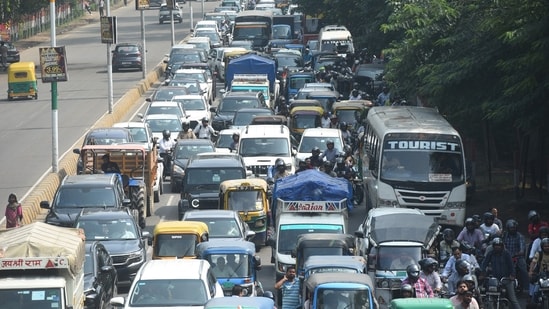
“Since there is a lot of traffic congestion on the GT Road and it remains a congested stretch, GDA has planned an additional elevated corridor from near the Metro station up to Ghanta Ghar crossing. In between, there is a two-lane Thakurdwara flyover, and this will be extended to four lanes as part of the new project. So, we will now have two corridors of four lanes, which will be joined, and commuters will seamlessly be able to cross the congested stretch of the GT Road,” GDA secretary Vivek Mishra told HT.
The GT Road stretch is a four-lane surface road in Ghaziabad, officials added.
{{/usCountry}}The GT Road stretch is a four-lane surface road in Ghaziabad, officials added.
{{/usCountry}}The officials said that the total length of the two corridors will be about 3.5 kilometres and the total cost involved is estimated at about ₹400 crore.
“The funds will be arranged from the Centre’s Urban Challenge Fund and also by GDA out of its funds. Additional funds will also be arranged with the help of loans. We will now get the detailed project report prepared. Once the project is finalised, it will take about three years to get complete,” Mishra added.
Earlier, on August 21, the GDA board cleared the proposal to fund the elevated corridor from Ghanta Ghar to Bhatia Morh at a cost of ₹200.23 crore, HT had reported.
The officials said that once the elevated corridors are constructed, long-distance commuters will be able to use them without getting stuck in traffic on the existing surface road.