The Gujarat government has intensified its crackdown on suspected illegal settlements following the Pahalgam terror attack in Kashmir last month, impacting Bangladeshi nationals residing near Chandola Lake in Ahmedabad. The area is often referred to as “mini-Bangladesh” due to its significant population of illegal immigrants.
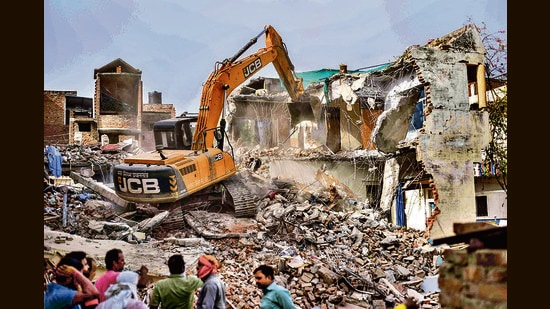
Launched on April 29 by the Ahmedabad Municipal Corporation (AMC) and the Gujarat police, authorities reclaimed over 1.5 lakh square yards of encroached land by Thursday.
“The operation marks Gujarat’s firm stance against illegal settlements and anti-national elements,” said Sharad Singhal, Joint Commissioner of Police (Crime).
The crackdown focused on multiple criminal networks operating in the area. Months ago, the Gujarat Anti-Terrorism Squad (ATS) had arrested four members of the banned Al-Qaeda in Indian Subcontinent (AQIS) from the same area, according to Singhal. All four were Bangladeshi nationals, and their case is currently under investigation by the National Investigation Agency (NIA), he added.
Intelligence inputs suggest that terrorists from groups such as Ansarullah Bangla Team (ABT) and Jamaat-ul-Mujahideen Bangladesh (JMB), recently released from prisons in Bangladesh, have been attempting to infiltrate India, according to Singhal. The demolition specifically targeted locations suspected of harboring such elements.
In addition to terror links, the area had become a hotspot for drug trafficking, with several cases involving Bangladeshi operatives, according to police. A major human trafficking and prostitution racket was also busted during the drive.
{{/usCountry}}In addition to terror links, the area had become a hotspot for drug trafficking, with several cases involving Bangladeshi operatives, according to police. A major human trafficking and prostitution racket was also busted during the drive.
{{/usCountry}}Over 70 earth movers, 200 dumpers, and 2,000 police personnel together razed approximately 4,000 illegal structures, including a 2,000-square-yard farmhouse linked to Mehmoodkhan Pathan, alias Lallu Bihari, who is accused of aiding illegal immigrants with forged documents, said a government official aware of the matter.
An FIR has been filed against him by the crime branch, and investigations continue to uncover ties to local politicians and police, highlighting his role in sustaining the illegal settlements for about one-and-a-half decade, the official added.
On Thursday, the AMC focused on clearing the remaining 40,000 square yards of illegal structures, deploying JCBs and dumpers with heavy police presence, the official said.
On April 30, the Gujarat cabinet, chaired by chief minister Bhupendra Patel, met to chart the future course of action for Chandola Lake. The cabinet, which includes home minister Harsh Sanghavi, approved a two-phase plan: first, completing the clearance of 40,000 square yards of illegal structures to restore the 2,965-acre water body under the Gujarat Land Revenue Code, and second, transforming the lake into a public amenity with potential green spaces and recreational facilities, backed by drone surveillance and police patrols to prevent re-encroachment.