Two days after environmentalists termed a Supreme Court ruling on mining in the Aravallis a “turning point”, experts on Saturday expressed concerns as well over the definition of the Aravallis.
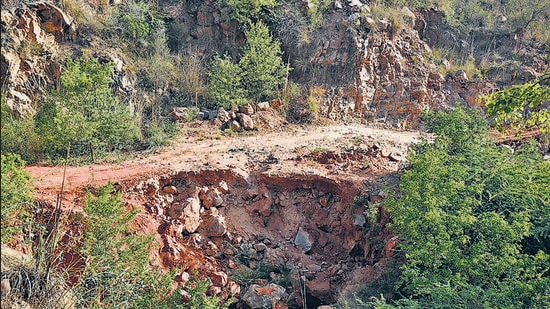
The November 20 order, passed by a bench led by Chief Justice BR Gavai, accepts the Union environment ministry’s recommendation to classify only landforms with a minimum elevation of 100 metres as part of the Aravalli hills. However, environmentalists say it could lead to exclusion of hundreds of smaller but ecologically vital hill systems across Gujarat, Rajasthan, Haryana and Delhi — potentially opening them for mining.
According to the apex court’s ruling, hills meeting the 100-metre elevation criteria and lying within 500 metres of one another will form the Aravalli range. While the bench directed that no new mining leases be issued until the Centre prepares a Management Plan for Sustainable Mining (MPSM) for the entire Aravalli stretch, experts claim the new definition itself is “worrisome.”
Neelam Ahluwalia, founder member of People for Aravallis, said the judgment is “a mixed bag.” Ahluwalia welcomed the halt on mining leases but claimed that the exclusion of low-elevation hills will break the continuity of the range and heighten environmental vulnerabilities.
{{/usCountry}}Neelam Ahluwalia, founder member of People for Aravallis, said the judgment is “a mixed bag.” Ahluwalia welcomed the halt on mining leases but claimed that the exclusion of low-elevation hills will break the continuity of the range and heighten environmental vulnerabilities.
{{/usCountry}}“These scrubby, low hills help retain water, conserve biodiversity, trap heat and regulate climate. Losing them will worsen dust pollution, water scarcity and extreme weather,” Ahluwalia said.
Environmental researchers said such a redefinition could have a negative impact on the range, especially in Haryana where forest cover is barely 3.6% and many Aravalli landscapes fall below the 100-metre threshold.
Ecologist Pia Sethi said Aravalli vegetation moderates wind velocity, preserves atmospheric humidity and influences local rainfall. A reduction in canopy cover caused by opening up smaller hills to mining could impact precipitation patterns and intensify heat stress across the region.
Environmentalist Tanuja Chauhan said the loss of green cover could further degrade air quality in Delhi-NCR.
Ecologist Ghazala Shahabuddin added that excluding lower hills from protection would shrink wildlife habitats, increase human-animal conflict and displace native species, including leopards, hyenas, jackals, civets, migratory birds and numerous reptiles.
The ruling has also raised questions about groundwater. Water conservationist Dr. Rajendra Singh said the Aravallis function as a crucial recharge zone, with highly fractured rocks allowing an estimated two million litres of groundwater recharge per hectare. “Disturbances caused by mining could alter aquifer patterns across Gujarat, Rajasthan and the NCR. Rural communities fear livelihood losses as well,” he said.
Grassroots leader Kailash Meena said that mining has already affected cattle-grazing areas and medicinal plant habitats, citing the example of Haryana’s Charkhi Dadri, once known for its ‘Harjor’ herbal medicine but now reduced to barren, dusty hills.
Retired forest officer RP Balwan said the new definition risks erasing large parts of Haryana’s fragile Aravalli terrain from official protection, potentially “undoing” decades of conservation efforts.