Continuous rainfall over the past 24 hours has provided relief from heat and humidity in the city, but it has also triggered widespread waterlogging, disrupted power supplies and exposed critical shortcomings in urban infrastructure.
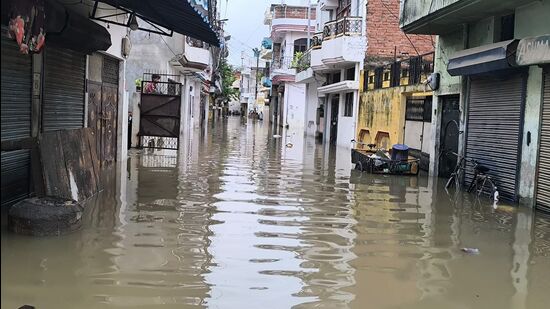
According to the India meteorological department (IMD), Prayagraj recorded 32.4 mm of rainfall in the last 24 hours. The spell, characterised by moderate-to-heavy showers on Tuesday followed by sustained rain beginning early Wednesday morning, has led to a welcome drop in temperature.
However, the downpour caused severe waterlogging in several localities, including Daraganj, Shivkuti, Chota Baghada, Johnstonganj, Baihrana, Allahpur, George Town, Tagore Town, Ghaus Nagar and Kareli, causing significant disruption for commuters and residents.
Jhunsi faced particularly difficult conditions, as poor drainage left several residential colonies submerged in knee-deep water. Residents reported that schoolchildren were forced to wade through dirty, overflowing drains to get home, struggling to keep their balance while their shoes and uniforms were soaked.
Prof BN Mishra, a weather expert and former head of the geography department at Allahabad University, noted that active low-pressure conditions over the Bay of Bengal are likely to persist, keeping similar weather patterns in place until August 7.
“If these low-pressure systems continue to develop over the Arabian Sea and Bay of Bengal in the coming weeks, the existing rainfall deficit may gradually be compensated,” Mishra said. He added that while Uttar Pradesh is currently facing a rainfall deficit of nearly 25 percent, favorable weather has provided adequate rain to northeastern states, Punjab, Haryana and various coastal regions. Central and northern India, however, remain in need of substantial rainfall.
{{/usCountry}}“If these low-pressure systems continue to develop over the Arabian Sea and Bay of Bengal in the coming weeks, the existing rainfall deficit may gradually be compensated,” Mishra said. He added that while Uttar Pradesh is currently facing a rainfall deficit of nearly 25 percent, favorable weather has provided adequate rain to northeastern states, Punjab, Haryana and various coastal regions. Central and northern India, however, remain in need of substantial rainfall.
{{/usCountry}}The heavy rainfall also severely impacted the city’s electricity supply. As a precautionary measure to prevent electrical accidents, power department officials shut down feeders in heavily waterlogged areas.
In Kareli, the feeder supplying the Makka Masjid area was switched off at 9:20 am By 9:50 am, power supply was suspended in Gaus Nagar, Neta Gali, and Madina Colony due to rising water levels. Adding to the residents’ difficulties, a loud blast at the Bakshi Bandh substation on Wednesday morning caused a blackout in surrounding neighborhoods, leaving residents of Nagvasuki facing extended outages while repair crews worked on-site. Earlier, a technical fault had disrupted supply in Daraganj late Tuesday night, with power not being restored until 3 am.
Officials stated that electricity in inundated areas will remain suspended temporarily for safety, with restoration planned once water levels recede and conditions stabilise.