MCG identifies over 17K illegal water connections in Gurugram
Many of these connections, officials said, were found in unauthorised colonies, commercial complexes, and rapidly growing residential sectors, where users bypassed official channels to tap into the municipal water supply. This not only caused unfair billing imbalances but also placed additional pressure on the already stretched public water distribution network
Gurugram: The Municipal Corporation of Gurugram (MCG) has identified at least 17,373 illegal water connections across the city and has started sending notices to the concerned property owners. These residents have been given 15 days to clear their dues and apply for legal, metered water connections, failing which their water supply will be disconnected and heavy penalties imposed on them, officials, aware of the matter, said on Thursday.
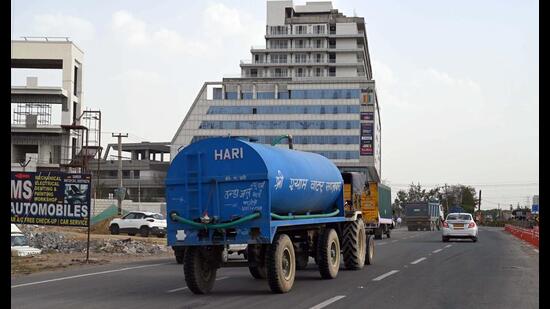
The MCG’s crackdown on illegal connections is expected to not only boost revenue recovery but also curb misuse, promote efficient water usage and create much-needed accountability in the city’s water supply system. (HT PHOTO)
{{^htLoading}} {{/htLoading}}
According to senior MCG officials, the penalty will be calculated based on the date of the Property ID being issued, effectively bringing long-standing defaulters into the legal framework. The civic body aims to plug revenue losses and ensure fair usage of water resources by targeting those who have been using municipal water illegally for years, without paying for it or being held accountable.
{{^usCountry}}{{/usCountry}}
Many of these connections, officials said, were found in unauthorised colonies, commercial complexes, and rapidly growing residential sectors, where users bypassed official channels to tap into the municipal water supply. This not only caused unfair billing imbalances but also placed additional pressure on the already stretched public water distribution network.
To maintain transparency, MCG meter readers are personally delivering the notices and taking written acknowledgment from each household or property owner. This documentation process is meant to ensure procedural accountability and avoid future disputes.
{{^htLoading}} {{/htLoading}}
{{^usCountry}}
“If any resident has doubts regarding the notice or wishes to get a legal water connection, they are encouraged to visit our Citizen Facilitation Centres at Sector 34, Sector 42, or the old MCG office opposite Civil Hospital,” said Pradeep Dahiya, MCG commissioner. Residents can reach out to the toll-free helpline at 1800-180-1817 for assistance, he added.
{{/usCountry}}
{{#usCountry}}
“If any resident has doubts regarding the notice or wishes to get a legal water connection, they are encouraged to visit our Citizen Facilitation Centres at Sector 34, Sector 42, or the old MCG office opposite Civil Hospital,” said Pradeep Dahiya, MCG commissioner. Residents can reach out to the toll-free helpline at 1800-180-1817 for assistance, he added.
{{/usCountry}}
The civic body has also clarified that no charges are applicable for the delivery of these notices. “If anyone demands money in the name of MCG or water connection regularisation, residents should immediately report the matter. The process is completely transparent and free of cost,” the MCG warned.
The entire process to apply for a legal water connection is now available online. Residents and commercial property owners can apply through the official website www.mcg.gov.in, where forms, documents required, and application tracking are all accessible.
{{^htLoading}} {{/htLoading}}
“This initiative is part of our larger goal to improve water management and ensure equity among citizens. Those who have been paying for legal connections should not be penalised indirectly due to the actions of defaulters,” additional commissioner Yash Jaluaka said.
The MCG’s crackdown is expected to not only boost revenue recovery but also curb misuse, promote efficient water usage, and create much-needed accountability in the city’s water supply system.
Leena Dhankhar is Senior Editor and Bureau Chief, Gurugram, at Hindustan Times, where she has spent over 17 years chronicling the transformation of one of India's fastest-growing urban regions. From starting her career as a crime reporter to leading the Gurugram bureau, her journalism has been defined by investigative reporting, in-depth storytelling and an unwavering focus on public interest.
Over nearly two decades, she has reported extensively across crime, politics, civic governance, elections, real estate, environment, courts, sports, education and entertainment, covering Gurugram, Faridabad, Nuh and Palwal. Her reporting has exposed several major scams and systemic failures, including insurance frauds, waste management irregularities, illegal arms manufacturing units in Nuh, illegal mining in the Aravallis, organised crime networks and governance lapses affecting millions of residents.
Known for her investigative work and exclusive stories, Leena has reported on high-impact national issues, including the Nicaragua charter flight carrying Indian migrants that was turned back amid allegations of human trafficking, exposing the growing network of illegal immigration rackets. Her work has also focused on gang wars, prison administration, juvenile crime, women and child protection systems, the functioning of the Juvenile Justice Board and Child Welfare Committee, and environmental challenges such as pollution, waterlogging and deteriorating civic infrastructure.
Beyond hard news, Leena has extensively documented Haryana's rich heritage, forests and wildlife, bringing attention to the state's historical landmarks, biodiversity, conservation efforts and ecological challenges through immersive reportage and feature writing.
Her journalism has consistently gone beyond breaking news. She has documented Gurugram's rapid urbanisation through long-form narratives and enterprise reporting on issues ranging from pothole-ridden roads, flooding and waste management to the changing social fabric of India's Millennium City. She also writes widely read feature columns, including The Outsider, Changemaker, and Concern for Gurugram, profiling people, places and ideas shaping the city's identity.
Leena is the author of Gurugram School Murder, published by Juggernaut Books, a deeply reported account of one of India's most high-profile school murder investigations. She is currently working on her second book, an investigative work exploring some of India's most significant scams and fraud investigations.
Beyond print journalism, she has expanded her storytelling through public speaking and digital media. She is a TEDx speaker and has produced podcasts exploring Gurugram's transformation, civic challenges and untold stories. Her work reflects a commitment to narrative journalism that combines rigorous reporting with compelling storytelling.
A law graduate with an MBA in Human Resources, Leena brings a multidisciplinary perspective to her reporting, particularly on governance, public policy and legal affairs. She has travelled extensively across India to pursue investigative assignments, often reporting from remote locations and conflict-prone areas in search of stories that matter.