
 E-Paper



Mizoram: Factionalism, politics cripple Chakma autonomous development council
The CADC representing the ethnic Chakma population is one of 10 such bodies under the Sixth Schedule, operating across Assam, Meghalaya, Mizoram, and Tripura.


The Chakma Autonomous District Council (CADC), headquartered in Kamalanagar, is facing a deepening political crisis, which has paralysed development plans for the community and eroded public trust.
Established in 1972 under the Sixth Schedule of the Constitution, the CADC was envisioned as a grassroots body for tribal self-governance, meant to uplift the ethnic Chakma population. Instead, it has become a stage for factionalism, where power struggles routinely eclipse public service.
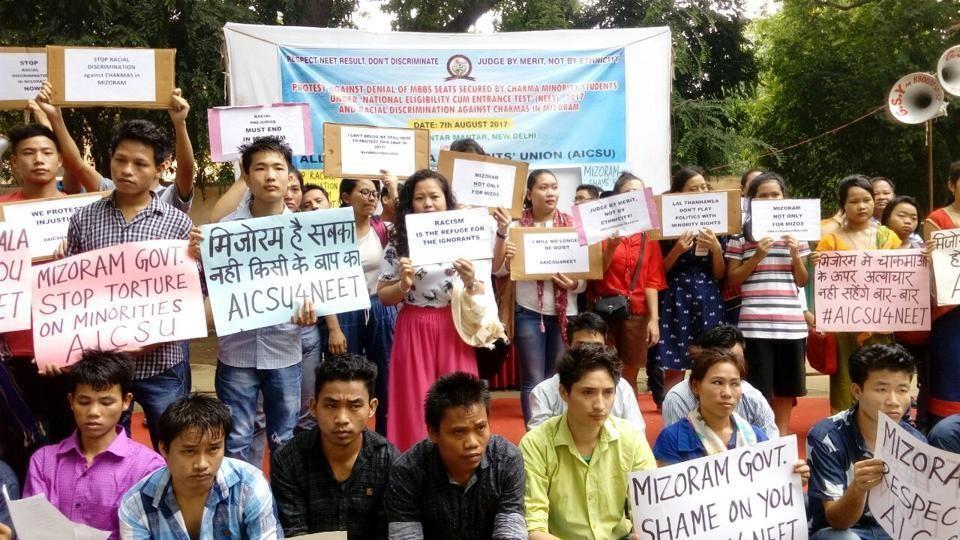
The stasis in CADC has triggered frustration and resentment among those who are vested in the state’s development. Parbesh Chakma, president of the Mizoram Chakma Students Union, for one, is strongly critical of the council.
“Chakma people are paying the price for our leaders’ incompetence,” Parbesh says, his tone measured yet edged with frustration. “We’re ignored, used, and misled. Nepotism runs deep, and education is not even on their agenda,” Parbesh, who returned home after years of studying in New Delhi, said.
His disillusionment is echoed by many young Chakmas who have grown up watching the very institution meant to safeguard their rights become a revolving door of unstable leadership. In just the last seven years, the CADC has seen seven chief executive members (CEMs) rise and fall, unseated through no-confidence motions and betrayals of party loyalty.
That dysfunction returned to the spotlight again on June 16, when CEM Molin Kumar Chakma who had led the first-ever BJP executive in the CADC—was ousted through a no-confidence vote. Molin had only been in office since February.
The power shift came after 12 BJP councillors defected to the Zoram People’s Movement (ZPM), giving the party a clear majority of 16 members in the 20-member council. Despite the numbers, the ZPM was blocked from forming the new executive, as Mizoram Governor VK Singh stepped in and imposed Governor’s Rule, citing “political instability.”
Juhnee Chakma, president of Chakma Mahila Samiti voiced her concerns. “Successive governments have consistently failed to meet the expectations of the public, with widespread poverty, unemployment, and unfulfilled promises contributing to a growing sense of disenchantment,” she said.
Juhnee attributed the crisis to endemic factionalism among political parties, where internal rivalries and the thirst for power take precedence over effective governance. “This is compounded by a weak democratic culture, where voters’ voices are ignored, council resources misused, and corruption normalised. The very foundations of democracy in the CADC are being eroded,” she added.
In the current 11th Council term, only one member—BJP’s Nirupam Chakma has remained loyal to his party. The remaining 19 councillors have shifted allegiances multiple times in pursuit of personal political gain.
Political analyst Lalhruaitluanga Kawlni, based in Aizawl, noted that council member Santosh Chakma has switched parties seven times in just two years. “Two others have changed allegiance six times, and four have done so five times,” he said. “With such instability, forming a sustainable government is nearly impossible.”
Repeated efforts by student organisations and civil society groups to restore order have so far been in vain. Delegations have met the Governor several times, appealing for action. “We’ve urged the Governor to consider an anti-defection law tailored for Sixth Schedule councils,” said Jyoti Bikash Chakma, president of the Central Young Chakma Association. “But it’s a slow and complex process, and until something concrete is done, this instability will continue.”
“Without an anti-defection law, no council members wanted to sit in the opposition bench, they changed their political alignments once they got an opportunity,” Jyoti Bikash added.
According to Parbesh, the political volatility has caused severe disruption in basic services such as education, healthcare, and infrastructure—directly affecting the quality of life in Chakma villages.
“Just look at our education system—it’s in shambles,” he said. “For 82 villages, there’s just one college offering only arts, and only one higher secondary school. Merit-based recruitment is non-existent. Deserving candidates are constantly overlooked. Even the healthcare system is hanging by a thread.”
The administrative paralysis has also triggered a financial crisis. The council currently faces a salary backlog of five months for its employees. A senior CADC official, asking not to be named, said the instability has pushed decision-makers to prioritise political survival over fiscal responsibility which led to short-sighted borrowing and poor financial planning that is damaging the council’s long-term stability.
“There’s a growing tendency to resort to ad-hoc measures, which only deepen the crisis,” the official said. “The result is a government too distracted by power games to focus on actual governance.”
Juhnee Chakma believes that only a united political front can break the cycle. “It’s time for our leaders to rise above petty differences and work toward a common vision for the CADC. We need to replace the culture of opportunism with one of accountability and constitutional integrity.”
A senior official on condition of anonymity said the president’s political instability is harmful for not only the CADC, but also the entire community.
“We are fed up with the political changes in the CADC, whatever development we have is being stalled because of their whimsical agendas,” H Nutan Chakma, president of All Chakma Employees of CADC, said. Nutan is a fisheries development officer.
The CADC’s recent history is a picture of dysfunction. During the 9th Council, five CEMs came and went in rapid succession. The 10th Council, formed in 2018, saw an unusual BJP-Congress alliance that lasted barely five months before collapsing just ahead of the Mizoram assembly elections that year.
The current 11th Council has already cycled through two CEMs. With BJP council members now defected to the ZPM, Lakkhan Chakma staked his claim to become the third. That was when Governor Singh stepped in and imposed Governor’s Rule citing “constant political instability.’
The CADC, an autonomous administrative body in Mizoram, representing the ethnic Chakma population, is one of 10 such bodies under the Sixth Schedule, operating across Assam, Meghalaya, Mizoram, and Tripura. Established on April 29, 1972, under the Sixth Schedule of the Indian Constitution, it functions as a regional government, exercising legislative, executive, and judicial powers over specific departments within its territory. In Mizoram, alongside the CADC, there are councils for the Lai and Mara communities.


