Renowned for its centuries-old perfume industry, the intense heatwave is wreaking havoc on flower production in Kannauj and diminishing the fragrance of rose, mehndi (henna), and bela, posing a formidable challenge to the scent-makers on the output front for the first time.
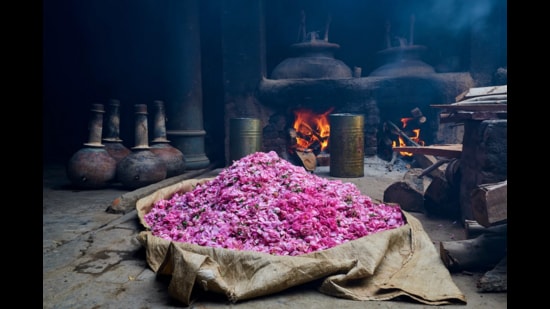
As a result, perfumers now find themselves utilising twice the usual amount of flowers to produce just 100 ml of perfume, compounding the issue of flower scarcity, with production plummeting by half and prices soaring by 40%.
The industry, which relies heavily on the daily early morning supply of fresh flowers for the meticulous steam distillation process, is witnessing a ripple effect across its 350 small and large units.
Flowers must be harvested and used the same day as they cannot be stored, making the supply chain particularly vulnerable to climatic variations.
“We use mostly rose, bela, and henna in this season. We are not getting sufficient oil from the flowers; we are now using double the amount of flowers to produce just 100 ml of fragrance, yet we are still falling short of achieving the fragrance intensity we’re accustomed to,” explained Khalilur Rehman, owner of one of the oldest perfumery firms dating back to 1880.
In Kannauj, flower cultivation spans approximately 250 hectares of land. The Kannauj development block contributes the most to the supply, said CP Awasthi, district horticulture officer.
{{/usCountry}}In Kannauj, flower cultivation spans approximately 250 hectares of land. The Kannauj development block contributes the most to the supply, said CP Awasthi, district horticulture officer.
{{/usCountry}}“The flowers, especially the light pink rose variety, predominantly come from Aligarh and its surrounding areas,” he added.
The flowers arrive at the distillation units between 7am and 10am daily. Mohammad Alam of SNDM perfumers said the flowers are swiftly processed using the “degh bhapka” or steam distillation method. Each brass cauldron can hold up to one quintal (100 kg) flowers, but due to shortage in supply, almost all units are operating at half capacity.
As a result, perfumers in Kannauj strive to maintain production amid reduced flower availability and diminished fragrance yields caused by adverse weather conditions.
“We have never encountered challenges of this magnitude before. Hopefully, we will see rain soon and the temperatures will decrease, restoring the natural fragrance and quality of flowers,” said Alam.
Scientists have noted that this year’s heatwave has been both exceptionally dry and intense, leading to a severe lack of soil moisture in flower farms. This moisture deficit has resulted in a high incidence of burning in the flowers, drastically reducing their fragrance concentration.
Dr Amar Singh, a scientist at the district agriculture centre in Kannauj, has been meeting farmers over the past month, discovering deep concerns about reduced yields and loss of essential oils from flowers. “Farmers are reporting that even after watering their flower farms, the moisture evaporates quickly. This is happening for the first time. We didn’t face such a situation last year,” he remarked. As a result, they are experiencing both lower yields and compromised flower quality. Everyone is now eagerly awaiting the onset of rain to alleviate these challenges.
For flowers to retain their fragrance, ample moisture in the fields is crucial. This year in Kannauj, temperatures have soared between 46 and 47 degrees Celsius, causing the soil temperature at depths of around one metre to increase by approximately 5 degrees. The prolonged high temperatures have resulted in dry soil conditions and scorching of flowers at their edges. As a consequence, the flowers are unable to yield their usual concentration of fragrance oils, said VP Tripathi, head of horticulture at Chandra Shekhar Azad University for Agriculture and Technology.
“We are closely monitoring the situation and advising farmers to increase irrigation,” he added. Ashish Pandey, a perfumer, explained the flower yield has been significantly reduced due to wilting of flowers, which has led to a 40% increase in prices.