
 E-Paper



Tension at Assam-Meghalaya border after mob attacks Karbi plantation site
The protesters dismantled wooden sheds and uprooted hundreds of saplings, triggering a confrontation that escalated when Assam Police resorted to firing five rounds of tear gas

 Prefer HTon Google


Shillong: Tensions flared yet again along the sensitive Assam-Meghalaya border on Wednesday, after a crowd of over 400 villagers from Lapangap and nearby areas in West Jaiñtia Hills in Meghalaya, backed by student unions and pressure groups, stormed a plantation site maintained by the Karbi Anglong Autonomous Council (KAAC) of Assam.
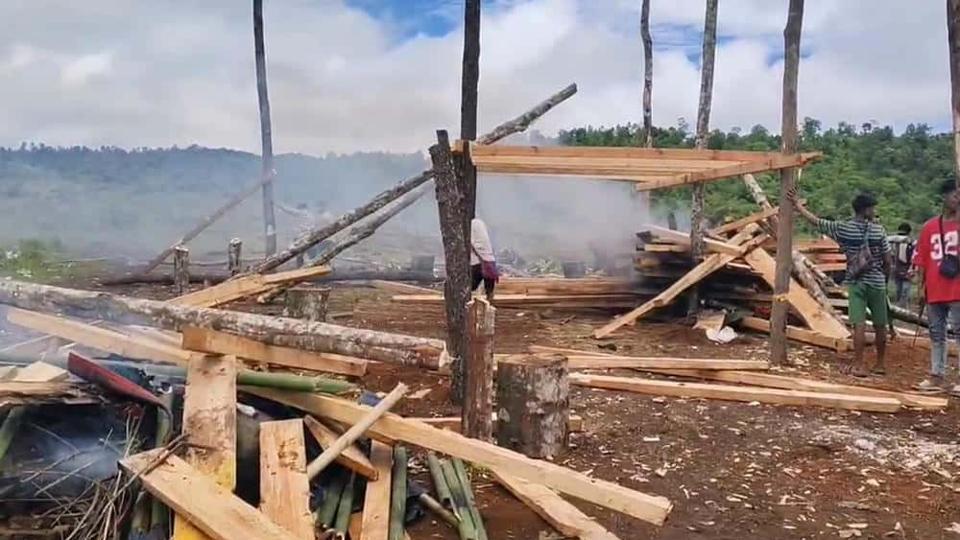
Accusing KAAC of illegally encroaching into Meghalaya territory, the protesters dismantled wooden sheds and uprooted hundreds of saplings, triggering a confrontation that escalated when Assam Police resorted to firing five rounds of tear gas. Two makeshift structures in the fields were also reportedly set on fire by Karbi locals.
The incident occurred between 11 and 11.30 am in Block I, a long-contested area along the 884.9-km Assam-Meghalaya boundary. West Jaiñtia Hills deputy commissioner Abhinav Kumar Singh confirmed that the plantation was carried out by KAAC “without any prior coordination” and despite ongoing peace efforts. “We had advised restraint as a peace meeting was scheduled at Tahpat village in the morning. But the Assam side didn’t turn up, prompting villagers to take matters into their own hands,” Singh said. “The plantation has now been halted, and police along with three border magistrates are stationed to monitor the situation.”
District superintendent of police (SP) Chemphang Syrti said, “A crowd of around 400 entered the plantation area and uprooted the saplings. Both administrations attempted to contain and disperse the crowd. The situation is now under control.”
The protest has found strong backing from civil society and students’ groups. A Khasi Students’ Union (KSU) leader warned, “This is a message. We will defend our land if the state cannot. Despite tear gas, we didn’t retreat.” Neilkee Mukhim, general secretary of the Jaiñtia Students’ Union (JSU), accused the Karbi side of violating a 2023 agreement to maintain the status quo. “They resumed planting despite prior understanding. Today’s action was necessary.”
The protest comes just weeks after the second Chief Minister-level round of border talks was held in Guwahati on June 2, 2025, between Meghalaya CM Conrad K. Sangma and Assam CM Himanta Biswa Sarma. This meeting was long delayed—originally planned following the first round of talks on May 17, 2023, where both leaders agreed to jointly visit disputed sectors including Block I and Block II. But that momentum was shattered by the Mukroh firing on November 22, 2023, in which six people were killed—one of them a forest guard—after a truck allegedly carrying illegal timber was intercepted. The killings, which took place in another part of Block I, triggered widespread outrage and unrest, putting all dialogue on hold.
The border issue between Assam and Meghalaya traces back to 1972, when Meghalaya was carved out of Assam as a separate state. The border was demarcated under the Assam Reorganisation Act, 1971—a framework Meghalaya has contested ever since. Over the years, the two states have held 32 rounds of official meetings, attempting to resolve 12 areas of difference spanning over 2,700 sq km.
After decades of deadlock, a breakthrough came in March 2022, when Assam and Meghalaya signed a Memorandum of Understanding (MoU) in New Delhi in the presence of Union home minister Amit Shah, resolving six of the 12 disputed sectors. Under this MoU, out of 36.79 sq km of contested land, Assam retained 18.46 sq km and Meghalaya received 18.33 sq km—a near-equal division hailed as a model for cooperative federalism.
However, the six unresolved areas—including Block I, Block II, Langpih, Deshdoomreah, Khanduli, and Nongwah-Mawtamur—remain flashpoints, particularly due to ethnic sensitivities, historical claims, and lack of ground-level enforcement.
During the second round of talks held this month, both CMs agreed to begin erecting border pillars in the six resolved sectors by August 15, 2025. Further discussions will continue through regional committees headed by cabinet ministers of both states.
Crucially, both states have also agreed to bring science to the table. The North Eastern Space Applications Centre (NESAC) has been tasked with conducting a high-resolution satellite imaging survey to map forest boundaries, natural drainage lines, and settlement patterns across the disputed zones. This neutral data will serve as a scientific basis for further demarcation, help mitigate future conflicts, and feed into broader environmental and infrastructural planning.
“Once the NESAC survey is complete within three months, we’ll engage technical experts like IIT Roorkee to analyse the data and suggest actionable solutions,” chief minister Sangma said after the meeting. “It’s not just about border lines—this is about understanding the terrain, the people, and the ecosystem.”
The talks also saw a tentative agreement to jointly commission the Kulsi multi-purpose hydroelectric and irrigation project, with both states pledging to consult local communities before implementation. Sangma described the initiative as “a symbol of Assam-Meghalaya friendship,” with potential for boosting power generation, irrigation, and tourism in both states.
But as Wednesday’s unrest at Lapangap proves, ground-level sentiment often moves faster than policy promises. A fresh round of peace talks between Lapangap and Tahpat village councils is now scheduled for Thursday. Whether this results in genuine de-escalation—or simply paves the way for another confrontation—will depend on how quickly the decisions made in Guwahati translate into action on the ground.
Even after 32 meetings and two chief minister-level rounds of talks, the road to peace along the Assam-Meghalaya border remains perilous.


