In one of the first attempts at trans-boundary collaborations to tackle air pollution, India has begun working with Pakistan to set up real-time air quality monitors.
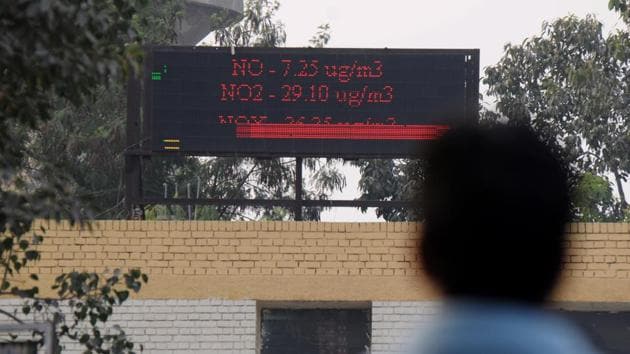
A citizen science collaboration by air pollution researchers from UrbanSciences in Mumbai and Pakistan Air Quality (PakAirQuality) Initiative in Islamabad is providing open data in Pakistan for citizens to get timely updates on air pollution across several major cities.
The decision was taken during an air pollution conference organised by the US state department ‘s ‘Clean Air for South Asia’ TechCamp in Kathmandu, Nepal last week. The first monitor went online in Karachi on Friday, reporting particulate matter (PM2.5 and PM10) data. A team in Pakistan is in the process of raising funds for additional air quality monitors to be installed in Karachi, Lahore, Islamabad and a few other cities.
Pakistani government officials, at the sidelines of the conference, told HT that air quality data was insufficient in Pakistan, as the government was not dispensing necessary funds. In Pakistan, different provinces are responsible for recording and maintaining air quality information, while the central government does not get involved directly, the official added.
“We are currently using outdated air quality equipment for major cities obtained under a Japan International Cooperation Agency (JICA) from as early as 2007. While the project ended in 2012, the air quality monitors are still being used. Considering the stringency of international parameters (safe limits), we are not sure how effective the data is in 2019,” said Zaigam Abbas Baloch, deputy director of the Pak Environment Protection Agency, Ministry of Climate Change “The data is not real-time, but we are able to provide it after 24 hours. However, near real-time updates are being generated for Islamabad, which needs to be replicated across other cities.”
{{/usCountry}}“We are currently using outdated air quality equipment for major cities obtained under a Japan International Cooperation Agency (JICA) from as early as 2007. While the project ended in 2012, the air quality monitors are still being used. Considering the stringency of international parameters (safe limits), we are not sure how effective the data is in 2019,” said Zaigam Abbas Baloch, deputy director of the Pak Environment Protection Agency, Ministry of Climate Change “The data is not real-time, but we are able to provide it after 24 hours. However, near real-time updates are being generated for Islamabad, which needs to be replicated across other cities.”
{{/usCountry}}According to Baloch, Pakistan currently has 20 manual air quality monitoring stations across cities namely Karachi, Lahore, Peshawar, Quetta, and Islamabad.
Baloch said the Ministry of Climate Change had reached out to the Pakistan government for more funds, considering the urgency of addressing the health impacts of air pollution. “The project can’t be named as of now, but we will enhance our monitoring situation and it will be funded by China,” he said, adding, “Citizen movements (mostly sponsored by the US) are welcome, but they are not fit for monitoring air quality vis-a-vis Pakistan’s safe standards, and we do not consider this as our official data.”
Air pollution is the greatest environmental risk to health currently with an estimated seven million premature deaths every year, according to the World Health Organisation (WHO). The 2018 World Air Quality Report released in March by non-profit Greenpeace and IQ AirVisual, a software company that tracks pollution worldwide, said Asian cities dominated the highest 100 average PM2.5 levels during 2018, with cities in India, Pakistan, China and Bangladesh among the top 50 cities.
Citizen science-based air quality has the power and potential to fill the gaps in the government-based air quality monitoring, said Ronak Sutaria, founder and director, UrbanSciences. “The larger goal of this collaboration and initiative is to enable a more informed dialogue around air quality between citizens, civic officials and policy makers to better address the trans-boundary issue of air pollution between the two countries,” he said.
The idea was first discussed during a conference in December 2018 when PakAirQuality team showed interest in India’s first scientifically validated ‘Atmos - Realtime Air Quality’ monitors by UrbanSciences. In the recently concluded TechCamp, the first monitor was handed over to the PakAirQuality team. “Our aim is to promote local, national and cross-border efforts to address clean air as a global environment priority to combat air pollution and promote government transparency in South Asia,” said Jamie Findlater, senior consultant, TechCamp team under the US State department’s Bureau of International Information Programs.
In India, air quality is being monitored at 779 locations covering 339 cities in 29 states and six union territories across the country, under the National Air Quality Monitoring Programme (NAMP). Further, real-time monitoring is taking place at 170 locations in 103 cities in 18 states and UTs, according to the Union environment ministry. Additionally, under the National Clean Air Programme (NCAP), the environment ministry has released funds for installation of 65 continuous ambient air quality monitoring (CAAQM) stations across 25 cities in 13 states and one UT by 2020.
Abid Omar, who founded the PakAirQuality Initiative, a citizen network of 40 low-cost air quality monitors across 10 cities in Pakistan, said there was no official real-time monitoring by the Pakistan government. “We feel that in terms of awareness we are probably three or four years behind India. However, citizens’ efforts have begun helping draw more attention to this subject,” he said. “What started as an idea is slowly being implemented with setting up of low-cost monitors in Pakistan with the help of UrbanSciences. Awareness will rise if more stakeholders get involved.”