A team led by Indian radio astronomers has discovered 34 new giant radio sources (GRSs) using the Tata Institute of Fundamental Research (TIFR) Giant Metrewave Radio Telescope (GMRT) Sky Survey Alternative Data Release 1 (TGSS ADR1) at 150 MHz. Some of these are among the most distant objects of this type. Two of these objects defy the widely accepted notion about their environments. The GRSs are among the largest objects in the universe and their enormous size and rarity has puzzled astronomers as to how they grew to such a gigantic size.
The team of astronomers comprises two PhD students, Netai Bhukta (SKBU, India) and Souvik Manik (MCC, India); and two astronomers, Sabyasachi Pal (MCC, India) and Sushanta K Mondal (SKBU, India). They used TGSS for their research due to its low frequencies and the sensitivity of the GMRT. The team discovered 34 GRSs during their research.
Sabyasachi Pal said, “GRSs, some of the Universe’s most colossal structures, span millions of light years, equivalent to lining up several tens of Milky Ways in a row. At the heart of the GRSs lies a supermassive black hole, typically with a mass ranging from ten million to one billion times that of the Sun. Serving as the central engine, this black hole pulls in the surrounding matter, which becomes ionised, creating a powerful electromagnetic force that propels the material outward to the edges. The resulting jets of hot plasma produce massive lobes of radio emissions, spanning much greater distances than the visible size of the galaxy.”
Astronomers believe that GRSs represent the final stage of radio galaxy evolution due to their enormous sizes. Netai Bhukta said, “Such enormous projected lengths of GRSs make them interesting candidates for understanding the evolution of radio sources and studying the intergalactic medium that confines the lobes far from the parent galaxy. However, detecting such GRSs is challenging because the bridge emission connecting the two lobes is often not visible. Low-frequency radio surveys are better suited for identifying this population than higher-frequency radio surveys as the aged plasma is brighter at low frequencies.”
{{/usCountry}}Astronomers believe that GRSs represent the final stage of radio galaxy evolution due to their enormous sizes. Netai Bhukta said, “Such enormous projected lengths of GRSs make them interesting candidates for understanding the evolution of radio sources and studying the intergalactic medium that confines the lobes far from the parent galaxy. However, detecting such GRSs is challenging because the bridge emission connecting the two lobes is often not visible. Low-frequency radio surveys are better suited for identifying this population than higher-frequency radio surveys as the aged plasma is brighter at low frequencies.”
{{/usCountry}}Two of the GRSs (J0843+0513 and J1138+4540) challenge the common understanding that GRSs grow in low-density environments. Souvik Manik said, “The environment alone does not play a major role in the exceptionally large size of GRSs. We plan to present new GRS samples in our forthcoming articles, along with detailed physical properties based on multi-wavelength observations, to unveil the mystery. This discovery has been published in the Astrophysical Journal Supplement Series (APJS) of the American Astronomical Society.”
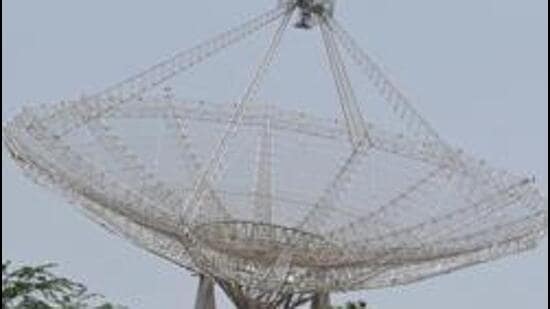
The GMRT is located near Khodad village, approximately 90 km north of Pune. It was built and is being operated by the National Centre for Radio Astrophysics (NCRA) Pune of the TIFR. Between 2010 and 2012, a survey was carried out using the GMRT to map the radio sky at 150 MHz, known as the TIFR GMRT Sky Survey (TGSS) covering about 90% of the sky.