Professor Yasmin Shaikh, the noted Marathi grammarian, linguist and teacher who spent more than seven decades studying, teaching and enriching the language, died due to age-related ailments in Pune on Monday. She was 101.
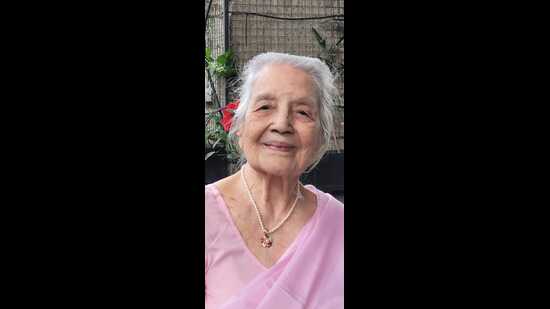
Born Jerusha Ruben into a Jewish family in Pune, she grew up surrounded by Marathi books. She married Aziz Ahmed Ibrahim Sheikh in 1949 and adopted the name Yasmin. She is survived by two daughters, Shama and Professor Rukhsana.
Shaikh studied at Sir Parashurambhau College in Pune and went on to teach Marathi for 34 years at school and college levels. She headed the Marathi department at SIES College in Mumbai and later taught grammar and linguistics to civil-service aspirants at the State Institute of Administrative Careers.
Her influence extended well beyond classrooms. She spent seven years working on Marathi textbooks published by Balbharati and was involved in preparing Karyatmak Vyakaran. She was also associated with Antarnaad as its grammar consultant.
Her Marathi ‘Shabdalekhankosh’, first published in 2007 and revised in 2015, became an important reference for standard Marathi spelling and usage. Her Marathi Lekhan Margadarshika, published by the State Marathi Development Institute, was designed to help students, teachers, writers, officials and ordinary users write Marathi correctly.
{{/usCountry}}Her Marathi ‘Shabdalekhankosh’, first published in 2007 and revised in 2015, became an important reference for standard Marathi spelling and usage. Her Marathi Lekhan Margadarshika, published by the State Marathi Development Institute, was designed to help students, teachers, writers, officials and ordinary users write Marathi correctly.
{{/usCountry}}Even in her late nineties, she continued writing the Bhashasutra column for Loksatta, responding to questions on grammar and correct usage from readers in India and abroad.
Her insistence on standard Marathi was firm. She believed spoken varieties could differ across regions, but writing required adherence to accepted standards until the rules themselves were formally changed.
“Language has no religion,” she said in an old interview. “The language of the country where you grew up becomes your mother tongue.”
On another occasion, when asked about her command of Marathi, her answer was characteristically uncomplicated: “Marathi is my mother tongue.”
For generations of students, teachers, writers and editors, Shaikh was not merely a grammarian but a patient teacher who made grammar less intimidating and language more accessible. “Marathi language and Yasmin Shaikh are inseparable, and will remain so,” said Dilip Phaltankar, who knew her closely. He recalled her as a scholar with “very profound and important” knowledge of Marathi grammar and linguistics, but also as a warm, affectionate, and humble person who maintained relationships across generations.
Her former students and colleagues remembered her ability to explain the most difficult grammatical questions in simple language. Sushil Dhaskate, a novelist and scholar of linguistics who worked with her at Antarnaad, recalled that she answered his many questions about grammar while he was working on the proofs of her Marathi Shabdalekhan Kosh.
“She was a teacher to the core. The fear of grammar disappeared, and an interest in the subject developed,” Dhaskate said.
That ability to turn grammar into something approachable remained one of her defining qualities. Shaikh observed that grammar could seem dry and boring to children, but became easier to understand when studied alongside linguistics.
Her contribution was recognised with several honours, including the Dr Ashok Kelkar Award, the Fatima Bi Shaikh Satyashodak Award and, in 2025, the first ‘Marathi Bhasha Jeevangaurav’ award for her work in grammar, standard writing and linguistics. The award citation noted that her work would have a permanent place in the history of the Marathi language.
For Shaikh, language was never an academic exercise alone. It was a cultural inheritance that had to be understood, used carefully and passed on.
“Marathi is beautiful, rich and meaningful,” she had said. For more than seven decades, she lived by that conviction.
With her death, Marathi has lost one of its most devoted teachers and careful custodians — a scholar who spent a lifetime ensuring that its words were not merely spoken, but understood.
Chief minister Devendra Fadnavis described the passing of Shaikh as the “personality that lent meaning and beauty to Marathi words has been lost...”
Fadnavis said, the work done by Prof. Yasmin Sheikh for the purity of the Marathi language, for its beauty, and for instilling a fondness for the language in the new generation will forever remain etched in memory. “Her bond with words was not merely one of study, but of boundless love for Marathi.”