A new study by researchers at the Inter-University Centre for Astronomy and Astrophysics (IUCAA) in Pune has taken a major step forward in measuring how fast the universe is expanding. The research team, led by Professor Anupam Bhardwaj, has used a special kind of star called the ‘Mira variable star’ to get one of the most precise measurements of the Hubble constant (the expansion rate of the universe).
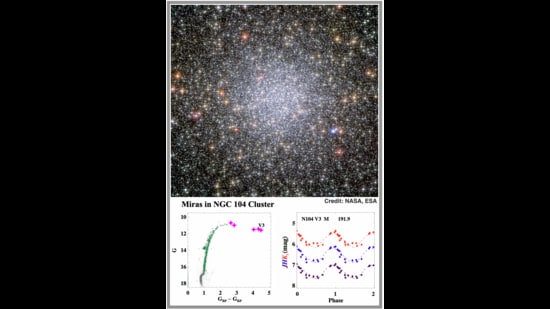
As per the information given by IUCAA scientists, Mira, also known as Omicron Ceti, is a famous star that changes its brightness regularly. These are giant stars in the last stages of their life. The important thing about Mira stars is that their brightness is linked to how long their cycle is. Because of this, astronomers can use them as ‘standard candles’. A standard candle is an object in space whose true brightness is known. By comparing its actual brightness to how bright it looks from Earth, scientists can calculate how far away it is.
Professor Bhardwaj and his team have studied 40 oxygen-rich Mira stars in 18 clusters of stars in the Milky Way galaxy. With the help of precise distance measurements from the European Space Agency’s Gaia mission, they could calculate the true brightness of these stars. Using this data, they created a highly accurate relationship between the period, or time, of their brightness cycle, and their brightness. This new calibration allowed them to measure the Hubble constant with a very high precision of 3.7 percent. Their findings were published in the science journal, Astrophysical Journal.
Professor Bhardwaj said, “We used Mira stars in our galaxy as anchors for the first time to calculate the cosmic expansion rate. These stars are less affected by metal content than Cepheids, which makes them a very reliable tool.” Nobel Prize winner Adam Riess from the Space Telescope Science Institute and Johns Hopkins University is also a co-author of the study. He explained, “This work shows that the Hubble tension is real and not due to mistakes in measurement, possibly hinting at new physics.” Another co-author, Dr Marina Rejkuba from the European Southern Observatory, said, “This work will have a long-term impact by proving that Mira stars can serve as a new and strong anchor in measuring the Hubble constant.”
{{/usCountry}}Professor Bhardwaj said, “We used Mira stars in our galaxy as anchors for the first time to calculate the cosmic expansion rate. These stars are less affected by metal content than Cepheids, which makes them a very reliable tool.” Nobel Prize winner Adam Riess from the Space Telescope Science Institute and Johns Hopkins University is also a co-author of the study. He explained, “This work shows that the Hubble tension is real and not due to mistakes in measurement, possibly hinting at new physics.” Another co-author, Dr Marina Rejkuba from the European Southern Observatory, said, “This work will have a long-term impact by proving that Mira stars can serve as a new and strong anchor in measuring the Hubble constant.”
{{/usCountry}}