The Pune Municipal Corporation (PMC) plans to create two family-friendly public spaces in each municipal zone by 2026 by repurposing underused areas and making them more accessible to young children and caregivers.
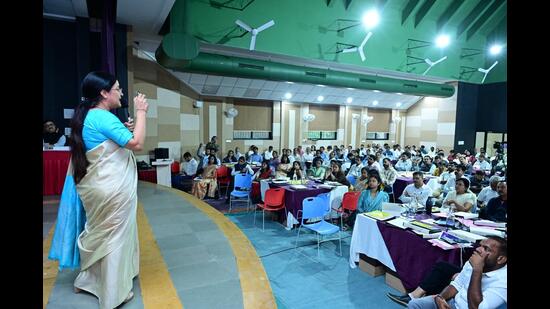
PMC additional municipal commissioner Pavneet Kaur outlined the plan at an early childhood development (ECD) workshop at Yashada on Sunday, highlighting Pune’s use of existing civic infrastructure for child development.
“The proposed spaces will enhance caregiver wellbeing through facilities such as crèches and peer-support groups for caregivers, while the PMC intends to institutionalise a child- and caregiver-centric approach through changes in planning processes, training and partnerships,” said Kaur.
As part of the session on “Urban95 – Infrastructure creation keeping children at the centre of development: Building urban spaces for children and caregivers,” Kaur presented Pune’s experience as a Lighthouse City under the Urban95 programme with presentation highlighting the city’s efforts since 2018 to improve public spaces, services and streets for young children aged 0-6 years and their caregivers.
The civic body has spent over ₹5.5 crore since 2018 on child-friendly public-space projects. Parks, primary health centres (PHCs), maternity homes, Anganwadis and streets are being used as ECD infrastructure.
{{/usCountry}}The civic body has spent over ₹5.5 crore since 2018 on child-friendly public-space projects. Parks, primary health centres (PHCs), maternity homes, Anganwadis and streets are being used as ECD infrastructure.
{{/usCountry}}At Lumbini Park in Yerawada, extending operating hours to 7 pm-9 pm, with lighting and CCTV, increased footfall by 30%, allowing more working fathers and male caregivers to use the park with their children.
At Kamla Nehru Hospital, an early stimulation corner uses the one- to two-hour immunisation waiting period for play, learning and parent-child interaction. A similar facility has been introduced at Rajmata Jijau Nursing Home in Parvati Paytha.
The PMC’s Pune Kids Festival drew more than 2.5 lakh participants, including over 1,01,877 children, with more than 90,600 aged 0-6 years. It also engaged over 1.38 lakh caregivers, 49% of them male.
The presentation reported a 60% increase in time spent by children and caregivers at child-centric locations, a 45% rise in footfall at parks, open spaces, Anganwadis, PHCs and maternity homes, and a 68% increase in caregivers walking to these facilities. An estimated 1.63 lakh young children benefited.
Chief minister’s principal secretary Shrikar Pardeshi said the first 1,000 days, from conception to a child’s second birthday, were crucial, with interventions during this period affecting health, education and future productivity.
He said Maharashtra had reduced stunting from about 46% in an earlier National Family Health Survey round to around 29.5% in the latest, but needed faster progress on social indicators.
Pardeshi said ECD required coordination among health, women and child development, education, tribal development, urban development, and water and sanitation departments.
He cited Meghalaya’s ECD experiment, presented at the prime minister-chaired chief secretaries’ conference, as a model Maharashtra could adapt. The workshop, he said, aimed not to launch new schemes but to identify gaps, scale successful interventions and develop measurable solutions.