
 E-Paper



Taste of Life: Monkey-Nut, bladder bait nets prized fish in Poona waters
Article written by army man, with pseudonym Felix, in “The Country Gentleman and Land & Water Illustrated” (August 10, 1907) documents some “eccentric practices of fishing” in 19th century Poona


Pune: Culinary archives, which are often considered to comprise cookbooks and menus, offer a fascinating glimpse into the world of historical gastronomy. They allow us to explore the culinary customs, traditions, and practices of different geographical regions, religions, societies, and eras.
While it is indisputable that culinary archives serve as the custodians of our culinary heritage, preserving the essence of recipes that have been handed down through generations, it should be understood that they are not the only gateways to the past, offering insights into the diverse cuisines and cultures that have shaped our culinary landscape. Stories of families, communities, and civilisations are found within the pages of old cookbooks. But they are also found in education, commerce, and trade reports, jail manuals, army rulebooks, economic databases, agricultural journals, religious texts, and sports magazines. A vital link between the culinary past and present could be traced through literary and oral memoirs, and even fiction.
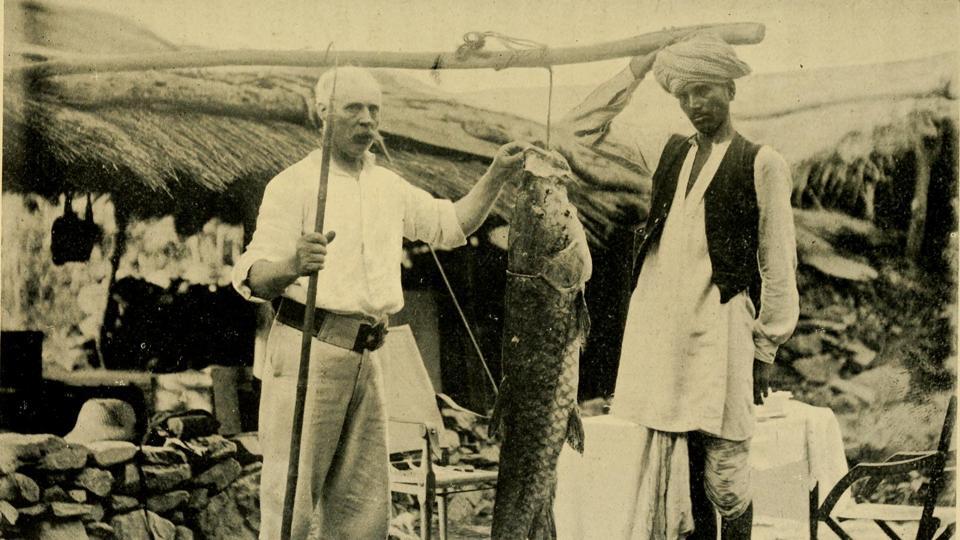
An article written by an army man, with the pseudonym Felix, in “The Country Gentleman and Land & Water Illustrated” (August 10, 1907) documents some “eccentric practices of fishing” in the nineteenth-century Poona.
Europeans arriving from their homeland carrying guns and rifles in and around Poona was not a rare sight at all at that time. India was known as a land of sport, and the Europeans believed that no other country had the abundance and variety of games for guns and rifles. But few carried a rod for fishing with them.
In India, fishing was very much the poor relation that was often side-lined for hunting. Though Europeans living in Poona missed fishing, they felt that neither the fish nor the rivers could compare with those at “home”.
The fish that changed the scenario was the Mahseer, a delicious freshwater fish of the Indian rivers.
Mahseer was abundant, but difficult to catch. If the Europeans in Poona were asked whether there was any fishing in the neighbourhood, they would invariably answer “No”, that there were lots of fish, but no one could catch them. Europeans coming from Northern India to Poona missed fishing in the cool weather and colder streams. They would mind the dry heat and wading in warm water.
In the cold weather – December, January, and February – it was generally agreed that Mahseer and some other species of fish simply will not take the bait. The native fishermen of Poona would tell the European anglers that the Mahseer’s mouth was “sewed up” during this season. During the summer, the sun was usually too bright for the fish to rise. September to November was the ideal season to catch Mahseer.
Felix, in his aforementioned article, wrote about fishing the Mahseer in the Bolan and Moola rivers in Baluchistan during his many years in India.
On May 8, 1876, he found himself in the Bolan Pass as a member of Sir R Sandeman’s escort. The troops, over one thousand strong, were encamped at Bebi Naai beside the Bolan River. As soon as business was over and he was free, he took the top piece of an Irish split salmon rod to the stream and made a cast, which was immediately responded to. He landed a dozen Mahseer in as many minutes and left them in the shadow of a rock.
On the Moola River, a few miles away from the Bolan River, soldiers shot the fish. Shooting fish was a common practice amongst natives in all parts of India. The fish were shot as they basked idly near the surface in the heat of the day. The waters being mostly shallow, the fish was easily secured when stunned by a bullet.
Shooting fish was not an uncommon practice in Poona, too. But Felix wrote about two unusual methods of fishing in his article.
At Kirkee, Mutha River was narrowed to a small waterfall rolling over the large boulders. At this point, the stream could be crossed without difficulty. The river was about fifty or sixty yards wide and contained very large fish.
According to Felix, the fish would not look at a fly spoon or minnow, but they would take live bait, and would rise to a floating monkey-nut carefully threaded onto a hook. The monkey-nuts were cultivated at Poona, and two pounds fresh from the fields could be bought for two annas in 1904. The hook was supposed to be twice passed through the kernels and allowed to hang out and remain clear of the nut.
A handful of nuts were hurled into the stream by the waterfall, and after a day or two, before the floating nuts had travelled far, they would all have disappeared. Before going fishing himself, Felix sent a servant morning and evening to bait the place, and after three days, the river was ripe for sport.
Once, when he visited the river with Major Waudby, they had no time to prepare the stream, and the nuts were not touched until they had floated far beyond the reach of their rods. In the circumstances, they joined their lines with a fairly strong thread and cross-lined. From each of their lines hung two nuts, the nearer nut to themselves having a longer gut, to cause all four nuts to touch the water simultaneously.
The scheme succeeded. Felix was on the northern bank, and Waudby on the opposite side. A fine fish rose to one of his nuts, and the strain of the fish caused the thread to break. Felix wound up his line and became a spectator. The battle went on till after dark; in fact, he had to collect some wood and light a fire so that Waudby might see what to do.
At last, Felix gaffed the fish. It weighed 18 lbs, and with it was another hook and fifty yards of salmon line, evidently lost by some other sportsman.
Otters were common in the river, and on a certain occasion, one of them stole a fish which Felix had placed in a cavity amongst the boulders behind his stand-point.
It was not bad fun on a sultry day to obtain a bullock’s bladder, and at the neck was fixed an ounce bullet to keep the bladder erect. Through the bullet, two ends of strong brass wire were passed, which were turned upwards, and to the horns thereof, gut and monkey-nut were added. Then fifty or sixty yards of silk thread were taken, and a stone was fastened to one end by the waterfall. The bladder was let go.
When the fish took the bait, the thread broke, and the bladder “danced merrily”, as Felix put it, until the fish was exhausted. A small boat was, of course, necessary, unless one had a native fisherman to swim to the bladder and draw it gently to the bank. According to Felix, to sit with a friend in the shade with a pipe, book, and luncheon basket with, say, one or two bladders at large was a very pleasant way to pass “the long, long Indian day”.
Food history is not an island. The history of agriculture, politics, economics, politics, ethnicity, geography, feminism, etiquette and manners, religion, caste, and science all contribute to the history of food. To limit it to an ingredient, or a dish, a recipe, or etymology is a great injustice to documenting the way our ancestors ate.
Chinmay Damle is a research scientist and food enthusiast. He writes here on Pune’s food culture. He can be contacted at chinmay.damle@gmail.com


