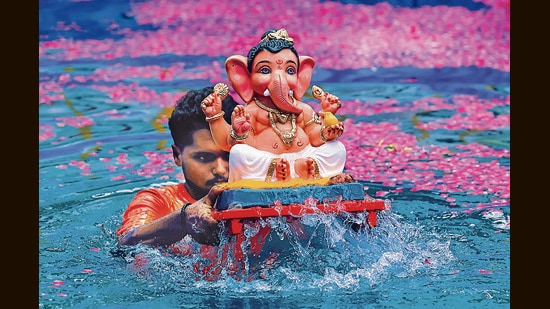
During the Peshwa period, Ganeshotsav in Maharashtra was celebrated from the fourth day to the tenth day of the bright half of Bhadrapada. It was a religious festival, centred mainly on “kathas”, “kirtans”, and other devotional programmes. During the reign of Sawai Madhavrao, the festival at the Ganesh Mahal in Shaniwar Wada grew into a grand affair. On the tenth day, the idol was carried in a flower-decked palanquin in procession and immersed in the river.
Ganeshotsav was also celebrated by aristocratic families such as the Patwardhans, Dikshits, Mujumdars, Gadres, and Kibes. Their celebrations included “kirtans”, recitations of sacred mantras, and musical performances. Although these celebrations were hosted by private families, large numbers of people from Pune attended them. Their doors were open to all.
Prof Kerunana Chhatre (1825-1884), whose students included VK Chiplunkar, BG Tilak, and GG Agarkar, would hold an open house on Anant Chaturdashi, where hundreds would gather to eat “dadpe pohe” or “dahi pohe” (curd and rice flakes), and “karanjis” (a sweet, deep-fried pastry stuffed with coconut and jaggery).
In 1893, religious riots broke out in both Mumbai and Pune. To prevent Hindu youth from participating in other religions’ festivals, Bhausaheb Rangari, Ganpatrao Ghotawadekar, and Nanasaheb Khasagiwale organised Ganeshotsav as a public festival that year. They also introduced the practice of taking all the idols together in a grand procession on Anant Chaturdashi and immersing them. It was also a strategic bypass of the British colonial ban on public political gatherings.
Lokmanya Tilak strongly supported the public festival and promoted it through his Marathi newspaper “Kesari”. He believed that the festival could rekindle an interest in religion among Hindu youth, whom he felt had become indifferent to their faith. In 1894, he installed a Ganapati idol himself at Vinchurkar Wada. The number of idols began to increase, and the immersion procession began to draw bigger crowds.
{{/usCountry}}Lokmanya Tilak strongly supported the public festival and promoted it through his Marathi newspaper “Kesari”. He believed that the festival could rekindle an interest in religion among Hindu youth, whom he felt had become indifferent to their faith. In 1894, he installed a Ganapati idol himself at Vinchurkar Wada. The number of idols began to increase, and the immersion procession began to draw bigger crowds.
{{/usCountry}}During Ganeshotsav, Pune saw a large number of visitors from far-off cities and nearby villages, who came to see the festival and the immersion ceremony, which lasted for many hours.
Most visitors arrived on the fifth day of the festival. Few had friends or relatives in Pune with whom they could stay. There were very few lodges at the time. As a result, many people would come in the morning and return to their villages by evening. But this was not possible for those who came from farther away. They stayed at the Reay Market grounds in tents. Some even lit their own fires and cooked there. But many others ate at “khanavals”, eateries, and roadside stalls.
During the ten days of the festival, shops selling chiwda would spring up near the Reay Market. They provided visitors with a place to eat. They also served those who rarely had the opportunity to eat out and had gone out to see the Ganpati displays. Going to a restaurant could mean being recognised by other customers or by the staff. At these shops, one could remain anonymous.
Chiwda was made with ingredients that were fried or roasted. Since it contained no water, it was considered “pure”, “unpolluted”, and “safe to eat” by people from the so-called “upper” castes.
The chiwda shops, however, also drew complaints. Newspapers carried reports about the dirt and waste they left behind.
The Arogya Mandal, a voluntary organisation that worked with citizens and the municipal authorities to maintain sanitation and hygiene in the city, submitted an application to the municipality in 1928, requesting proper arrangements for the accommodation and food of visitors during Ganeshotsav. Year after year, it published reports in the Marathi newspaper “Dnyanaprakash” about the food waste left near Ganpati temples and pandals after the festival.
Lack of water for drinking, bathing, and washing clothes was a major problem for visitors. In 1936, the municipality began providing a 24-hour water supply during the last five days of the festival.
During plague outbreaks, some citizens demanded that people from outside be barred from entering Pune during Ganeshotsav. With an epidemic raging in the city and many residents having left Pune, they asked: Why place an additional burden on the city?
However, contemporary newspapers and municipal reports do not appear to contain any discussion of preventing visitors from entering Pune during Ganeshotsav.
The Arogya Mandal pointed out in September 1933 that visitors from the villages washed their utensils near public taps and threw leftover food there, which attracted rats. It urged the municipality to prevent visitors from throwing food waste on the streets.
In 1928, “Dnyanaprakash” listed 134 Ganeshotsav mandals in the immersion procession. In 1936, the number had risen to 210. Even in the 1920s, the immersion procession lasted at least seven or eight hours. This created a problem for visitors who had to return to their homes outside Pune. There was no transport at night, so they would have to spend the night at someone’s house in the city, at the Market grounds, or even on the roadside. As a result, from 1933, the procession began at 1 pm, in the hope that it would end by evening.
The Ganpati idol was carried on all kinds of vehicles then in use in Pune. There were bullock carts, tongas, chariots, buggies, motorcars, and lorries. These vehicles were decorated with ornamental structures surrounding the idol. Some also carried advertisements for businesses. VN Natu, the author of “Adhich Pune Gulzar”, told me that advertisements for Dalda Vanaspati Ghee appeared on some of the chariots for many years after 1938. “Dnyanaprakash” wrote on September 23, 1935, that there were even large carts decorated with empty soda-water bottles that year.
The immersion procession would leave Reay Market and pass through Rameshwar Temple, Globe Cinema, Appa Balwant Chowk, Laxmi Road, and Sevasadan before reaching Lakdi Bridge, where the idols were immersed in the river.
In front of each Ganpati there was invariably one of the following: a mela, a “bhajani dindi”, a “lezim” troupe, or children dancing to the chant of “Morya, Morya”. The combined and relentless din of “nagaras”, “padghams”, “lezims”, and, occasionally, Western instrumental bands was so tremendous that even the thunder rolling across the sky seemed faint by comparison, “Dnyanaprakash” wrote on October 2, 1936.
Men walking in front of the Ganpati idol would throw “gulal” at people they met along the way. People stood on the street or on the terraces of their houses and showered the idols with “battase” and “rewadis”, small sugar candies. Women watched the procession from the balconies and terraces of their homes.
Devotees offered food to the deity on the way to the river. This was called “shidori”, food for the journey, and was usually wrapped in banana leaves.
The mandals would arrange small wooden carts to follow the idol. The “shidoris” were placed in these carts after being offered at its feet. Some families gave “watali dal”, while others gave “dahi pohe”. “Watali dal” was made from soaked whole chana dal, ground to a coarse paste, mixed with spices, and cooked.
The “shidori” travelled with the idol towards the river. When the immersion was over, the people who had brought it turned back towards home, the Reay Market grounds, the “motor stands”, or the railway station, beginning their own long journeys into the night.