
 E-Paper



Taste of Life: When ‘domestic’ candidate topples ‘better educated’ rival in polls
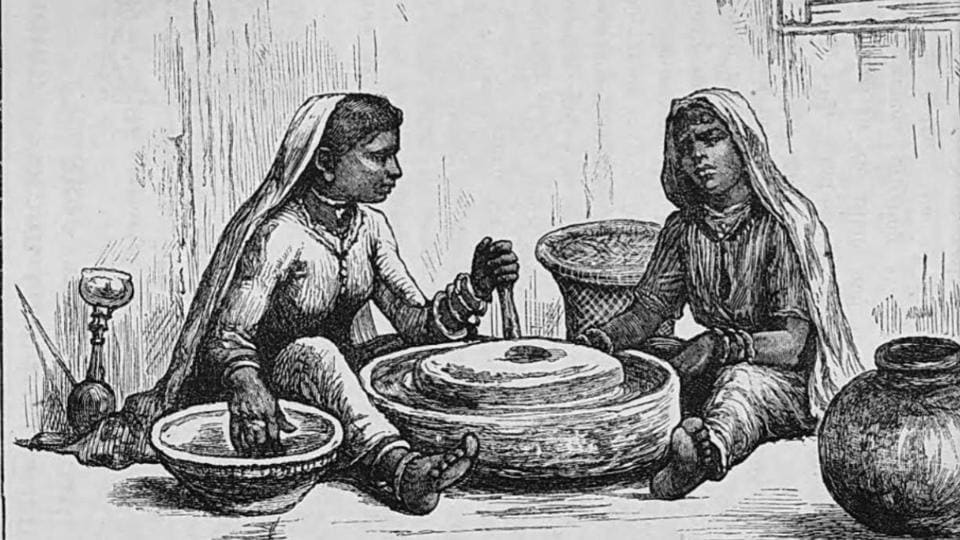
Congress woman candidate Lakshmibai Thuse was ridiculed based on her election symbol – the portable stone hand-mill


Pune: In 1937, elections to the provincial legislatures were held under the Government of India Act 1935, a landmark piece of legislation that brought about significant democratic reforms in India, including direct polls. It provided suffrage rights to women based on literacy, property ownership or marriage to propertied men. It also granted forty-one reserved seats for women in the provincial legislatures, as well as limited reservations for them in the central legislature.
There were two assembly seats from Pune city, with one reserved for women. The Congress party nominated Bhalchandra Maheshwar Gupte, a prominent lawyer, and Lakshmibai Thuse for these seats.
The Lokshahi Swarajya Party had stood up to fight the Congress with Lakshmanrao Bhopatkar and Subhadrabai Tarkunde, both lawyers, as its candidates. The party comprised members from the so-called “Kesari” faction and those with allegiance to the Hindu Mahasabha.
The contest was closely fought and both parties were criticised by many for their unsavoury behaviour during the poll campaign, with the Marathi newspaper “Dnyanaprakash” calling it a disgrace for the city. Keshavrao Jedhe, Narhar Vishnu Gadgil, and Gajanan Narayan Kanitakar, the Congress leaders, were called out for their speeches that were allegedly “casteist” and “anti-Brahmin”. Stones were pelted at campaign meetings held by Bhopatkar and Tarkunde.
However, a greater controversy arose when Thuse was ridiculed based on her election symbol – the portable stone hand-mill.
Grains like wheat, jowar, or bajra were ground for daily use in a portable hand-mill. Two circular stones were roughened on the corresponding surfaces, and laid one upon the other, a fixed pin in the lower stone passing loosely through the upper as an axis. The grain was put into the mill through an opening near the centre in the upper stone, which was turned by a handle fastened near its edge.
The grain, when it had been broken or ground by the action and weight of the stone, was thrown out at the edges and caught in the receptacle in which the mill was placed. One of the first morning duties of the women in the North-west and Central India was to grind the corn required for the use of the family. The flour was made into flat loaves of bhakari or chapati.
Born in Khopoli, Thuse was widowed at the age of eleven. Later, she went to Indore to study midwifery and worked as a nurse in Mumbai. But she, and her election symbol, were considered unworthy of representation in the legislative assembly by her opponents. For them, the hand-mill was worthless and mundane, just like the principle of non-violence that they abhorred.
Bhopatkar and Tarkunde were contesting with the symbol of a roaring tiger.
One of the leading Marathi newspapers in Pune, which espoused the Hindu nationalist cause, compared both the election symbols and advised Thuse to stay put in her kitchen.
As a child widow, Thuse was not supposed to assert any power. She was to work in the kitchen and be submissive. Her profession was considered lowly. Her detractors also called her “ugly”. She did not fit their perception of an “ideal Indian woman”.
Tarkunde, practising law since 1933, was then the only woman advocate of Pune. She had been appointed as the municipal pleader by the Poona City Municipality. She was married to Balkrishna M Tarkunde, who had studied at Oxford University and was also a lawyer. With his encouragement, she had cleared the advocate’s examination after their marriage.
The “Dnyanaprakash”, usually mildly critical of the Hindu nationalists, extended its support to Tarkunde. “Pune needs someone better educated, someone who can argue in the legislative assembly as its representative; a midwife with a hand-mill as her symbol is hardly a worthy candidate”, it wrote on multiple occasions before the elections. It ignored Thuse’s socio-political contributions.
Thuse had participated in the Home Rule Movement and contributed actively to the “Swarajya Fund”. She was a member of the Provincial Harijan Sevak Sangh and regularly visited the so-called “harijan bastis” to attend to ailing women and children. During the Civil Disobedience Movement of 1930, she was the “dictator” of the party in Pune for three months during which female satyagrahis picketed shops selling toddy and foreign goods, and endured lathi-charges. She organised volunteers to provide food and water to those protesting against the Raj. She took care of the wounded. More than a hundred women, including her, were imprisoned for six months during the Movement.
She was a devoted follower of Mahatma Gandhi, who encouraged women to step out of their houses to participate in the independence struggle. Gandhi’s appeal to join the Congress garnered an amazing response. One moment, the women were confined to their homes, and the next, they were out on the streets picketing against toddy shops.
Gandhi’s belief that the wife was the husband’s “comrade, his better half, colleague, and friend” drew criticism from conservative quarters. They were worried that women’s emancipation would erode their power base and shake the traditional patriarchal power they had over them.
With the rise of the middle class in nineteenth-century Maharashtra, strong ideologies emerged on domesticity that borrowed Victorian ideals and revolved around the home, marriage, and motherhood. They created a clear division between the public and private spheres, with the home seen as a haven for peace, stability, virtue, and piety, which was to be held together by the woman by moral and emotional bonds.
The Hindu nationalists supported limited emancipation of women in the twentieth century to aid the cause of a Hindu nation that was “strong” and “masculine”. Women were supposed to earn an education, participate in sports and physical education programmes, and practice religion so that they could give birth to “healthy, intelligent, and strong” children who would serve the society and the nation.
Education for women was endorsed as a tool to enhance women’s social presence and make them more responsible towards their familial duties. Women were supposed to inculcate the virtues of cleanliness, companionship, discipline, and self-control through education and add to their traditional roles in the families, without challenging patriarchy.
During the campaign, large posters of a hand-mill were put up in the city and at the Congress polling offices on the election day. People would shout - “We don’t want a hand-miller’s politics! Maharashtra is a tiger’s cub, and we need that spirit and attitude!”
Congress workers would reply – “No one can work on an empty stomach. We have to buy grain and grind it to make flour, and for that, we need the hand-mill’.
Thuse won the election by 3,702 votes.
In 1937, eighty women were elected to legislative assemblies. India then had the third-highest number of female legislators in the world after the US and the Soviet Union.
Thuse was elected to the State Legislative Assembly a couple of times more and contributed to the socio-political sector till her death.
Tarkunde was elected as the president of the Pune Bar Association in 1966, perhaps the first Indian woman to grace the presidency of a bar association. She was also the first Indian woman to become president of the Debt Relief Fund.
The burden of representing the inner or spiritual realm of the nation, however, is still delegated to the constructed image of the “modern Indian woman” who belongs to the so-called “upper caste” and upper class, is educated and religious, yet not “western”.
Chinmay Damle is a research scientist and food enthusiast. He writes here on Pune’s food culture. He can be contacted at chinmay.damle@gmail.com


