Pune: On June 16, 1937, the sixth death anniversary of Achyut Balwant Kolhatkar, the versatile litterateur and popular journalist, was commemorated at the Central Talkies in Pune. NV Gadgil, freedom fighter and Congress leader, presided over the gathering. In recalling Kolhatkar’s journalism and his independent political outlook, Gadgil also spoke of his deep patriotism.
By then, the Congress had established the practice of observing various national days. But this had not been the case in Kolhatkar’s time. Gadgil made a particular point of mentioning that Kolhatkar had used traditional festivals such as Ram Navami and Krishnashtami as occasions for political awakening.
On Krishnashtami, Kolhatkar would visit temples where people had gathered for kirtans. There, drawing on the familiar imagery of Krishna and Kansa, he would rouse his listeners against the British rule.
In colonial India, mythological stories gave nationalist speakers a vocabulary that their audiences already knew. The most striking example was Krushnaji Prabhakar Khadilkar’s “Keechak-Vadh”, first staged in Pune in 1907. The story came from the Mahabharata, but audiences understood Keechak as Lord Curzon, Draupadi as the oppressed nation, and Bheema as the force willing to resist oppression.
The story of Krishna and Kansa offered another familiar way of speaking about tyranny and resistance. The British could thus be likened to Kansa, while Krishna became an image of resistance to oppressive authority.
{{/usCountry}}The story of Krishna and Kansa offered another familiar way of speaking about tyranny and resistance. The British could thus be likened to Kansa, while Krishna became an image of resistance to oppressive authority.
{{/usCountry}}Marathi newspaper “Kaal” reported on August 15, 1906, that at the Murlidhar temple, a kirtan featuring “thoughts of patriotism” was held on Gokulashtami, followed by the “Gopal-Kala” ceremony. Nationalists like Kolhatkar found a natural vehicle in this ritual, which had long been a familiar observance among Vaishnavas and devotees of Vitthal and Krishna.
“Gopal-Kala” referred to the mixture of puffed grain, curd, milk, and butter. According to tradition, while Krishna was tending cattle in Braj, he would bring together the food from his own lunch basket with that carried by his companions, mix it all into a single preparation and share it with them. The “Dahi-Kala” or “Gopal-Kala” was associated with this story.
Apart from Krishna’s birth celebrations, “Gopal-Kala” held a central place in the Warkari tradition. At Pandharpur, following the Ashadhi and Kartiki Ekadashis, the celebrations continued until the full moon, when the traditional ceremony of “Gopal-Kala” brought them to a close.
On the full-moon day, at a customary spot set aside for the ritual, curd and puffed jowar were mixed together and placed in an earthen pot. The pot was then hung high above the ground. After the bhajan, it was broken, and those who managed to catch some of the curd and puffed grain accepted it as prasad. This “Gopal-Kala” was not considered subject to ritual impurity, and hence could be had by people of all castes.
Pandharpur was not the only place where the ceremony was held. Newspapers such as “Dnyanaprakash” and “Kesari” carried numerous reports of “Gopal-Kala” celebrations held in different places, including Pune, in the days following Ekadashi.
In Konkan, children and young men from the village would join hands and dance through the streets. When these groups went from house to house, householders would pour pots of water over their heads and, when possible, curd and milk as well. At each house, they were offered “poha” mixed with curd and milk.
While the climactic “Gopal-Kala” served as an egalitarian leveller in public spaces, the days leading up to it inside the home were governed by strict personal discipline and ritual purity. In Pune, the observance of the birth of Krishna began on Saptami, when devotees ate only one meal. On Ashtami, they bathed after applying a paste of white sesame seeds to the body and took the ritual vow of the fast. The place of worship was decorated with leaves and creepers, and a symbolic maternity chamber was prepared for Devaki. Images of Devaki and the infant Krishna were placed on a small bed, while images of Yashoda and her daughter, along with Vasudeva and Nanda, were arranged nearby.
At midnight, after completing the prescribed purification, devotees made their formal resolve to worship Krishna and performed the sixteen-fold ritual worship of Krishna and his family. The night was spent in vigil, with stories from the Puranas, singing, dancing, and other devotional performances.
The fast was observed throughout Ashtami, and only foods permitted during the fast were offered to the deity. On Navami, the concluding worship was performed with the prescribed five offerings, followed by a “mahanaivedya”.
In many Deshastha Rigvedi Brahmin households, Gokulashtami was observed as a nine-day festival. It began on the first day of the waning fortnight of Shravan and continued until Navami. After Krishna’s birth was celebrated at midnight on Ashtami, the festivities concluded the following day, after the fast was broken.
Reading or listening to the “Bhagavata” was an important part of these nine days of observance, culminating in “Gopal-Kala”. According to Bapushastri Moghe, who translated the “Dharmasindhu” into Marathi, Vaishnavas were expected to sprinkle curd and milk over one another after listening to the stories of Krishna’s birth and childhood in Gokul. He traced the practice to the “Bhagavata”, which described the cowherds sprinkling one another with curd, milk, ghee and water. Moghe believed that this ritual was what had come to be observed in Maharashtra as “Gopal-Kala”.
For all the meticulous household austerity of these nine days, the festival found its true celebration only when devotees stepped back outside for “Gopal-Kala”. In temples dedicated to Lakshminarayan, Gopal Krishna, Muralidhar, and Vitthal-Rukmini, devotees brought ingredients like puffed grain, chilli pickle, curd, milk, and butter. Mixed at the temple and distributed as prasad, this shared feast broke the fast and dissolved the domestic boundaries of caste and purity.
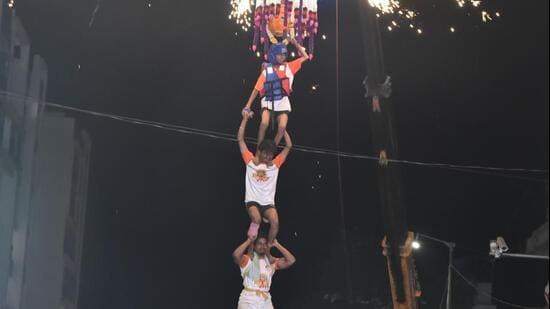
The “Gopal-Kala” of Gokulashtami is becoming increasingly rare. Today, the ritual of ‘Gopal-Kala’ has largely receded behind the high-decibel spectacle of commercial “Dahi Handi”, with its towering human pyramids, political sponsorships, and blaring loudspeakers. In the process, both the communal domestic traditions and the politically subversive kirtans of Kolhatkar’s era have faded from popular memory.
Chinmay Damle is a research scientist and food enthusiast. He writes here on Pune’s food culture. He can be contacted at chinmay.damle@gmail.com