
 E-Paper



Monday Musings: Rationalism in the era of fake news
If science is believed to be something realistic, yet the technologies based on science seem to facilitate more fake news and information that doesn’t necessarily advance the public good

 Prefer HTon Google


If the killers of Dr Narendra Dabholkar thought they would be able to curb his thoughts, 10 years later we can see it turned out to be plain wrong. The anti-superstition movement has grown faster post Dabholkar’s murder, with members and branches of Maharashtra Andhashraddha Nirmoolan Samiti (MANS) growing beyond the State borders.
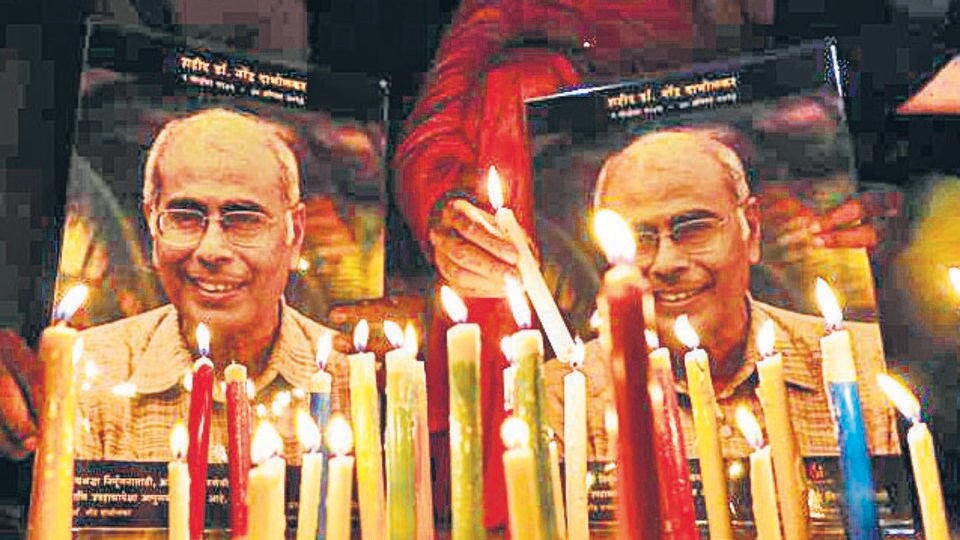
However, in the era of fake news, the challenge for rationalists is even bigger. It’s an irony that progress in science and technology has led to a spurt in modes of communication with various gadgets available for it. So even as science and superstition are poles apart, the same gadgets in some cases are used to disseminate fake news, mostly spreading beliefs that are unfounded.
If science is believed to be something realistic, yet the technologies based on science seem to facilitate more fake news and information that doesn’t necessarily advance the public good.
If science and facts are the foundational basis for rational and logical disputation and the possibility of reaching some truths, fake news negates that. Although fake news is not new but digital technologies and social media have made it much easier to produce and disseminate fake news.
Poor truth discernment is linked to a lack of careful reasoning and relevant knowledge. There is also a large disconnect between what people believe and what they will share on social media, and this is largely driven by inattention rather than by purposeful sharing of misinformation.
Fake news has come to be known as a big challenge, is a set of at worst, manufactured or concocted facts that are a perversion of reality. It is the direct antithesis of science.
In Dr Dabholkar’s son Hamid’s words: “These technologies are market-friendly. So even if workers engaged in anti-superstition want to fight against beliefs which are unscientific, the battle is uneven.”
The rationalist was shot dead by two unidentified gunmen on the morning of August 20, 2013, after almost 30 years of working to propagate the scientific outlook and eradicate superstition in Maharashtra. For more than three decades before his death, Dr Dabholkar advocated scientific temperament to seek the truth. Today, even as Maharashtra has Maharashtra Prevention and Eradication of Human Sacrifice and other Inhuman, Evil, and Aghori Practices and Black Magic’, colloquially known as the anti-black magic act, which the rationalist advocated in the last few years before his death, the instances of superstition have grown.
In Maharashtra over 1,000 cases – 58 of them from Pune district alone - have been registered under this act. However, for each such case, there must be 10 instances of superstition possibly taking place in various parts. The good part is, in most of these cases, even as fake news may have contributed in some ways or the other, those who exposed such acts also included common citizens. This offers a glimmer of home even as the challenge is bigger.


