
 E-Paper



Why Nashik onion farmers remain unhappy despite Centre hiking procurement price
Onion growers in Nashik protest despite a price hike to ₹1,580/quintal, citing rising costs and inadequate relief from the government.

 Prefer HTon Google


Resentment continues among onion growers in Nashik despite the Centre raising the Minimum Assured Procurement Price (MAAP) from ₹1,235 to ₹1,580 per quintal, with farmers saying the hike is inadequate to offset rising cultivation costs and mounting losses.
Amid growing protests by farmers and concerns raised by sugar industry groups, Union home minister Amit Shah has convened a meeting in Delhi on Wednesday to discuss the issue. Chief minister Devendra Fadnavis, deputy chief ministers Eknath Shinde and Sunetra Pawar, cooperation minister Babasaheb Patil, agriculture minister Dattatray Bharne and food and civil supplies minister Chhagan Bhujbal are expected to attend. Senior officials from the cooperation, marketing and agriculture departments will also be present.
Speaking to the media, Fadnavis said, “Both the state and central governments are sensitive to the problems faced by onion growers, and discussions will be held to find solutions.”
State disaster management minister Girish Mahajan acknowledged the crisis, saying both the Centre and state government are trying to resolve the issue. “We are trying to resolve the issue by talking to all stakeholders,” he said.
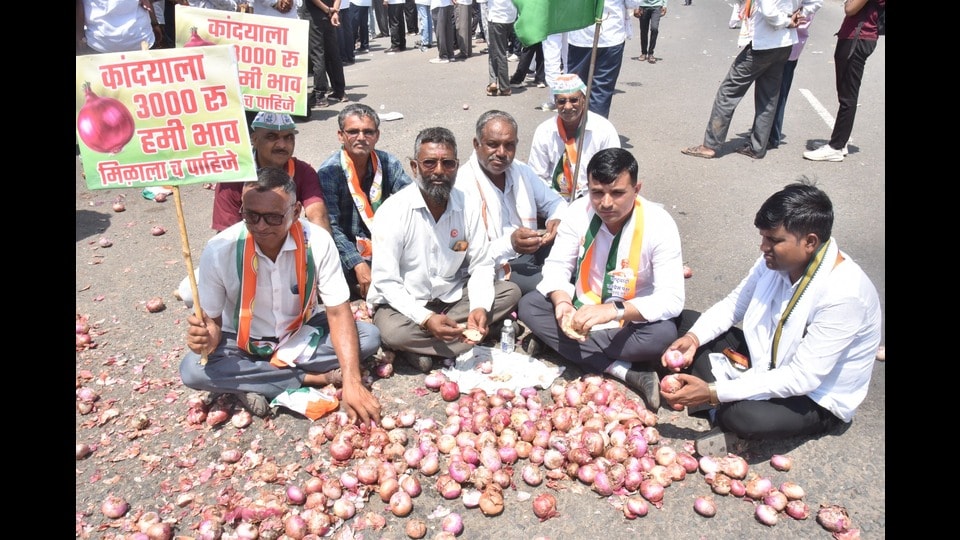
On Tuesday, hundreds of onion farmers from rural Nashik joined a protest rally organised by the Maha Vikas Aghadi (MVA) at Chandwad tehsil against low wholesale prices. State Congress chief Harshwardhan Sapkal, NCP (SP) state president Shashikant Shinde, Shiv Sena leader Ambadas Danve and NCP (SP) MLA Rohit Pawar participated in the agitation.
Opposition leaders accused the Centre and state government of failing to provide meaningful relief to growers.
“The governments are spending crores on the Simhastha Kumbh Mela in Nashik, but when it comes to onion farmers, there is no money,” Sapkal said.
MVA leaders warned of protests at Mantralaya if the government fails to address farmers’ financial distress. During Tuesday’s agitation, protesters briefly blocked the Mumbai-Agra highway and dumped onions on the road before police dispersed them.
Farmers said the revised MAAP offers little relief as market prices remain below production costs.
“I sold 90 quintals of onions last week. The good-quality crop fetched ₹350 per quintal while the inferior quality sold for just ₹50. I have a ₹1 lakh loan from a moneylender and no idea how I will repay it,” said farmer Jitendra Solanke.
Another farmer, Dushyant Pawar, said cultivation costs have risen sharply due to higher diesel, fertiliser, pesticide and labour expenses.
“Five years ago, production cost was around ₹1,300 per quintal. Now it is nearly ₹1,800. The current wholesale rates will ruin us financially,” he said.
Farmer Sandip Magar said the lack of storage facilities is forcing many growers into distress sales.
“I sold 50 quintals at ₹1,000 per quintal because I could not store the produce. Hundreds of farmers are facing the same problem,” he said.
Nashik cultivates onions on nearly 35.7 lakh hectares and produces around 71.9 lakh metric tonnes annually, with summer (rabi) onions accounting for the largest share. Agriculture department officials said production in 2025-26 fell by around 10 lakh metric tonnes due to unseasonal rain and hailstorms.
Despite lower production, wholesale demand has remained weak since March as exports to Gulf countries nearly stopped during the regional conflict, according to officials at the Lasalgaon Agricultural Produce Market Committee (APMC). Daily arrivals at Lasalgaon APMC have dropped to around 8,000 quintals from the usual 30,000 quintals, as many farmers are unwilling to sell at low prices.
“In March, exports to Gulf countries such as the UAE, Iran, Iraq, Oman and Saudi Arabia stopped because of the conflict. Together, these markets accounted for nearly 25% of Nashik’s onion exports,” said Lasalgaon APMC director Pravin Kadam.
Bangladesh, once the largest importer of Nashik onions, has also sharply reduced imports over the past two years as it increasingly relies on domestic cultivation.
Nashik-based exporter Vikas Singh said soaring shipping costs during the conflict made exports unviable.
“A container that usually costs $500 went up to $7,000 during the conflict. Exporters simply could not afford it,” he said.
APMC officials added that domestic traders are also buying cautiously because diesel shortages have affected truck availability.
Bharat Dighole, president of the onion growers’ association, said protests would continue unless procurement prices are substantially increased.
“The MAAP should be at least ₹3,000 per quintal to significantly improve wholesale prices,” he said.
Dighole added that many farmers are reluctant to sell onions to central agencies such as the National Agricultural Cooperative Marketing Federation of India and the National Cooperative Consumers’ Federation of India because the procurement process is cumbersome.
“Farmers have to register on online portals and upload Aadhaar and PAN details. Payments are not immediate and often take over a month to reach bank accounts. So many farmers still prefer mandis despite the low prices,” he said.
The two agencies are expected to procure two lakh metric tonnes of onions this year to create a buffer stock and stabilise prices. Officials said over 50 metric tonnes have been purchased since procurement began last week, with more than 700 farmers registered so far.


