Your wish has come true. Abhishek Sharma and Vaibhav Sooryavanshi opening for India isn’t a pipedream anymore. It’s an outrageous 43-ball 133-run partnership taunting bowlers from a scorecard that makes scant sense despite repeated readings. Fifty in 14 balls, 100 in 30, a target of 199 annexed in—you read that right—13.2 overs, it was shock-and-awe batting, no bowling opposition can prepare to hide from.
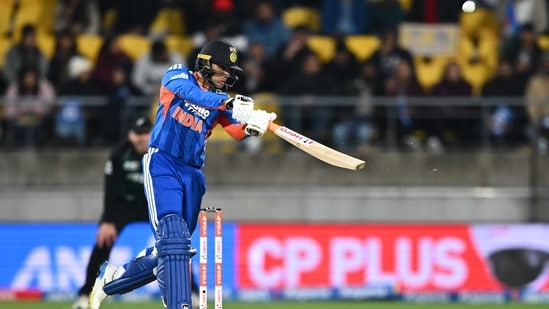
Sooryavanshi missed out on a deserving fifty, but Abhishek motored to a 35-ball hundred—still his second quickest—as India couldn’t have carved a more dominant way to take an unassailable 3-0 lead in the five-match series at Wellington on Tuesday.
No target matters on days like these, but India making a habit out of chasing with such nonchalance will surely keep every team on edge. Forced to watch the carnage, New Zealand knew this match was as good as gone when India finished the powerplay on a staggering 118 for no loss.
Because by then the game had gone beyond the point where no analysis makes sense. It’s all high backlift, generous batswing, scintillating hand-eye coordination and exceptional timing, but also the bravado that fuelled each of those shots.
Twenty20 gives you licence to hit, but this was extraordinary beyond the realms of belief. Fastest team fifty, fastest team hundred as well, Abhishek falling short of Yuvraj Singh’s 12-ball fifty record by three balls, but more remarkably: 12 sixes and 11 fours hit by the time Sooryavanshi was caught by Daryl Mitchell to break the partnership on 133.
{{/usCountry}}Twenty20 gives you licence to hit, but this was extraordinary beyond the realms of belief. Fastest team fifty, fastest team hundred as well, Abhishek falling short of Yuvraj Singh’s 12-ball fifty record by three balls, but more remarkably: 12 sixes and 11 fours hit by the time Sooryavanshi was caught by Daryl Mitchell to break the partnership on 133.
{{/usCountry}}Abhishek never lifted his foot off the gas, blazing his way to his fourth T20I hundred before holing to Glenn Phillips at midwicket, leaving India 21 to win off 60 balls.
All because Abhishek and Sooryavanshi chose to treat the chase as a formality. Jacob Duffy’s opening over cost 26 runs, including five wides and a no-ball, Adam Milne conceded 17 in his first over, Michael Bracewell went for 21 in his first, before Kyle Jamieson surrendered 20. By then, New Zealand had tried pace, spin and different field settings. India only tried hitting the ball harder.
To Abhishek, New Zealand went short and shorter but he kept toppling the bounce. He backed away, made room and dispatched the ball over the infield with a regularity that suggested the fielding captain had misplaced the instructions.
Sooryavanshi was scarcely more accommodating. The teenager combined brutal power with an unnerving simplicity—see the ball, hit the ball, looking annoyed if it didn’t reach the boundary. Even two consecutive dot balls against Duffy provoked visible frustration. At this rate, New Zealand were not merely expected to concede runs; they were expected to do so without interrupting the entertainment.
India reached 100 in five overs, matching the fastest team hundred in T20Is in available records. The target of 199 had required a chase but India’s opening pair turned it into a countdown. New Zealand’s bowlers were not necessarily short of ideas. But they were simply running out of deliveries that Abhishek and Sooryavanshi were willing to respect. Abhishek ended with 20 boundary hits, 11 of them sixes, reducing the match to a mismatch.
It was certainly not on the cards after Mitchell’s unbeaten 89 from 52 balls took New Zealand to 198/3. And to think of it, they could have certainly ended up with more had India’s seamers not found their discipline at the death. Tim Seifert fell for two, once again undone by Arshdeep Singh’s movement away from the right-hander, but Finn Allen counterattacked to change the tempo.
Allen’s 25-ball 40, featuring five sixes, provided the impetus for an 86-run partnership with Mitchell. The pair took New Zealand to 88 for one after seven overs, exploiting India’s difficulties with their lengths as the ball began to lose its early movement. Mitchell, who had struggled in the opening two matches, found his range with powerful strokes through the leg side and an inventive scoop that repeatedly unsettled the bowlers.
Nitish Kumar Reddy broke the stand by having Allen caught by Naman Dhir, but Mitchell continued unabated. He reached his half-century in 26 balls and accelerated further, mixing clean hitting with deft placement. Phillips contributed 17 before falling to Axar Patel, leaving Mitchell to build another substantial partnership, this time with Bevon Jacobs. New Zealand scored 135 in their first 13 overs but managed only 63 in the last seven, thanks to India’s sharp response in the closing overs.
Reddy repeatedly attacked the blockhole, while Arshdeep mixed wide yorkers with full deliveries to deny the batters room to swing freely. Prince Yadav, despite an expensive middle spell, used full deliveries to concede only nine runs in the final over. As did Bhuvneshwar Kumar in the 18th. In hindsight, it probably didn’t matter. Not when Abhishek Sharma plots to eviscerate a target in just 80 balls.