After 1,425 days, nearly four years, Bhuvneshwar Kumar returned to international cricket in India's fifth T20I against West Indies on Saturday. India had played 106 T20Is in the intervening period, making it the longest gap between appearances in the format for an Indian player.
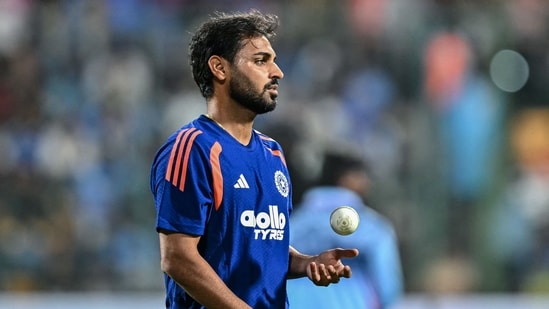
There was a fitting touch to his comeback, too. Bhuvneshwar was back in India colours at the M Chinnaswamy Stadium, the venue where his fortunes had turned around in IPL. Since joining Royal Challengers Bengaluru in 2025, he has been part of a franchise that won back-to-back titles.
But rain delayed his return to bowling. After just 7.4 overs of play, with India put in to bat, the match was abandoned without a result.
The focus now shifts to New Zealand where India begin a five-match T20I series on Thursday. If his recall and recent form are any indication, Bhuvneshwar has a strong case to feature in the playing XI. His comeback, after all, was no nostalgia pick.
Across the IPL seasons from 2023 to 2026, no Indian fast bowler took more Powerplay wickets than Bhuvneshwar or made a greater impact with the new ball. According to CricViz's Bowling Impact metric, he saved 225 runs in the first six overs — 80 more than the next bowler. His 2026 campaign in particular stood out for his Powerplay bowling.
Bhuvneshwar rarely bowls in the middle overs and is more focused on containing runs than taking wickets at the death. That could help complement Jasprit Bumrah, potentially allowing India to pair Bhuvneshwar's new-ball skills with Bumrah's impact later in the innings.
In a league of his own
{{/usCountry}}Bhuvneshwar rarely bowls in the middle overs and is more focused on containing runs than taking wickets at the death. That could help complement Jasprit Bumrah, potentially allowing India to pair Bhuvneshwar's new-ball skills with Bumrah's impact later in the innings.
In a league of his own
{{/usCountry}}In his 60 matches across the last four IPL seasons, the only tournament in which he has consistently featured since playing his last match for India in November 2022, Bhuvneshwar represented two franchises — Sunrisers Hyderabad and RCB — and took 42 wickets with the new ball, three more than the next-best Indian bowler, Mohammed Siraj. He conceded 7.51 runs per over in the first six overs. Only Bumrah has bowled tighter, at 7.17. Indian seamers, as a group, conceded 8.78 runs per over during the period.
Each of his wicket cost 23.8 runs, the best figure among Indian fast bowlers. The group average was 35.5.
Runs saved with the new ball are where Bhuvneshwar elevates himself into a league of his own. According to CricViz's Bowling Impact metric, which measures the impact of bowling well through discipline and economy, as well as the runs saved by taking wickets, the 36-year-old's figure stands at 225.24, split between 107.14 from economy and 118.09 from wickets. Bumrah's Powerplay value comes purely from control. In fact, Bumrah’s wickets are worth 32 runs less than par.
From good to exceptional
Having built that reputation early in his professional career, Bhuvneshwar has remained a new-ball specialist in white-ball cricket. However, his dominance had diminished during the first three IPL seasons after he was dropped from the Indian team. In 2023, 2024 and 2025, he ranked third, third and seventh, respectively, among Indian pacers for runs saved, yet beat the average economy rate each year. Bhuvneshwar remained economical in each season, with a dot-ball percentage among the best, but lacked impact as a wicket-taker in the Powerplay.
His stock rose sharply in 2026. He took 17 wickets with the new ball, at 13.35 runs each, and conceded 6.67 runs per over. He saved 178 runs that season for RCB, where he narrowly missed out on the Purple Cap — more than double of Siraj's 86. That one season accounted for 79% of his four-year total.
The source of his value also shifted. In 2025, Bhuvneshwar's value came only from his economy, while his wickets cost him 10 runs against par. In 2026, his control remained, but wickets contributed 114 of his total value of 178.
Modus operandi
There is no ball-tracking data for BCCI matches in India, but the dismissals in Powerplay tell a story. Almost one in four of Bhuvneshwar's new-ball wickets comes from a catch by the wicketkeeper. For Indian fast bowlers as a whole, the figure stands at one in eight. He does not attack the stumps as often, so bowled and lbw dismissals are less frequent than average, but he draws the edge.
Another factor in his Powerplay approach is the timing of his dismissals. No other Indian bowler has taken more first-over wickets than him in IPL history, yet that does not make him a first-over wicket machine. Only 13 of his 42 Powerplay wickets between 2023 and 2026 came in the opening two overs. In 2025, he took none in that phase.
Early on, his job is to choke the scoring. His economy rate is 6.10 in overs one and two, against 7.38 for Indian seamers. Nearly half of his deliveries (49.5%) have resulted in dot balls, while batters have struggled to find boundaries, hitting them off just 15.81% of his deliveries, against 20.8% from Indian seamers. This suggests that he builds controlled pressure on batters. His dismissal rate, however, is below par in this phase. The wickets tend to follow, mostly in overs three to six.
Dependable at death, but not decisive
Bhuvneshwar's dominance diminishes in the final phase of an innings, but he remains a dependable option. Over the last four IPL seasons, he ranks third among Indian bowlers for runs saved at the death. The figure stands at 40, less than one-fourth of Bumrah's 182. The gap in runs saved per over is wide: 3.94 against 0.55.
A closer look at the numbers shows that his role with the old ball differs from Bumrah's. At the death, Bhuvneshwar's value comes entirely from economy, albeit in an unusual way. While he bowls fewer dot balls — 20.9% against a group average of 25.7% — he concedes fewer boundaries than most, suggesting that batters take singles off him rather than hit sixes. His Bowling Impact from economical bowling stands at 55.67, behind only Bumrah's 173.37, but his wickets are worth 16 runs less than par, with most of that deficit coming in 2024.
Unlike his Powerplay numbers, his death-over figures have fluctuated sharply over the last four years. He was excellent in 2023, but his form dipped significantly in 2024, when he took one wicket and conceded 12.62 runs per over. He was around par in 2025. In 2026, however, he was the best Indian bowler with the old ball, though that performance was still built on control: he saved 52 runs and conceded a boundary off just 15.9% of deliveries.
Where he stands
Captains do not use Bhuvneshwar in the middle overs, and the numbers show why. He bowled just 18 overs during that phase across the last four IPL seasons, costing his teams 10 runs against par.
With the new ball, Bhuvneshwar is unparalleled. Even though his numbers were merely good between 2023 and 2025, he was among the best at saving runs with the new ball each season before peaking in 2026. At the death, he could be a reliable second option behind Bumrah, although that assessment is based largely on his 2026 season.
The risk is clear, and it will ultimately come down to how Bhuvneshwar copes with international cricket after a four-year gap. While age has not appeared to be a factor for him, India will also have to consider that he will be 38 when the 2028 T20 World Cup comes around.