


 Live Score
 Cricket Teams
 Cricket Players
Dreams, drums and packed stands: How SA20 is redefining the live cricket experience
Packed stands, fan parks and family-friendly matchdays have turned SA20 into South Africa’s most vibrant domestic cricket experience.

 Prefer HTon Google


Under a nippy Durban afternoon sky, a seven-year-old let rip a couple of leg-breaks at the SA20 fan park just outside Kingsmead. Three plastic stumps stood inside makeshift nets, mirroring a training session more than a pre-match carnival. His father, Shane Viera, watched closely, offering gentle cues after each delivery. When the turn came to an end, he slung the kit bag over his shoulder, patted his son on the back, and stepped aside - making room for the next eager participant.
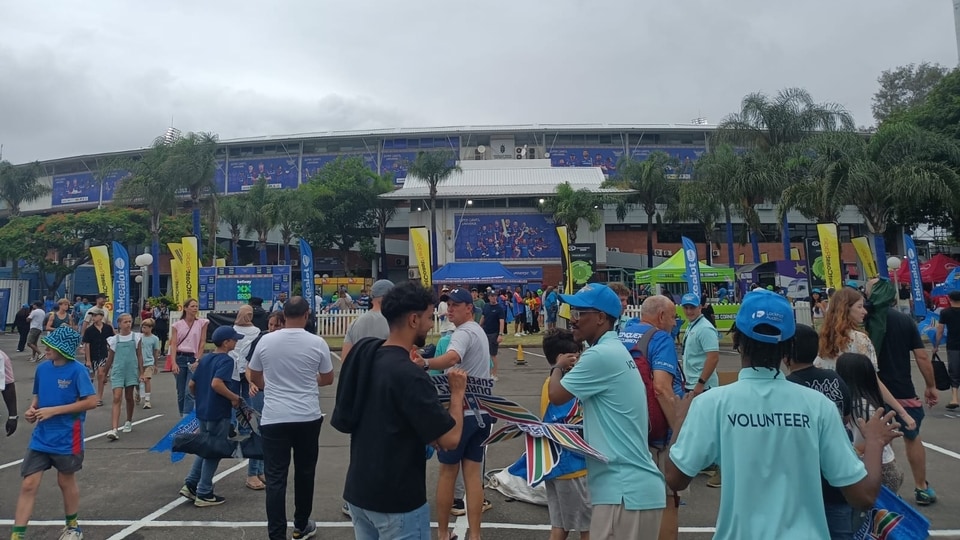
There was still over an hour to go before Durban's Super Giants faced Pretoria Capitals, but Kingsmead was already stirring. Rain had lingered through the morning, the wind stayed sharp, and thick clouds threatened more interruptions. The forecast wasn’t kind. Yet, instead of seeking cover, fans gravitated towards the fan park, where cricket had already begun in earnest.
At the stadium entrance, DSG flags and placards, along with SA20 bucket hats, were handed out freely. A performer perched on stilts drew children in with bursts of bubbles, while queues formed at a counter titled ‘Raining Sixes’. Nearby, kids spun wheels, picked up temporary SA20 tattoos, or lined up for merchandise; the space buzzed with activity long before the first ball was scheduled to be bowled. And it’s not just at Durban, the set-up has been similar at all the SA20 venues.
ALSO READ: Beyond the window: Rain-ruined games, but Graeme Smith insists SA20 is winning the long game
“SA20 has definitely grown, and it’s been an amazing fourth season so far. I’m really keen to watch our boys (DSG) win tonight,” said Shane. “But beyond that, just look at the atmosphere—the crowds, the kids. It’s been top-notch. The most mesmerising part has been seeing families come together.”

Among them was Kalpesh Jeevan, a 51-year-old South African of Indian origin, who had travelled from Johannesburg to Durban on a family vacation. A day at the picturesque beach, kissing the Indian Ocean, could wait; cricket could not.
“Cricket in South Africa, just like in India, means the world,” he said with a beaming smile. “You can feel the vibe here. Everyone’s having fun—face painting, T-shirts, activities. More people are getting involved, and the crowd has become livelier.”
The chat ended with a surprise. Though Kalpesh was wearing a Durban’s Super Giants jersey, he lifted it to reveal a Gujarat Titans shirt underneath, prompting laughter from his wife and children.
Durban is often referred to as ‘mini-India’, given its significant population with roots in the subcontinent. That connection has found fresh expression in SA20, where IPL-linked franchise identities have given many fans a sense of familiarity and belonging.
“When SA20 started a couple of years ago, it felt like they were trying to create a South Africa-based IPL,” said Abhishek, a 20-year-old of Gujarati origin, who stepped forward confidently from a group of friends. “Seeing teams like Durban Super Giants and Pretoria Capitals, and even coaches like Ganguly involved, made me excited. It felt like they were taking something from India and adapting it for South Africa—a country with a strong cricket culture. I was really happy when SA20 came here.”

For native South Africans, however, SA20 has offered something different: a fresh identity on the global cricketing map, one they proudly call their own.
“The SA20 has grown more and more popular,” Shane said. “Everyone watches the IPL. Everyone watches the Big Bash League in Australia. Pakistan has its PSL. So this is our own brand, and everyone loves cricket. South Africa is a very strong cricket nation—so SA20 all the way.”
Eighteen-year-old Jackson Neir, who was introduced to the sport by his father and grew up watching cricket in all its forms, couldn’t agree more. For him, SA20 is not just about the atmosphere, but also the investment it brings into South Africa from across the world, giving it a truly global footprint.
“I think it’s just the sheer number of people coming to watch,” he said. “When I look at the IPL, I sometimes get jealous because every single seat is full. But in South Africa, you usually see gaps here and there. With SA20, though, every single seat is full—no matter what’s happening.”
What has stood out for Jackson this season, however, is the surge in viewership.
"It just brings a lot more viewership to South Africa and a lot more investment into cricket, especially. And I'm glad that other countries have come to South Africa, allowing us to come together as a global community to support even just one team. And it's awesome just to see, like, the vibe we've created here and just everyone around, like, it means so much just to me as a South African, that we can all come and watch just cricket and, like, have a joy," he said.
Graeme Smith, SA20 league commissioner, confirmed Jackson’s observation during a select media interaction last week, explaining how ticketing has emerged as a key metric in measuring the success of a season.
“There has been a 27 or 28 per cent increase in ticket sales in the first half of the season. There have also been four more sold-out games compared to the same point last year,” Smith said.
How SA20 plans the in-stadium fan experience
Beyond raising the standard of cricket and expanding the pool of international stars featuring in the league each year, SA20 has invested heavily in enhancing the in-stadium fan experience. That process, however, is far from simple, involving months of meticulous planning.
In response to an email from Hindustan Times, SA20 COO Lynn Naude revealed that preparations for a new season begin immediately after the previous one ends. This includes nearly two months of comprehensive review to capture key learnings, following which planning begins in late March or early April.

“The core of the process revolves around extensive stakeholder surveys,” Naude said. “We incorporate feedback from players, fans, media, commercial partners and venues, which gives us a holistic understanding of what worked well and where improvements can be made.”
She added that the league’s planning is guided by clear strategic principles.
“In terms of planning considerations, our key strategic anchors are to be fan-first, digitally led, and to deliver a high-quality experience across stadium, online and broadcast environments. Insights from our annual surveys, combined with these strategic anchors, guide our decision-making and ensure we continue to evolve while staying true to the essence of the tournament.
“Being digitally led is particularly important, as it allows us to tell the story of the SA20 spectator experience to audiences who may not be able to attend matches in person.”
Naude said SA20, since its inception, has aimed to stand out from its competitors by blending world-class cricket with an entertainment-driven match-day experience. In the ongoing fourth season, there has been a conscious effort to widen audience reach, coupled with more affordable ticket pricing to encourage fans to attend with family and friends.
“Our aim has always been to appeal to both traditional cricket fans and more casual or social audiences,” she said. “With matches taking place daily and ticket pricing designed to be accessible, we wanted to make it affordable for families and groups to attend multiple matches throughout the month.
“In season four, the fan base attending SA20 reflects a very balanced mix of committed cricket supporters and casual fans. Our match-day offering is deliberately designed to cater to both groups equally. Importantly, this is a collaborative effort—our commercial partners, franchises and franchise partners all play a role in delivering the overall in-stadium experience.”
Jackson, in fact, was not alone at the venue last Wednesday for Durban’s game against Pretoria. He had brought along a rugby-loving friend, who was watching a live cricket match for only the second time in his life—the previous one being a Sharks vs Stormers fixture a few years ago.
“I’m a big rugby fan,” he said, “but this also doubles up as a social gathering. There’s a vibe here, an energy you feel the moment you walk in. Even if the cricket takes a back seat or the game gets affected by rain, the culture—the Durban vibe—is something special. That’s why I came today: to hang out with friends, watch some cricket, and just chill. It’s a wonderful experience.”

Naude underlined that fan feedback has been central to SA20’s growth, revealing that post-season surveys showed a strong preference for consistency rather than change. The numbers reflected that trust, with over 90 per cent of fans rating the in-stadium experience as excellent and expressing a clear intent to return and recommend the league to others. That consistency, she explained, has helped SA20 build a repeatable match-day experience—one that fans now look forward to every January and feel confident introducing to first-time or non-cricket audiences.
Two key fan-driven changes were implemented in the fourth season. One was increased player engagement, which saw teams—working in collaboration with their franchises—host post-match signing sessions after each home game. The other was allowing children access to the main playing area during the first hour after the gates opened.
To tap into a wider audience, SA20 significantly stepped up its marketing and outreach efforts in the fourth season, one of the key initiatives being collaborations with Indian influencers, several of whom were seen engaging with local fans at venues. With six franchises owned by Indian stakeholders and a strong broadcast presence in the country, the league has consciously leaned into its long-standing connection with Indian cricket audiences as part of its growth strategy.
“We’ve got a very strong Indian broadcast relationship and six franchises from India. South African cricket has always shared a great connection with Indian fans, so it’s natural for us to invest in that market and work with media, influencers, and broadcasters to help people fall in love with South African cricket again," Smith added.
Beyond the experience and the sense of identity it fosters among South Africans, the initiative also inspires the next generation of fans, offering them hope, dreams, and the belief that they too could one day step onto the professional cricket field.
Watching his young son beam with innocent excitement, Shane reflected, “SA20 means everything. It gives me the chance to bring my boy here, let him dream big, and maybe one day we’ll see him playing on that field.”


