
 E-Paper



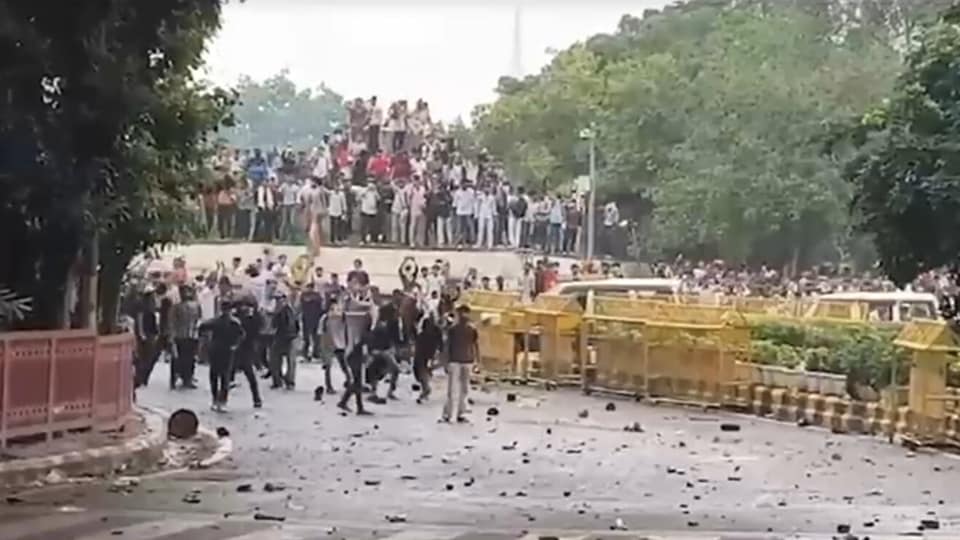
Stone-pelting by CJP protesters happened even after Parliament march violence: Officials
The violence by protesters was contained with enforcement agencies exercising restraint despite servere aggravation.

 Prefer HTon Google


Stone-pelting by Cockroach Janta Party (CJP)'s protesters and political actiivists in the heart of Delhi carried on for over at least six days, but police acted with restraint to defuse the tensions, according to security officials aware of the developments.
The officials also shared details of locations that became flashpoints, as well as damaged or missing government properties during the protests over the alleged paper leak in the NEET-UG examination. HT has accessed the list.
According to the officials cited above, a section of people with vested political interests and political parties infiltrated the crowd of genuine students who had gathered at Jantar Mantar, and stoked violence.

On July 20, the day of the CJP's march to Parliament when the House was in session, clashes broke out, and law enforcement officials had to resort to a cane charge and tear gas amid allegations of police excesses. Security officials said the action against protesters should not be seen in isolation, and that it came after repeated warnings against provocation and aggression, including stone-pelting and the breaking of barricades in a high-security zone.
Also read: Jaish operative held in Bengal planned to target Suvendu, sabotage Jantar Mantar protest: STF
Stone-pelting incidents continued even after the Parliament march violence—right till July 25, when the CJP ended its protest after the government accepted its demands, including the resignation of then education minister Dharmendra Pradhan, the officials said. They added that police handled all incidents without any escalation, given the sensitivity of the matter.
According to the document accessed by HT, the flashpoints during the protest were concentrated within a roughly 2-kilometre radius, indicating that the incidents were spread across key roads and intersections near Parliament rather than being confined to a single location.
Also read: Day after 'forgive' remark, PM Modi praises youth for powering India's growth
The places of occurrence were Gol Dak Khana, the Tolstoy-Janpath Crossing (Restaurant Corridor and Parking), the Rafi Marg barricade near Rail Bhawan, Jantar Mantar, Outer Circle near the LIC Building in Connaught Place, multiple locations along the Tolstoy-Sansad Marg corridor, Sansad Marg near the SBI Building, Raisina Road near the Press Club of India, and the Regal Building towards the Sansad Marg-Tolstoy red light.
The location closest to Parliament was the Rafi Marg barricade near Rail Bhawan, while other locations ranged from 0.8 km to 2 km away, according to the document, which also said stone-pelting was reported at all the locations.
The document also detailed damage to and loss of government property during the violence. According to the list, 110 barricades and 171 ropes were damaged or went missing, along with operational equipment such as a wireless set, a body-worn camera, 10 handheld metal detectors (HHMDs), two public address systems, 15 loudhailers, 10 fire extinguishers, four wire cutters and an X-ray baggage scanner. Protective gear, including 355 helmets, 285 body protectors, 54 shields, 10 torches, 24 first-aid boxes and 12 blankets, was also reported missing or damaged.
In addition, 29 official vehicles (including cars, buses, motorcycles and tempos) were affected, along with a water tanker, a DTC bus and one public vehicle, the document said.
The document added that 244 police personnel and 209 civilians sustained injuries that were recorded as Medico-Legal Cases (MLCs).
Security officials had earlier told HT that the use of force during the CJP's march to Parliament was the culmination of escalation, repeated warnings, barricade breaches, vehicle damage, and continued unprovoked heckling of both police and the press.
According to a widely reported internal Delhi Police report submitted to the government, more than 100 people facing murder charges and hundreds accused in robbery, sexual offences, Arms Act and narcotics cases were identified through facial recognition technology during the violence at the CJP's march.


