Mumbai: When the proverbial lambs to slaughter was being played out in the Guwahati ODI with bowlers’ being the victims, Parthiv Patel in commentary narrated his pre-match conversation with the pitch curator where they were half joking 400 runs might be scored. Little did they know, Mt 400 would be scaled twice across 93.3 overs in the India-West Indies ODI.
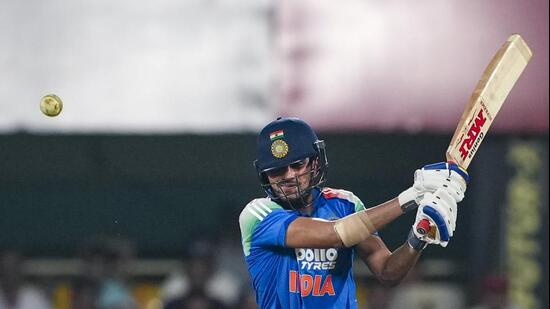
Ashish Bhowmick, incidentally also BCCI’s lead curator, was in charge of the pitch in a match being played in the home state of BCCI secretary Devajit Saikia, who was also in attendance. No prizes for guessing the bald playing surface was not an accident.
Cricket administrators the world over operate with a long-held belief that the viewing public likes to see runs only in fours and sixes. Broadcast cameras crave colour. They constantly look for spectators grooving to the visceral thrill of watching the ball sail into the stands.
When the new ball does not swing, the old ball refuses to reverse, the slower ball sits up to be hit, and the ball refuses to turn when flighted, batters are bound to use the licence to thrill.
With 478 of the 811 runs scored on Wednesday coming in boundaries including 27 sixes, it would have reinforced the belief of those running the show that the crowd had their money’s worth.
{{/usCountry}}With 478 of the 811 runs scored on Wednesday coming in boundaries including 27 sixes, it would have reinforced the belief of those running the show that the crowd had their money’s worth.
{{/usCountry}}Often, the spin-off from using pitches that marginalize the bowler is left unaccounted for. For cricket fans in Guwahati, the next ODI may not come soon; but would those tuning in from their home screens on October 3 be game for another 400-run run-feast?
Any form of cricket featuring the Men in Blue still drives viewership in India. Habituated to batting flatbeds in T20 cricket, are viewers okay with the monotony that ODI run-athons bring? It’s a deeper question, best not asked of BCCI state associations, who get hosting rights less frequently and would rather remain formulaic than seek a balance between bat and ball.
Also, if Virat Kohli and Rohit Sharma are the flavor of the season and the expected poster boys for the next World Cup, it’s unlikely that addressing the long-term health of the ODI game will be at the top of the minds of the administrators or the broadcasters.
“It’s very important for the game to be entertaining,” a key stakeholder in the game told HT on the bat-ball imbalance debate. “At times, the problem with certain constituents of the ecosystem is that they tend to think sport is above entertainment. It may be for the supercore fans. We must remember, that set is about 6-8 %.”
The argument is that for the cricket faithful, there is Test cricket.
Before he became the ICC CEO, Sanjog Gupta would address this argument from a broadcaster’s standpoint. When the Impact Player debate in the IPL was at its peak, he was asked if more runs translated to more viewers.
“What we know is that entertaining cricket tends to attract more viewers,” he said. “And levels of engagement are directly proportional to the scoring patterns. A close T20 game with scores less than 150 is less compelling than a close game with scores closer to 180. The important thing to remember is that play should not start seeming monotonous after a point. It should not be that hitting sixes becomes so easy that sixes become the norm and not a novelty.”
The predicament holds, even more strongly in ODI cricket. If bilateral matches leading up to the 2027 ODI World Cup continue to be high-scoring, do we expect the same in tournament proper?
Scoring patterns have scarcely been identical in ODI World Cups and bilateral cricket. Rarely do batters get a free hit in big events. Once the commercial worth of a competition goes up, so does the attention to detail. The organizers seem aware that in a long tournament, if 350-plus scores became a norm, it might force the spectators into boredom. That explains why Virat Kohli’s runs have been matched by Mohammed Shami’s wickets over the last three World Cups.