Wellington: Pankaj Roy’s ophthalmologist Dr Aloke Ghosh’s consulting rooms were in Kolkata’s Chowringhee. On one side of the broad boulevard were a parade of impressive 18th century and early 19th century mansions, the Grand Hotel, Firpo’s Restaurant and the nightclub Lido Room, not to mention the 1814-established Indian Museum. Opposite was a sprawling parkland known as the Maidan, dotted with military green tents tenanted by sports clubs with adjoining playing areas. One such was Roy’s Sporting Union, a premier
Deep Dive
Why has India struggled to win Test series in New Zealand?
What does India need to do to compete in Test matches in New Zealand?
How important are the New Zealand Tests to India’s World Test Championship chances?
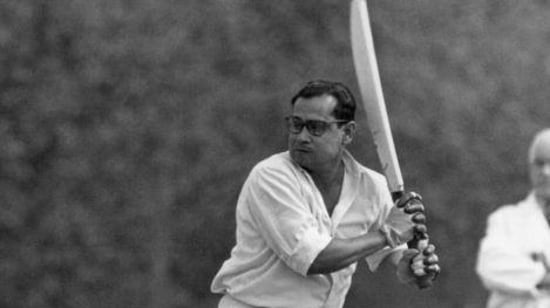
About a month later was scheduled the fourth Test at Kolkata’s Eden Gardens. He was recalled for this game; and, playing with glasses, notched up a hundred batting at number three.
The final Test was at the Corporation Stadium in Chennai. Roy returned to his customary slot as opener. India batted first on a rather placid pitch. At stumps on the first day, India were 234 for no loss, with Vinoo Mankad at 109 and Roy at 114. Eventually, on the second day, Roy fell on 173, by which stage the first-wicket partnership had amassed 413 runs – a new record in Tests, eclipsing Englishmen Len Hutton and Cyril Washbrook’s feat of 359 against South Africa in 1948.
India’s first visit to New Zealand was not until 1968. Recalling the experience, Tiger Pataudi, then India’s captain, told me: “Throughout that New Zealand series, the spinners really did themselves very proud and I think a number of catches were taken; more catches than perhaps during any other four-Test series. So, we improved our fielding, and as we went along, our confidence also improved.”
About the highest wicket-taker on either side, off-spinner Erapalli Prasanna, he commented tongue-in-cheek: “Well, he couldn’t get many LBWs, which annoyed him. But he found that he could turn the ball more (compared to Australia, where he had bowled equally well)… here he got more purchase, more turn, didn’t have the same class of batsmen (facing him); they (the New Zealanders) would tend to lunge forward or to heave. So, we basically put three men close and three men in the deep. So, either they were caught bat-pad or if they heaved, they were caught on the boundary line.” India romped home 3-1 in the series, a margin which remains unequalled by any Indian visiting party till date.
A transformation
With English counties opening their doors to overseas cricketers from 1968, New Zealand cricketers began converting their athleticism to acumen. The next time the Indians touched New Zealand turf, the home side forced a draw for the first time -- winning the third and final Test at Wellington after losing the first at Auckland.
In 1981, India arrived in New Zealand fresh from a famous win at the Melbourne Cricket Ground – the first-ever Down Under against a full-strength Australian team. The venue of the first Test was New Zealand’s capital, where the two teams will renew combat on November 19 in the upcoming two-Test series. It was typically windy at Wellington. Besides, the wicket was green enough to prompt the Indian skipper Sunil Gavaskar to insert the hosts. He reposed faith in his fast-medium leader of attack Kapil Dev, who had just decimated the Aussies at their hallowed headquarters.
Kapil was a potential match-winner, but at that juncture still developing as a mover of the ball. He also lacked adequate support at the other end. Moreover, missing in the Indian XI was the seasoned left-arm spinner Dilip Doshi, who had fractured a toe in the Melbourne Test. Indeed, a perky 18-year-old Ravi Shastri was air-dashed from Mumbai to replace him.
Gavaskar’s gamble failed as New Zealand, boosted by an unbeaten 137 by his opposite number Geoff Howarth, banked a total of 375. India thereafter posted a meagre 223 in reply, with Sandeep Patil – hero of the Adelaide Test a few weeks earlier – the lone half-centurion.
India fought back by skittling the Kiwis out for a measly 100 in their second venture. Kapil got his act together, as did Roger Binny; and Shastri returned quite flattering figures of three for nine on debut as he polished off the tail. However, the Indian batting failed again and New Zealand prevailed by 62 runs.
The next engagement at Christchurch was washed out; while the third and final Test at Auckland ended in a draw. Starkly, India haven’t won a series in New Zealand since, other than in 2009. Even batting luminaries such as Virender Sehwag, Rahul Dravid, Sachin Tendulkar, Sourav Ganguly and VVS Laxman lost both tests in a series in 2002.
A contest awaits
Since 2019, Test cricket is endowed with a context. It is played for the World Test Championship (WTC) -- held over two-year cycles. It is the most consequential championship in the sport -- a true challenge to a cricketer’s prowess. In 2021, in conditions not dissimilar to New Zealand’s, India lost the WTC final to the Kiwis at Southampton, England. But the unkindest cut arose from New Zealand whitewashing the Indians on rank turners in India. It was one of Indian cricket’s greatest ever humiliations.
The two squads now clash swords with New Zealand topping the current WTC points standing, while India languish at fourth spot. Unless second- and third-placed South Africa and Australia unprecedentedly disintegrate, the Indians need to win both Tests against the Black Caps and then outshine the Aussies at home to stand a chance of qualifying for the WTC final.
Other than in a sustained spell of hot and sunny weather, pitches in New Zealand assist quicker bowlers. In short, a sojourn of the islands is a scrutiny by seam and swing. In such circumstances, the Kiwis predictably pick four faster bowlers (although Will O’Rourke who was among the main destroyers of England in the summer will be missing in action due to injury) and are likely to do the same against Shubman Gill’s side. Unless the squares turn out to be drastically different from yesteryears, India will do well to follow suit. One of the quartet could be Nitish Reddy or Anshul Kamboj as a medium pace bowling all-rounder. With Jasprit Bumrah and Prasidh Krishna virtually pencilled in, one among Mohammed Siraj, Akash Deep or the late inclusion Gurnoor Brar can be the third specialist seamer.
Drafting in Test regulars for the recent India A games in New Zealand extended acclimatisation and match practice in the first-class format to some of the Test batsmen. But Bumrah, the lynchpin of the Indian attack, picked for the last of those fixtures, was denied a decent workout because of rain. The comparatively less strenuous demand of two Tests suits him. He was when he last toured New Zealand in 2020 not yet the versatile bowler he became.
In England last year, when India heroically drew a dramatic series 2-2, the foundations laid by openers K L Rahul and Yashasvi Jaiswal were launchpads for the middle order. There could of course be a little more grass on New Zealand pitches than on English surfaces. Whether left-handed Devdutt Padikkal’s dominance at first drop in Sri Lanka has resolved the conundrum at first drop remains to be determined, as New Zealand tracks are a far cry from the ones in the subcontinent. With both sides blessed with fairly potent batteries of pacers, the series result rests on which of the rival batters cope better in the face of a test by fire.
For the record, India’s last victory at the Basin Reserve was in 1968; and New Zealand prevailed in the only Test played between the two teams at Hagley Oval, Christchurch – venue of the ensuing series’ second Test -- in 2020. Historically, the cricketing centre in this South Island city was Lancaster Park, before it was irreparably damaged in an earthquake in 2011.
It’s incongruous that a side who have lifted the WTC crown and another who have reached its final twice should be engaging in a motley two-Test series. A series between big league sides should ideally comprise of an odd number of three or five matches. Besides, don’t reciprocity and fairness demand that since New Zealand are called upon to undertake three Tests in India, the latter should do the same in New Zealand?