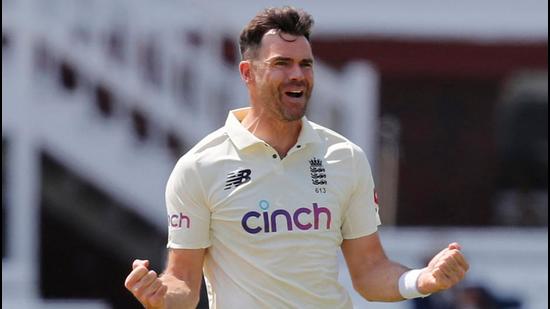
James Anderson, the likely last entrant to the 1,000 first-class wicket club
England and Lancashire master of swing achieves the four-figure feat in a County game against Kent on Monday, one that has become almost impossible to reach
On Monday, James Anderson dismissed Kent’s Heino Kuhn to become the 216th bowler in the history of cricket to take 1,000 first-class wickets. In his 18th cricket season, Anderson reached the milestone in his 262nd first-class match, including 162 Tests where he has taken 617 wickets. Till date, Anderson has taken 339 wickets for Lancashire (he is playing his 85th game), 44 wickets for England XI and two for Auckland (he took 2-95 against Wellington in 2008 as a short-term contract player when sidelined during England’s tour of New Zealand).
England pacer James Anderson. (AFP)
It’s not just a stupendous record; it is possible that the England pace stalwart may be the last to achieve it.
Anderson, 38, admitted he could well be the last 1,000-wicket man. “It still sounds ridiculous to think I have taken 1,000 wickets,” he was quoted as saying after play on Monday. “To get 1,000 wickets is becoming harder with the amount of cricket that is played across the world, and it is getting less and less likely that it will happen again. I could potentially be the last person to do it, which just adds to the feeling of it being very, very special.”
Let’s put it in context. Of the 14 bowlers to have taken 1,000 wickets this century, five are pacers—Wasim Akram (in 2001), Devon Malcolm (in 2002), Martin Bicknell (in 2004) and Andy Caddick (in 2005) are the others. The rest are spinners, the latest additions being Rangana Herath (in 2017) and Dinuka Hettiarachchi (in 2019).
Among contemporary first-class bowlers, Middlesex’s Irish medium-pacer Tim Murtagh (867 wickets) and England’s Stuart Broad (836 wickets) are behind Anderson, but both have to really stretch it to even come close to the landmark. Murtagh is a month shy of his 40th birthday while Broad, 35, is a Test specialist who rarely plays for Nottinghamshire (he has played 16 first-class games since 2018). Spinners have better longevity, a good example being Sri Lanka off-spinner Dilruwan Perera (808) but even he might find the task boggling. R Ashwin, 34, is the most prolific spinner right now (648 first-class wickets in 134 matches) but it’s unlikely he or Nathan Lyon (623) can play the number of matches they will need to emulate Anderson.
There are a number of reasons for this. Till the 1970s, cricket was a one-format dominant game, the bowler dividing his time between international and domestic circuits. That explained the steady additions to the 1,000-wicket club. Even spinner Rajinder Goel (highest Ranji Trophy wicket-taker) who never played for India ended with 750 wickets from 157 first-class matches. Bishan Singh Bedi, his contemporary, played only 67 Tests but finished with 1,560 wickets (most among Indians), thanks to a 303-match first-class career with Northern Punjab, Delhi and Northamptonshire.
Over the years, one-dayers and T20s have been given precedence in the calendar, leading to a drastic reduction in seasonal first-class matches that have hit an all-time low since the turn of the century. The proliferation of limited-overs cricket has led to greater stress on workload management, especially for pacers. Top international bowlers—they get plum central contracts and franchise league money—now play first-class mostly to gain match fitness or feature in that rare knockout game where their experience is required.
Even spinners are not exempt from this trend. Take for instance the records of Herath, Anil Kumble and Danish Kaneria, the last top international spinners from the subcontinent to make it to the 1,000-wicket club. Herath played 177 first-class matches apart from 93 Tests, Kumble 112 matches to go with 132 Tests and Kaneria 145 matches besides 61 Tests. Ashwin, 34, in comparison has played only 55 first-class games, and Lyon, 33, just 74.
Longevity may ensure some records but such are the requirements of modern cricket that it is not guaranteed. Get this. All seven cricketers to have played 800-plus first-class matches were in the pre-World War era. The only person to come close since then was England off-spinner Fred Titmus, who was 49 when he bid adieu after a last-minute appearance for Middlesex against Surrey in 1982 (he was a spectator at Lord’s but the pitch for the late summer (August 25) game prompted skipper Mike Brearley to call him up). That was his 792nd first-class match. Titmus became the first post-War bowler to play County cricket in five decades.
These numbers are impossible to match now. The bulk of the records, anyway, were set before the War when batsmen had to tackle bowlers on uncovered, dangerous pitches. Many players saw themselves as all-rounders with careers spanning decades at times, fitness taking a backseat to the whims of stars of those eras.
Perhaps no one twisted the system to his favour like WG Grace (he even set up his own first-class side—London County—at 52 after falling out with Gloucestershire). He played first-class cricket for 43 years, till he was 60, which yielded 2,809 wickets despite his primarily being a batsman. The all-time record though belongs to Wilfred Rhodes, an English slow left-arm bowler who took 4,204 wickets in 1,110 first-class matches.
Somshuvra Laha is a sports journalist with over 11 years' experience writing on cricket, football and other sports. He has covered the 2019 ICC Cricket World Cup, the 2016 ICC World Twenty20, cricket tours of South Africa, West Indies and Bangladesh and the 2010 Commonwealth Games for Hindustan Times.Read More


 Live Score
 Cricket Teams
 Cricket Players