It can’t be a great feeling when a budding player puts in the hard yards in domestic cricket, gets picked for the national team but then on their debut, they are taken to the cleaners.
It’s not because you are not what you have been cut out to be. Rather, it’s because of something you have no control over.
In the last two years, India have hosted 15 ODIs and the runs per over have been 7.11. During the same period in T20Is, it's mind-boggling at 10.66. This is clearly not a level-playing field anymore.
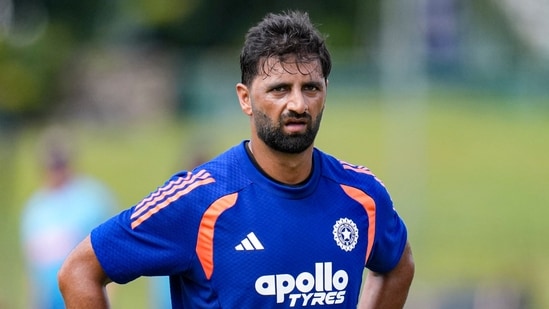
Jammu and Kashmir pacer Auqib Nabi recently made his international debut for India in the second ODI against the West Indies at Guwahati. He got his first international game after months of waiting.
His heroic performances for Jammu and Kashmir (60 wickets in the 2025-26 Ranji Trophy season) helped them win the Ranji Trophy for the first time, and earned him the support from former players like Sourav Ganguly and Irfan Pathan.
Then the IPL happened. On docile wickets, he didn’t get too many matches at Delhi Capitals, and in the ones he did play, the batsmen went after him.
{{/usCountry}}Then the IPL happened. On docile wickets, he didn’t get too many matches at Delhi Capitals, and in the ones he did play, the batsmen went after him.
{{/usCountry}}His ODI debut turned out pretty much the same way as his first season in the IPL. 84 runs in 8.5 overs with no wickets to speak of. In a match that saw India chase down upwards of 400, he was up against it.
The next game, he was dropped.
Anshul Kamboj made his ODI debut in the third match at New Chandigarh and conceded 82 in 9 overs with no wickets.
Nitish Kumar Reddy, currently being looked at as a Hardik Pandya alternative, returned figures of 0/50 (6.5 overs) in that same game as the Windies chased down 352. Reddy’s figures in the first game in Kerala were 1/45 in five overs.
Gurnoor Brar, considered the next big thing in Indian fast bowling, came up with 2/96 in the second game.
It's clear that none of India's young fast bowlers managed to give a good account of themselves. The day after the game can sometimes feel even worse as media and fans give them the hairdryer treatment.
And that can’t be a great feeling and it is particularly painful when the bowler in question gets no real assistance from the conditions.
‘In ODIs, it should not be like that’
Chief curator at the iconic Wankhede Stadium in Mumbai, Ramesh Mhamunkar, is displeased with the whole situation.
“This is just not cricket,” Mhamunkar told HT. “In domestic cricket, there is a lot of moisture for at least the first 10 overs in the morning. Thereafter, the pitch is conducive to batsmen. After 35 overs, the pitch starts assisting the spinners. This is a sporting wicket. As far as international matches are concerned, T20Is are fine with flat wickets because that's what people want to see: sixes and fours. But in ODIs, it should not be like that.”
Mhamunkar added that even spinners weren’t of much use nowadays.
“Forget fast bowlers, even spinners are not getting much purchase. Spinners in the IPL often complain to me, ‘there is nothing happening off the pitch. Think about us too’. The red ball still moves a bit but the white ball does nothing. It just goes straight off the pitch,” he said.
“MS Dhoni has told me many times that Wankhede has the best pitch in India. Why? We add murum (a kind of soil-rock material) to the red soil but how much we add is key. When we add too much murum, water/moisture doesn't stay. There are sand particles too, which do the same thing. We have been asked to make batting wickets. We have to follow the instructions. It’s unfair to both spinners and pacers,” he added.
Hopefully, the Board of Control for Cricket in India (BCCI) takes notice of Mhamunkar’s honest critique and brings about change by producing sporting pitches.
It may not be what the BCCI or the broadcasters want but the bowlers certainly won't be complaining.