


 Live Score
 Cricket Teams
 Cricket Players
Mike Hesson pushes back on Pakistan’s tactical errors after India defeat: 'Ishan Kishan took the game away from us'
Mike Hesson dismissed suggestions that the toss decision or pitch conditions determined the outcome.

 Prefer HTon Google


With six spinners in the line-up, Pakistan appeared to have the perfect arsenal to challenge India and revive a cricket rivalry that has often felt one-sided in recent ICC events. But in the high-stakes T20 World Cup clash, a series of tactical calls backfired as the defending champions secured another commanding win, sealing a 61-run victory at the R Premadasa Stadium in Colombo on Sunday to book their place in the Super Eight stage.
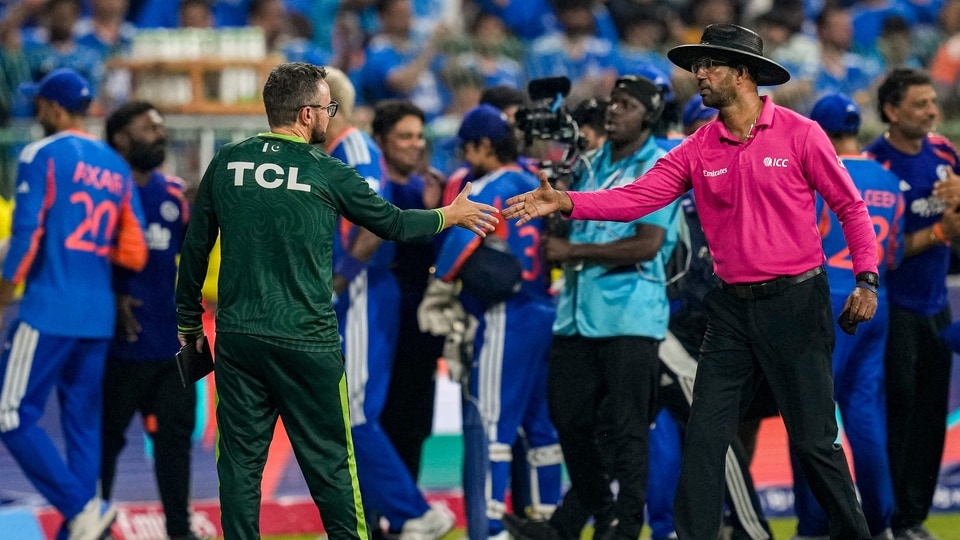
While many observers termed the decisions costly blunders, Pakistan coach Mike Hesson refused to frame them that way, insisting instead that Ishan Kishan’s brilliance proved decisive.
The Indian opener smashed 77 off 40 balls, striking 10 boundaries and three sixes on a tacky Colombo surface where no other batter looked entirely at ease against spin. India posted 176, a total Hesson later admitted was well above par. In reply, Pakistan never gained momentum in the chase and were bowled out for 114 in 18 overs, collapsing under sustained pressure.
“I think with the ball, obviously it was spinning quite a lot initially, and the way Ishan Kishan played took the game away from us,” Hesson said in the post-match press conference. “To be fair to India, they probably got about 25 above par on that surface. From a batting point of view, we didn’t really give ourselves a chance in terms of adjusting to conditions.”
Pakistan had gained an early advantage when captain Salman Agha won the toss. On a pitch where the team batting first had won all three previous games in this T20 World Cup in Colombo, Pakistan opted to bowl. Australia had made a similar call at the venue last week before suffering a shock defeat to Zimbabwe.
However, Hesson dismissed suggestions that the toss decision or pitch conditions determined the outcome.
“I think if you look at the game, the ball spun half as much in the second innings — it skidded on,” he said. “There was nothing wrong with the decision to bowl first. It was the quality of bowling in the first six overs and the way Ishan Kishan played that hurt us. It certainly had nothing to do with the pitch. You’ve got to look at the facts rather than emotive accountability.”
Another talking point was the delayed introduction of Usman Tariq. After considerable build-up around his match-up against India’s middle order, with India even conducting a special training session in Colombo to prepare for his unique bowling action, Tariq was only introduced in the 11th over, shortly after Ishan’s dismissal.
Despite the scrutiny, Hesson defended the move. He maintained that Abrar Ahmed and Shadab Khan were trusted to control the overs immediately after the powerplay and that one off day did not make it a tactical error.
“Usman’s got a very specific role for us. Could he have bowled earlier? Yes, he could have,” Hesson said. “But Abrar and Shadab have done that job for us in the last five wins. They just didn’t get their lengths right today. It didn’t work, but that doesn’t automatically make it a blunder. Usman was exceptional tonight.”
Pakistan now face a must-win situation in their final group-stage fixture against Namibia later this week. Victory would keep their Super Eight hopes alive, but defeat could leave them staring at another early exit from the T20 World Cup.


