Kolkata: If wrists could sing, Mohammed Shami’s seam bowling would have been a ballad. And it had to be with the red ball, because only that allows the entire experience of Shami — the swing, the reverse swing, change of pace, the bouncer out of nowhere, every kind of ball imaginable, really. Above all, an artist with the ball, protecting the seam, feverishly maintaining the shine before the two collaborated to remunerate Shami. “His seam kisses the pitch. He doesn’t bang it in,” Wasim Akram once said about Shami.
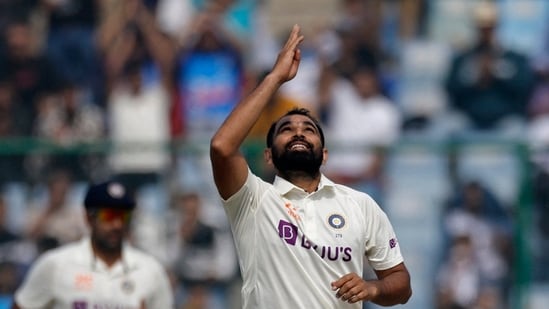
Shami brought even flat pitches to life. With scruffed up, battered balls, Shami could wake you up from post-lunch siestas with his seam movement. Then there was his pace, rarely dropping below 135 kph, almost always hustling batters. A smooth, measured run-up, perfect balance closing into the pitch, and just the right spring to the final jump before the focus shifted to the wrist and seam position, Shami’s bowling encompassed everything you would expect of a traditionalist.
Also Read: Mohammed Shami’s best match-winning spells in Test cricket
Deep Dive
What made Mohammed Shami effective on flat Test pitches?
What were Mohammed Shami’s most memorable match-winning Test spells?
What were Mohammed Shami’s Test career statistics when he retired?
The foundation for that meticulousness was built at the maidans of Kolkata, where ill-protected club league cricket pitches aren’t very different from the sidewalks. It goaded Shami to explore fuller lengths with the cricket ball and work on a range of cutters. Such was Shami’s range that by the time he had spent a couple of seasons to move from Dalhousie Athletic to Town Club, everyone knew he was at his best with the old ball, when no one expected either the pitch or the ball to do anything drastic.
Shami’s alter ego was his pace, always managing to disrupt even the most established batters. The story goes that former national selector Sambaran Banerjee was standing near the sight screen at a club game, watching Shami breeze in from the other end with the Hooghly river breeze behind him. He was quick. But just to verify, Banerjee asked the Town captain to make Shami bowl against the wind. His pace didn’t drop.
{{/usCountry}}Shami’s alter ego was his pace, always managing to disrupt even the most established batters. The story goes that former national selector Sambaran Banerjee was standing near the sight screen at a club game, watching Shami breeze in from the other end with the Hooghly river breeze behind him. He was quick. But just to verify, Banerjee asked the Town captain to make Shami bowl against the wind. His pace didn’t drop.
{{/usCountry}}That’s the thing with Shami. Meet him for the first time and you wouldn’t know Shami is capable of all that unless you were told. He neither has the height nor the frame of a fast bowler. Far from boisterous too, a trait most fast bowlers find essential to survive. His bowling came with zero baggage as well. He would tick every box needed to get in shape for a game, turn up, do his thing, and just leave. Never a hollow claim, almost unassuming to the point of being a recluse, Shami was a captain’s delight because of his ability to refrain from being a loose cannon with a short fuse. Eat, sleep, bowl, repeat — he kept his cricket life simple.
That, and much more, made Shami so relevant not just away overseas but also on deadbeat pitches in India. Fifteen or 20 overs into an innings at home, the press box would almost always try to pick up some reverse if Shami was operating. The more abrasive the pitch, the better. Like the Wanderers pitch in Johannesburg on 2018 — a landmine of a pitch — on that seminal tour of South Africa when Shami conjured a myth-busting spell of 3.3-0-10-4 to complete in an innings haul of 5/28, triggering a 63-run winning turnaround that saw India go on and wrest a Test series in Australia later that year. Shami’s returns in Australia were 16 wickets at an average of 26.18, which in conjunction with Jasprit Bumrah’s haul of 21 wickets for 17 runs, left Australia overwhelmed.
It took Shami exactly 13 years to call it a day in Tests. Shami’s Test career though had run its course by 2023, the World Test Championship final loss to Australia being his last Test. Sixty four Tests could have easily been 80 had it not been for recurring knee trouble. He had taken 47 wickets in 12 Tests till the 2015 tour of Australia, before being sidelined for 16 months after surgery. He returned with a spring in his step, using the Caribbean tour to get into groove, bowling long spells.
Quicker and more evolved after surgery
Fast bowlers tend to drop pace after surgery. Not Shami. He was quicker, decidedly more evolved, with a sharpened understanding of the architecture of a Test innings that helped him plan his spells better. In the lush turfs of England, Shami’s knees were spared unlike the harder run-ups in Australia, which probably contributed to why he ended up playing almost double the number of Tests there, but with less envious numbers. Eight Tests each in Australia and South Africa however underpin Shami’s genius: 66 wickets at an average of 27.42 and a strike rate of 49.1. Make that 76 wickets in India, at an astounding average of 22 and strike rate of 42.6
At his adopted home, Eden Gardens, was where Shami’s heart was, where countless Bengal scorecards bear the description “caught Saha, bowled Shami” as a testament to his enduring bond with Wriddhiman Saha. It was thus, in many ways ideal, that Shami retired from Test cricket hours after bowling for Bengal — making the ball talk, clattering stumps, doing his thing against Maharashtra at the same ground that gave him his debut in 2013.
Born in Sahaspur in Uttar Pradesh where his father Tausif Ahmed once recounted to HT that no one even discussed cricket, Shami dared to dream and leave the state in its pursuit. When that moment arrived, in what was also Sachin Tendulkar’s 199th Test, Ahmed made Shami promise he “would have to give his 200% in honour of Sachin Tendulkar.” Shami took nine wickets, bringing reverse swing into play against West Indies at Eden Gardens.
There have been quicker bowlers, there have been taller, more physically imposing ones too. Bumrah is unquestionably a singular bowling phenomenon. But Shami practised with precision an art that was distinctly his own. Not always the headline act, but forever the team man, he made the cricket ball sing even in the most adverse conditions. And Test cricket was richer for every note.