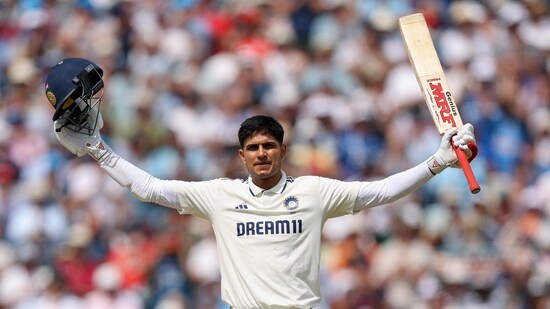
On Wednesday, Shubman Gill became the fourth Indian, after Vijay Hazare, Sunil Gavaskar and Virat Kohli, to score hundreds in his first two Tests as captain. A day later, the 25-year-old produced the biggest knock by an Indian skipper in all Test cricket. And he is only in his second outing as the leader. What a start.
Hazare, Gavaskar and Kohli were already the premier batters in their respective sides when they brought up this milestone. Kohli made three centuries in his first two games at the helm, including hundreds in both innings in his maiden outing as captain, in a stand-in capacity against Australia in Adelaide in December 2014.
Also read: Shubman Gill does what no other Asian captain could do in history of cricket. Gavaskar, Tendulkar, Kohli, not even close
Even a fortnight back, the jury was out on whether Gill was the best batter in this new-look Indian outfit. Now, the Doubting Thomases have been won over, the wagging tongues effectively silenced.
Gill came into this series with a cloud – maybe an artificial one, certainly a temporary one – hanging over him. His record outside Asia was less than exemplary – hard to explain, given his all-round, well-rounded game and his strong basics; the disparity in his numbers in India and Bangladesh on the one hand and everywhere else on the other was glaring. For that reason alone, to stamp his authority and mark his territory, Gill the captain needed Gill the batter to fire. That box has now emphatically been ticked. If anyone was still sceptical after his 147 in Leeds, that has been decisively exploded following his extraordinary 269 of Thursday, an innings of immeasurable control and supreme command over eight and a half hours when he hardly played a false stroke or put a foot wrong.
{{/usCountry}}Gill came into this series with a cloud – maybe an artificial one, certainly a temporary one – hanging over him. His record outside Asia was less than exemplary – hard to explain, given his all-round, well-rounded game and his strong basics; the disparity in his numbers in India and Bangladesh on the one hand and everywhere else on the other was glaring. For that reason alone, to stamp his authority and mark his territory, Gill the captain needed Gill the batter to fire. That box has now emphatically been ticked. If anyone was still sceptical after his 147 in Leeds, that has been decisively exploded following his extraordinary 269 of Thursday, an innings of immeasurable control and supreme command over eight and a half hours when he hardly played a false stroke or put a foot wrong.
{{/usCountry}}The image of Gill outside the dressing room – we really don’t know what the insiders think of him, do we? – is one of a quiet, fun-loving, serious young man, but opinion was divided on whether he had the steel to impose himself. It’s debatable if he entertained those concerns but if he did, then that is a thing of the past. Nothing sends the confidence soaring than 147 backed up by 269. Nothing screams out ‘premier’ louder. In a team just about coming to terms with life in the Test lane, Gill has established himself as the first among equals. That he has done so this early in his captaincy career is a wonderful development for Indian cricket as a new set takes tentative steps into the future, eager to build on the legacy of Kohli and Rohit, and Pujara and Rahane before them, but also determined to carve its own identity.
More like Dravid and Kumble
It’s impossible for success in one sphere not to rub off on the other, so it shouldn’t come as a surprise if Gill the skipper is more assertive on the field, if he starts demanding greater excellence from his colleagues. It won’t be overt because that isn’t the suave right-hander’s style, but his lack of in-your-face aggression must not be mistaken for softness or the absence of passion. Individuals are wired differently and there is no template to aggression – Rahul Dravid and Anil Kumble, for instance, were no less result-driven than Sourav Ganguly or Kohli, but they didn’t feel the need to exhibit that streak from the rooftops. It’s more likely that Gill will fall in the Dravid-Kumble league than the Ganguly-Kohli category.
Will these two knocks change the face of Indian cricket? Only time will tell. But will it alter Gill’s philosophy towards leadership? Will it convince him that this is his team, his time, that he is the undisputed leader and that he should stop doubting himself on that front, if he ever did? Most certainly yes. The gains from this development cannot be quantified. Gill has always enjoyed the respect and the admiration of the changing-room, which really is what matters to those involved in team sport, but suddenly, there is an aura around him. The others won’t walk on eggshells in his presence, but his words will resonate more loudly.
There has been some apprehension about whether Gill might have to operate in head coach Gautam Gambhir’s shadow, about who might have the final, and perhaps the loudest, voice. Gill has earned that privilege; things shouldn’t have been any difficult if he had scored 0, 46 and 12 in his first three innings as captain but that’s not how perceptions work. Establishing himself as the toast of the nation and the natural successor at No. 4 to two of the greatest Test batters in Indian cricket will do wonders for his morale, his confidence, his self-belief, his thinking.
Gill’s boys. It has a nice ring to it. A ring that will become even more mellifluous with an early maiden Test win in charge. Perhaps over the next three days at Edgbaston? Watch this space.