Mumbai: Slated to clash on Day 4 of the first round of the 2027 ODI World Cup, India and Pakistan will again carry the burden of generating early buzz for what will be a 51-day, 57-match, 14-team tournament.
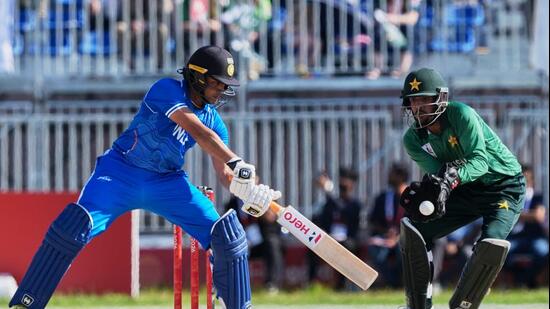
As the ODI World Cup returns to Africa after 25 years, the schedule and grouping announcement on Thursday sparked the customary narrative of India-Pakistan being the International Cricket Council’s (ICC) pet fixture. The criticism is thrice more than usual with the possibility of three India-Pakistan face-offs in this World Cup.
That said, it’s not the only contest that may play out thrice. If there are no upsets, there could be a hat-trick of India-Australia, South Africa-England, South Africa-New Zealand and England-New Zealand matches too. It’s another matter that barring India-Australia (industry estimates say it does better business than India-Pakistan in group stages), other matches would not move the commercial needle.
Now, that’s not reason enough to troll the ICC, but the governing body has itself to blame for refusing to be unapologetic about the marquee status of the India-Pakistan encounter.
The possibility of three repeat matches comes as a consequence of the round-robin nature of the Super7 format where the best 7 teams lock horns with a potential re-clash in the semi-finals or the final. That reduces the jeopardy of early exits for fancied teams, but cricket can ill-afford ultra-competitive format structures - more than ever with ODI World Cups - else the revenue model will come crashing down.
{{/usCountry}}The possibility of three repeat matches comes as a consequence of the round-robin nature of the Super7 format where the best 7 teams lock horns with a potential re-clash in the semi-finals or the final. That reduces the jeopardy of early exits for fancied teams, but cricket can ill-afford ultra-competitive format structures - more than ever with ODI World Cups - else the revenue model will come crashing down.
{{/usCountry}}Teams are also pre-seeded in the Super7s. “This seeding is done to ensure the integrity of the qualification process is maintained while preserving fixture certainty for fans,” an ICC statement said.
In effect, that helps ICC make the tournament cost-effective and simplifies
logistical convenience for spectators of fancied teams, read India. Avoidable in an ideal world, but which other global competition has 80 % commercial dependency on one market?
Seedings are in place for another reason. It’s common practice in most tennis Grand Slams. Wimbledon would seed Roger Federer high enough to avoid an early clash with Rafael Nadal or Novak Djokovic, even if his rankings had slipped because of an injury layoff. Like in cricket, the success of a Grand Slam is highly dependent on marquee rivalries, which are scarce.
Theoretically, Pakistan could flop royally and fail to make it past Round 1. But that’s less likely in ODI cricket where there are fewer upsets than T20. Even in their current fragile state, unless they plunge further, Pakistan are fancied to do better than Afghanistan, Zimbabwe and a qualifier in Group A or scrape though as the 7th best team out of 12 in Round 1.
As for India and Pakistan being placed together in Round 1 in the first place, that is based on the underlying principle of equally placed groupings at a pre-announced cutoff date, one is told.
Many years ago ex-ICC CEO Dave Richardson let out the open secret: ‘So long as the pools are balanced, it is silly to avoid (the match)’.
Silly, indeed. Although, there will never be an official word on it.