
 E-Paper



Ecological imbalance or contempt of HC — Delhi forest department has to choose
The Delhi High Court, over the past few months in separate cases, had asked various litigants to plant tree saplings in the Central Ridge, as compensation. The forest department was asked to ensure compliance. Over time, the total saplings ordered to be planted has accumulated to around two lakh.


The Delhi government’s forest department is in a fix. It has to choose between two options – plant around two lakh trees including mango and jackfruit in the Central Ridge, which experts say could disrupt the fragile ecosystem; or face contempt charges for not following the order of the Delhi High Court, which had directed the department to ensure that the saplings are planted.
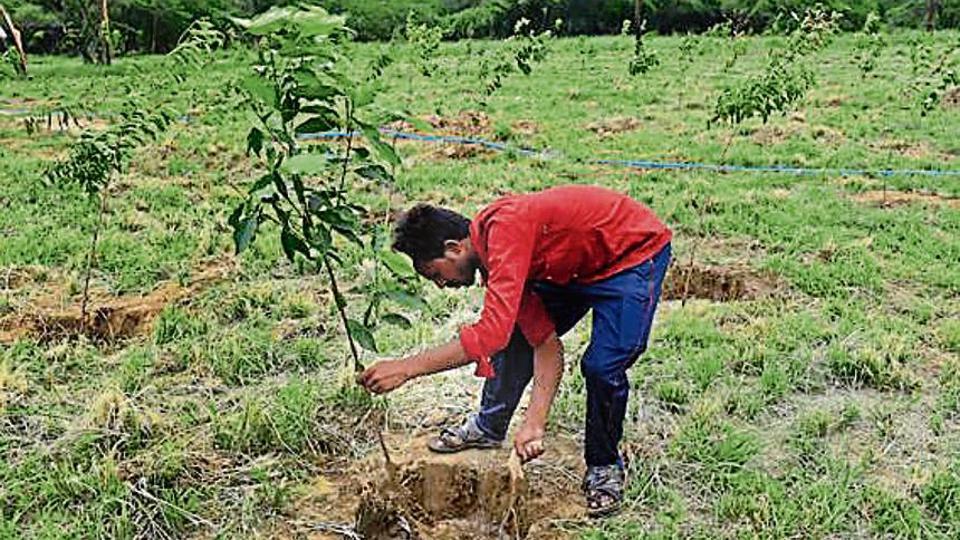
The Delhi High Court, over the past few months in separate cases, had asked various litigants to plant tree saplings in the Central Ridge, as compensation. The forest department was asked to ensure compliance. Over time, the total saplings ordered to be planted has accumulated to around two lakh.
The Central Ridge, located near Karol Bagh, spreads over 864 hectares of which 423 hectares are managed by forest department. The court has also specified that the tree saplings should be six feet tall and at least three and half years of age. The species which needs to be planted, as stated by the court, includes mango, jackfruit and putranjiva among others.
Citing the Delhi Preservation of Trees Act 1994 which defines a tree as a woody plant, not less than five cm in diameter at a height of 30 cm from the ground and is not less than one metre in height, the court stated: “It is in this context that the nursery age and size of the tree has been specified for plantation as the same would aid in their survival.”
In one case, the court, while hearing a contempt plea on March 11, 2019 had directed one of the respondents to plant 1.4 lakh tree saplings in the Central Ridge.
Ishwar Singh, head of the Delhi forest department refused to comment. “The high court has given a series of orders to plant tree saplings in the Ridge. We have taken the comments of experts as directed by the court. We are consulting our legal team,” said a forest official.
The court even asked the respondents to seek assistance of CR Babu, professor emeritus at Centre for Environmental Management of Degraded Ecosystem in Delhi University.
Babu suggested to the forest department that while species such as mango and jackfruit are not suitable for the Central Ridge, 6 feet high saplings would be difficult to establish in the rocky terrain of Central Ridge where the soil layer is thin.
“I told the forest department that planting 1.4 lakh tree saplings would disturb the fragile ecosystem, which is already degraded due to invasion of vilayti kikar. Indiscriminate large scale plantation will disturb the groundwater recharging zones and the biodiversity,” Babu said.
The Ridge Management Board visited the Central Ridge for an inspection on July 13. The inspection report stated that at most 5,700 tree saplings could be planted at the Central Ridge.
Pradip Krishen, ecological gardener and author said: “The Central Ridge is rocky and has a thin layer of soil. Only those species of trees which can grow on their own can exist there. Secondly, the vilayti kikar is so invasive that it wont let other saplings grow. The kikar needs to be removed first.”
Babu and Krishen said the solution to the problem is not massive plantation but restoration of the native ecosystem. “If Delhi has to mitigate its air pollution and address groundwater depletion , there is no better way than to restore the native ecosystem of Delhi Ridge,” said Babu.


