Before the outbreak of the barbarous World War II on September 1, 1939, Germany and Poland had been holding rigid positions for a considerable period of time over the Free City of Danzig. Italy, France and Britain — major powers in the West were convinced that Danzig was not worth fighting for, and they were adamant that it should be returned to Germany. But with this, they also wanted to safeguard Polish trade.
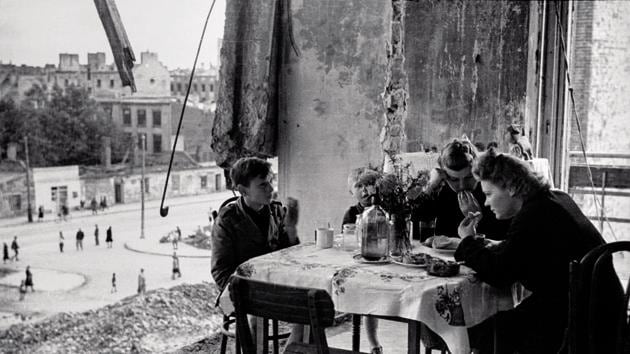
Despite being up against a formidable German military, Poland showed great fortitude and remained firm on its ground, keeping its nerve unbroken.
Poland had one tank battalion and 250 first line aeroplanes of antiquated type and on the other side was a mighty German army — equipped with Adolf Hitler’s techniques of Blitzkreig (military effort where in tanks, motorised infantry, artillery and aircraft work in tandem). The Poles, clearly, had little hope — only had courage to put a fight. And there was no escape from the inevitable.
According to historians, on that fateful morning of September, at around 4.45 am the Germans attacked Poland. A few hours later German aeroplanes started bombarding Warsaw, which was once the flourishing centre of cultural, artistic, economical and political life of the country. The German Armed Forces captured western Poland within two week and besieged Warsaw, capital city of the country.
The exhibition, A Phoenix from the Ashes revisits the horrific attack of German Troops and the devastation that led to the fall of Warsaw. German war planes ruthlessly continued to bomb Warsaw until only carcass of once flourishing city remained. Warsaw became a ghost town in no time, akin to what we are witnessing in Syria where cities have been shrouded into a dead silence — one won’t find any traces of life in those cities.
{{/usCountry}}The exhibition, A Phoenix from the Ashes revisits the horrific attack of German Troops and the devastation that led to the fall of Warsaw. German war planes ruthlessly continued to bomb Warsaw until only carcass of once flourishing city remained. Warsaw became a ghost town in no time, akin to what we are witnessing in Syria where cities have been shrouded into a dead silence — one won’t find any traces of life in those cities.
{{/usCountry}}But like a phoenix, Warsaw rose from the ashes — the city was rebuilt and brought back to life. The show takes the viewer on a journey through pre-war Warsaw, to its destruction and reconstruction.
The exhibition can be divided into three parts. In the first section, Pre-War Warsaw, which consists of four images — including the one of Napoleon Square, which was before the war a symbol of rising Poland. All images show how the city was the cultural, political, intellectual and economic hub of Poland before the war.
The second section, Wartime Warsaw, redounds the viewer’s conscience with 10 powerful images that show historically significant buildings such as The Royal Castle’s Zygmuch Tower going up in flames after being hit by German artillery. Some images show Warsaw’s residents being led to concentration camps in endless queues. In an image, a Polish girl stands forlorn at the ruins of Warsaw's ghetto, where Jews were mercilessly murdered by the Germans.
The section, Warsaw BOS (the Bisro Odbudowy Stoilicy or office for the reconstruction of the capital) has images that show how the city was rebuilt from scratch as almost everything was ravaged by German bombing — including 11,229 buildings were destroyed (782 being historic buildings), 3,879 partially destroyed and 10,390 lightly damaged. In 1945, after the war, Warsaw found itself bound in an endless strings of ruins, and it seemed impossible for the city to return to life. People who had fled Warsaw during the war, upon returning, found the city in great turmoil due to large scale destruction. But like a great city, it collected its broken pieces and blossomed once again.
Stay updated with all top Cities including, Bengaluru, Delhi, Mumbai and more across India. Stay informed on the latest happenings in World News along with Delhi Election 2025 and Delhi Election Result 2025 Live, New Delhi Election Result Live, Kalkaji Election Result Live at Hindustan Times.
Stay updated with all top Cities including, Bengaluru, Delhi, Mumbai and more across India. Stay informed on the latest happenings in World News along with Delhi Election 2025 and Delhi Election Result 2025 Live, New Delhi Election Result Live, Kalkaji Election Result Live at Hindustan Times.