South Delhi’s Sarojini Nagar, which has the most popular go-to market for budget shoppers, was actually among the 10 colonies planned soon after Independence to accommodate government employees. The project was first conceived in 1950 as part of the first Five Year Plan (FYP). The construction of the flats and market area was taken up in 1955 by the Central Public Work Department. Over the years, more shops were added to the market. These shops were then allotted to refugees who had landed in Delhi from Pakistan after Partition.
AK Jain, former commissioner (planning) of the Delhi Development Authority (DDA) said that Lodhi Colony, a neighbourhood comprising government quarters, existed much before Sarojini Nagar. However, as the demand for dwelling units increased, agricultural land from Gujjars in Pilanji Village was acquired for a new project. “Nearly 10,000 flats were available, but there was a demand of around one lakh more units to accommodate government employees. Hence, the government prepared a mega plan to create colonies in the southern part of the city. Mehr Chand Khanna, then union minister of rehabilitation, supervised its development. He looked after the construction of the colony and the allocation of shops to migrants from Pakistan. Since he was a Punjabi, he soon became popular with the refugees.”
This was second time when land was acquired from Pilanji Village. Earlier, residents of fringe villages like Pilanji and Aliganj were resettled in Kotla Mubrakpur area around 1914-1921 for the formation of New Delhi. In the next two decades, no massive change took place. However, the 50s and 60s brought sweeping changes as the Centre planed Vinay Nagar, which later came to be known as Sarojini Nagar.
{{/usCountry}}This was second time when land was acquired from Pilanji Village. Earlier, residents of fringe villages like Pilanji and Aliganj were resettled in Kotla Mubrakpur area around 1914-1921 for the formation of New Delhi. In the next two decades, no massive change took place. However, the 50s and 60s brought sweeping changes as the Centre planed Vinay Nagar, which later came to be known as Sarojini Nagar.
{{/usCountry}}Developed for middle-level staff, the area was named ‘Vinay’ which means ‘in a position of submission’. However, in the 70s, it was considered a term signifying the class divide prevalent during the British period. As a result, it was renamed after Sarojini Naidu for her contribution to the freedom struggle. Similarly, Shaan Nagar and Maan Nagar, colonies meant for senior officers, were renamed as Rabindra Nagar and Bharti Nagar respectively.
Sarojini Nagar was initially divided into three districts — East, West, and South. At that time, neighbouring Kidwai Nagar was known as East Vinay Nagar which extended till Dilli Haat. Later, Vinay Nagar was divided into Sarojini Nagar, Kidwai Nagar, Netaji Nagar, Laxmi Bai Nagar and Nauroji Nagar.
The colony is now divided into blocks, alphabetically, from A to M. There are 3,539 flats here, with makeshift shops outside every block selling snacks and other such items. All the blocks have clean and well maintained parks as well as designated parking lots. Its construction was based on neighbourhood design principle with a school, provisions for market and open areas like parks and space for parking, too.
Mukesh Sharma, who was born and brought up in I block, recalled how things have changed. “In our time people were united. We used to celebrate all festivals with all our neighbours. But now the scenario is different, people don’t even bother about who lives next door. Earlier, even if there was a marriage function, everybody was involved in everything,” he said.
Earlier, the Sarojini Nagar market had small shops, Sharma said. The market’s face has totally changed. “In those days, people used to sleep on the terrace in summer. But one can’t even think of doing this now due to various reasons, crime being one of them,” he added.
MARKET AREA
While the residential area is calm and peaceful, the market on the contrary is crowded and noisy. Almost 90% of the shops here are still held by original allottees. Yashpal Lakhina, who has been in the market for 65 years, said, “All the shops are of the same size, that is, around 70m in length, all the refugees used to stay at the nearby railway station by the time they were allotted these shops.”
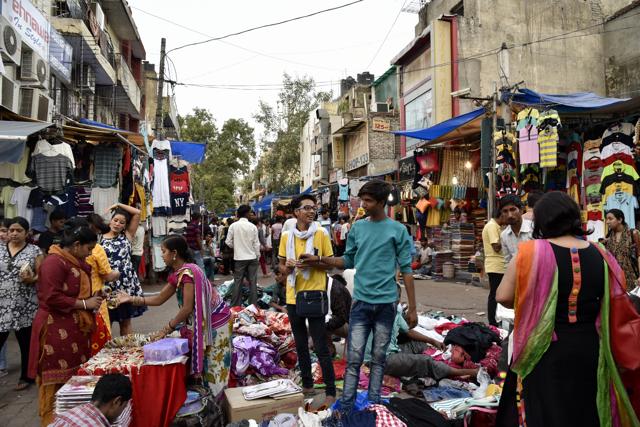
The market is divided into three parts — Central Market, Babu Market and Sabzi market. There are 200 shops in the central market and 110 shops in the elevated Babu Market. Babu Market was created to cater to the needs of the occupants of the colony. This market has a number of garment stores, eateries, salons and tea shacks.
The market is one of city’s biggest and most crowded markets. It’s especially popular for its export surplus stuff available at throwaway prices. From stylish clothes to fake designer bags to fashionable jewellery, Sarojini Nagar never disappoints.
Besides, there are various street food vendors and kulfi vendors famous since 1990s. The famous Khandani Pakore Wala in Nauroji Nagar was earlier in Sarojini Nagar market. Muchhal Halwai ki Dukan, named after his owner, who had a big moustache, is one of the oldest eateries here. After his demise, his children run the business. In evenings, people in large number can be seen standing in queues in front of this shop to buy hot samosas and jalebi. The far end of Sarojini Nagar has a sabzi market that sells fruits and vegetables at reasonable prices.
PROBLEMS
Though the residential area is clean with broad avenues and manicured parks, the market lacks basic amenities. It has become congested over the years. Parking is in a huge mess and weekends are especially bad as lanes surrounding remain jam-packed as motorists use surface parking despite the fact it has an automated multilevel car parking facility in the vicinity. Shopkeepers say that more benches are required for customers to sit and rest. Maintenance of public toilets and streetlights are other issues.
The Master Plan for the market was reviewed in 1984 and the changes suggested should have been implemented, but nothing has been done so far, shopkeepers said. Promod Sharma, president of Sarojini Nagar Market Shopkeepers Association, said, “There has been no development since 2008. There are more than 2,000 unidentified hawkers in the market. Vendors need to be verified and others should be removed. We’ve been complaining to the authorities regularly, but no measures have been taken yet. ”
Stay updated with all top Cities including, Bengaluru, Delhi, Mumbai and more across India. Stay informed on the latest happenings in World News along with Delhi Election 2025 and Delhi Election Result 2025 Live, New Delhi Election Result Live, Kalkaji Election Result Live at Hindustan Times.
Stay updated with all top Cities including, Bengaluru, Delhi, Mumbai and more across India. Stay informed on the latest happenings in World News along with Delhi Election 2025 and Delhi Election Result 2025 Live, New Delhi Election Result Live, Kalkaji Election Result Live at Hindustan Times.