“Vulgus amicitias utilitate probat,” said Ovid, the celebrated — and exiled — Latin poet writing roughly around the time of Christ. Ordinary people forge friendships purely based on utility, is what it means. Pakistan perhaps knows its Ovid well. Should India, then, be worried about the trilateral defence agreement signed in Mecca on August 7 by Saudi Arabia, Pakistan and Turkey? The answer depends on who is asking the question and who is answering it. While the pact deserves more than the familiar “closely following developments” handout from the ministry of external affairs (MEA), there is certainly no need for alarmism. The Mecca pact, in essence, formally binds Pakistan, a nuclear power, to two of the Islamic world’s most consequential states in a NATO-style arrangement. The utility of this pact in the face of an actual conflict at a later date is of lesser consequence for India than the signalling it does at the moment.
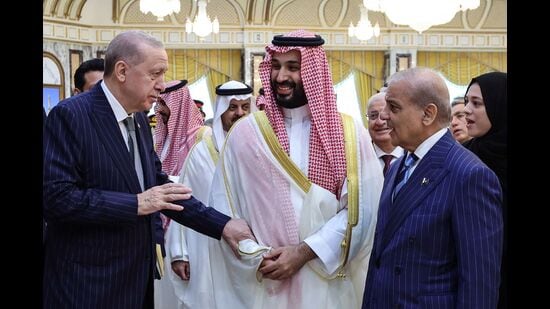
Pakistan, enjoying inexplicable goodwill in the White House after decades, has attained prestige precisely when New Delhi would prefer Islamabad isolated. Anything that bolsters Pakistani army chief Asim Munir’s stature is a strategic eyesore for India. Pacts such as these achieve exactly that. More importantly, and almost contradictorily for Pakistan, the pact signals eroding confidence in American security guarantees across West Asia, as exposed during the ongoing Iran conflict. India has invested heavily in the region in terms of energy imports, expatriate remittances, and defence ties with both Riyadh and Tel Aviv.
India’s response to the pact should mean building on these existing ties and forging some new ones. Quiet work with Riyadh and Ankara, individually, should continue as well. Since the Mecca pact is still ambiguous in terms of how it will translate on the ground, this can be met with strategic clarity of our own. It is still not a binding military alliance and lacks the institutional heft of NATO. The partners—Turkey, Saudi Arabia, and Pakistan—may want to signal a formidable Sunni solidarity, but they have, even in the recent past, displayed divergence over issues like Israel’s operations in Gaza. India must ignore the din of divisive domestic politics and work towards planting firmer feet internationally.